- Written & Reviewed by Jeremy
- Published
- Last Updated Oct 09, 2026
Financial advisor marketing automation is the use of technology to handle repetitive marketing and follow-up tasks, such as capturing leads, sending emails, scheduling appointments, and organizing prospect information. The goal is not to automate the advisor-client relationship. Instead, automation should help financial professionals respond consistently, reduce manual work, and create a smoother path from first interaction to qualified appointment.
For financial advisors and insurance professionals, marketing can involve many moving parts. A prospect may discover a blog post, download a guide, register for a webinar, submit a consultation request, or receive an email before eventually speaking with an advisor. Managing every step manually can become difficult as a firm’s marketing activity grows. Choosing the right marketing automation platforms for financial advisors can help firms organize lead management, automate follow-ups, and streamline their marketing workflows.
The right automation can connect these steps while leaving important conversations and professional judgment to people.
What Is Financial Advisor Marketing Automation?
Financial advisor marketing automation refers to software and workflows that automatically perform predefined marketing tasks based on a prospect’s actions or other conditions.
For example, someone might complete a consultation form on a financial firm’s website. Instead of requiring a team member to manually enter the information, send a confirmation email, and create a follow-up reminder, an automated workflow can handle those steps.
A simple process might look like this:
Website visitor → Lead capture → CRM entry → Follow-up → Nurturing → Appointment scheduling → Human conversation
Automation can support several parts of this process, including:
- Website lead capture
- Email follow-up
- Lead nurturing
- Appointment scheduling
- Webinar reminders
- CRM updates
- Re-engagement campaigns
- Internal notifications
- Marketing reporting
The important distinction is between automating a workflow and automating professional advice. Marketing automation can organize and support communication, but it should not be treated as a substitute for individualized financial guidance or human judgment.
Why Does Marketing Automation Matter for Financial Advisors?
A financial advisor may receive inquiries from multiple sources at different times. Without a consistent process, some prospects may receive immediate attention while others wait.
Automation can help create a repeatable process.
For example, a new prospect could automatically receive a confirmation message, enter a lead-nurturing sequence, receive an appointment option, and trigger a notification for the appropriate team member.
That does not guarantee a client or appointment. It simply makes the process more consistent.
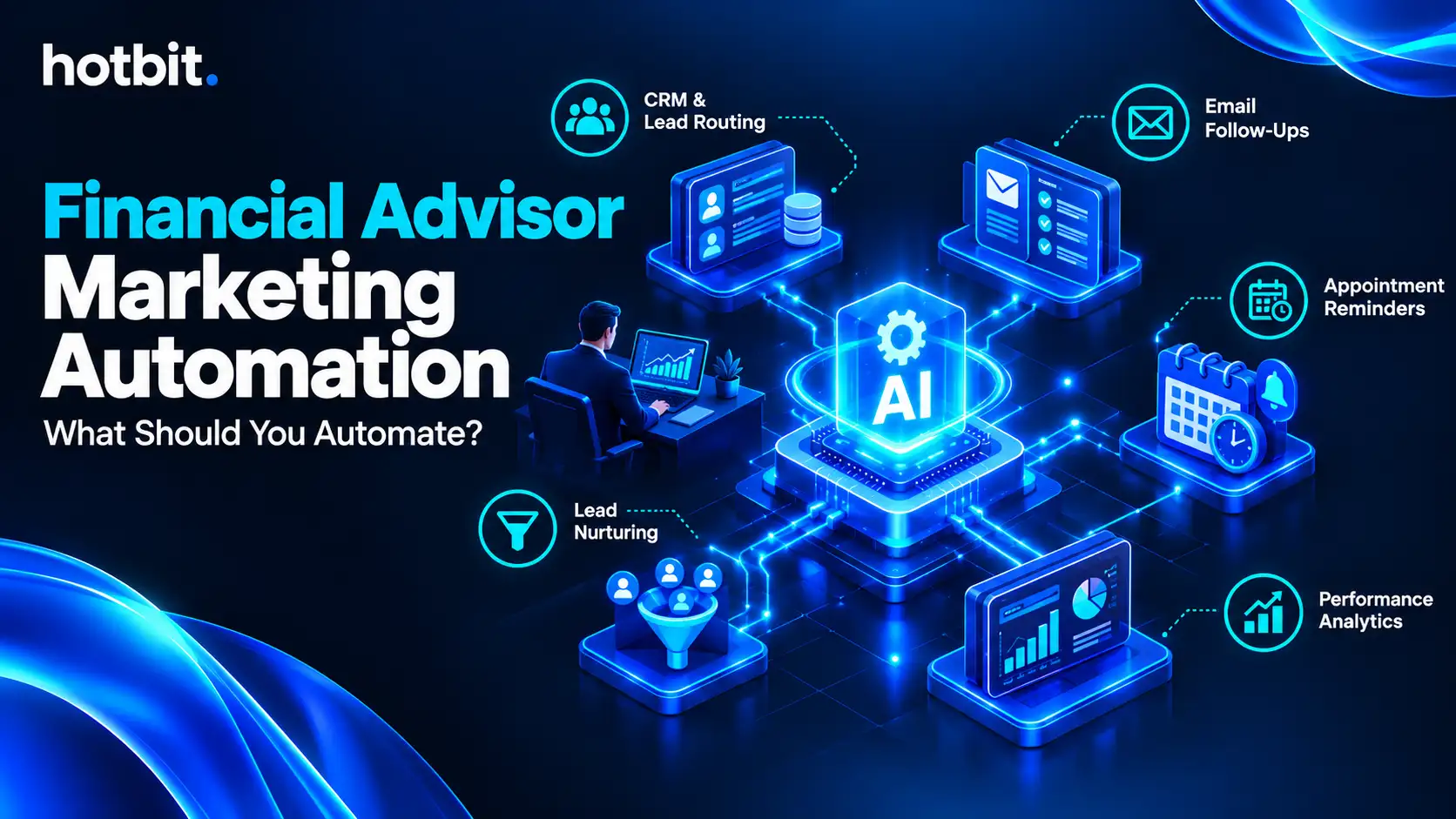
What Should Financial Advisors Automate?
The best tasks to automate are repetitive, predictable, and time-sensitive. For financial advisors, this can include lead capture, follow-up, email nurturing, scheduling, CRM updates, webinar communication, and re-engagement.
1. Lead Capture
Automate lead collection through website forms, consultation requests, webinar registrations, downloads, and landing pages. New inquiries can automatically enter the firm’s CRM, reducing manual data entry and keeping prospects organized.
2. Lead Qualification
Automation can collect basic information such as a prospect’s general needs, location, timeframe, and appointment preferences. This helps teams organize and prioritize leads without using automation to provide personalized financial recommendations.
3. Initial Lead Follow-Up
When someone submits a form, automation can send an immediate confirmation and provide the next step.
Form submission → Confirmation → Educational resource → Appointment option → Team notification
This helps create consistent follow-up without making every interaction manual.
4. Email Nurturing
Email marketing for financial advisors can automate welcome emails, educational sequences, webinar reminders, appointment reminders, and re-engagement campaigns. Messages should match the prospect’s stage and be handled according to the firm’s applicable compliance processes.
5. Appointment Scheduling
Scheduling tools can automate confirmations, calendar invitations, reminders, and rescheduling instructions. This reduces unnecessary back-and-forth and makes it easier for prospects to move from interest to conversation.
6. Webinar and Event Follow-Up
Automation can create different follow-up paths for attendees and no-shows.
Attended → Follow-up → Appointment invitation
Did not attend → Resource/recording → Follow-up → Appointment invitation
7. CRM Updates and Lead Routing
Automation can create lead records, track sources, update lead stages, assign prospects, and trigger follow-up tasks. This keeps prospect information organized and reduces repetitive administrative work.
8. Re-Engagement
Automation can reconnect with prospects who downloaded a resource, attended an event, started an inquiry, or stopped responding. The focus should be on useful educational content rather than repeated sales messages.
What Should Financial Advisors NOT Automate?
Financial advisors should avoid automating tasks that require personal judgment, trust, or individualized guidance.
- Personalized Financial Advice: Requires professional judgment and an understanding of each client’s circumstances.
- Complex Prospect Questions: Route detailed questions to a qualified professional.
- Sensitive Conversations: Keep important, trust-based discussions human-led.
- Every Marketing Message: Avoid excessive, repetitive, or generic communications.
- Compliance-Sensitive Content: Review automated messages appropriately to help meet applicable compliance requirements.
Financial Advisor Marketing Automation vs. Manual Marketing
Automation and manual marketing are not necessarily competing approaches. The most effective process may combine both.
Marketing Activity | Manual Approach | Automated Approach |
Lead capture | Staff manually records inquiries | Lead enters the designated system automatically |
Initial response | Team member sends individual confirmation | Triggered confirmation |
Lead nurturing | Staff remembers follow-up dates | Scheduled workflow |
Appointment booking | Back-and-forth emails | Online scheduling |
Webinar reminders | Manual attendee communication | Automated reminders |
Re-engagement | Team identifies inactive prospects | Triggered campaign |
CRM updates | Staff enters information | Workflow updates records where configured |
Reporting | Manual data collection | Automated reporting/dashboarding |
The purpose of automation is not necessarily to reduce headcount. It can allow advisors and marketing teams to spend more time on activities that require judgment, communication, and relationship-building.
How Does Financial Advisor Marketing Automation Support Lead Generation?
Financial advisor lead generation and marketing automation serve different purposes.
Lead generation focuses on attracting and capturing potential prospects. Automation helps manage what happens after someone enters the firm’s marketing process.
For example:
SEO → Website visit → Lead capture → Automated nurturing → Appointment opportunity
Suppose a prospective client finds an educational article through search. They read the article and download a related resource.
The marketing system can then:
- Record the lead.
- Deliver the requested resource.
- Send relevant educational follow-up.
- Offer an appropriate next step.
- Notify the team when the prospect reaches a defined stage.
Automation does not make the original lead qualified by itself. Audience targeting, content quality, messaging, offers, and the firm’s overall marketing strategy still matter.
How Does Automation Fit Into a Financial Advisor Marketing Strategy?
Marketing automation works best as one component of a broader strategy.
A financial firm may use:
- SEO
- Educational content
- Webinars
- Social media
- Paid campaigns
- Landing pages
- CRM systems
- Appointment scheduling
- Analytics
Each channel can have a different role.
For example, SEO for financial advisors can help attract people who are actively searching for information. A well-planned financial advisor marketing strategy can combine content that educates visitors, lead forms that capture interest, and automation that manages follow-up.
That means automation is not the entire marketing strategy.
It is the system that helps connect different parts of the strategy.
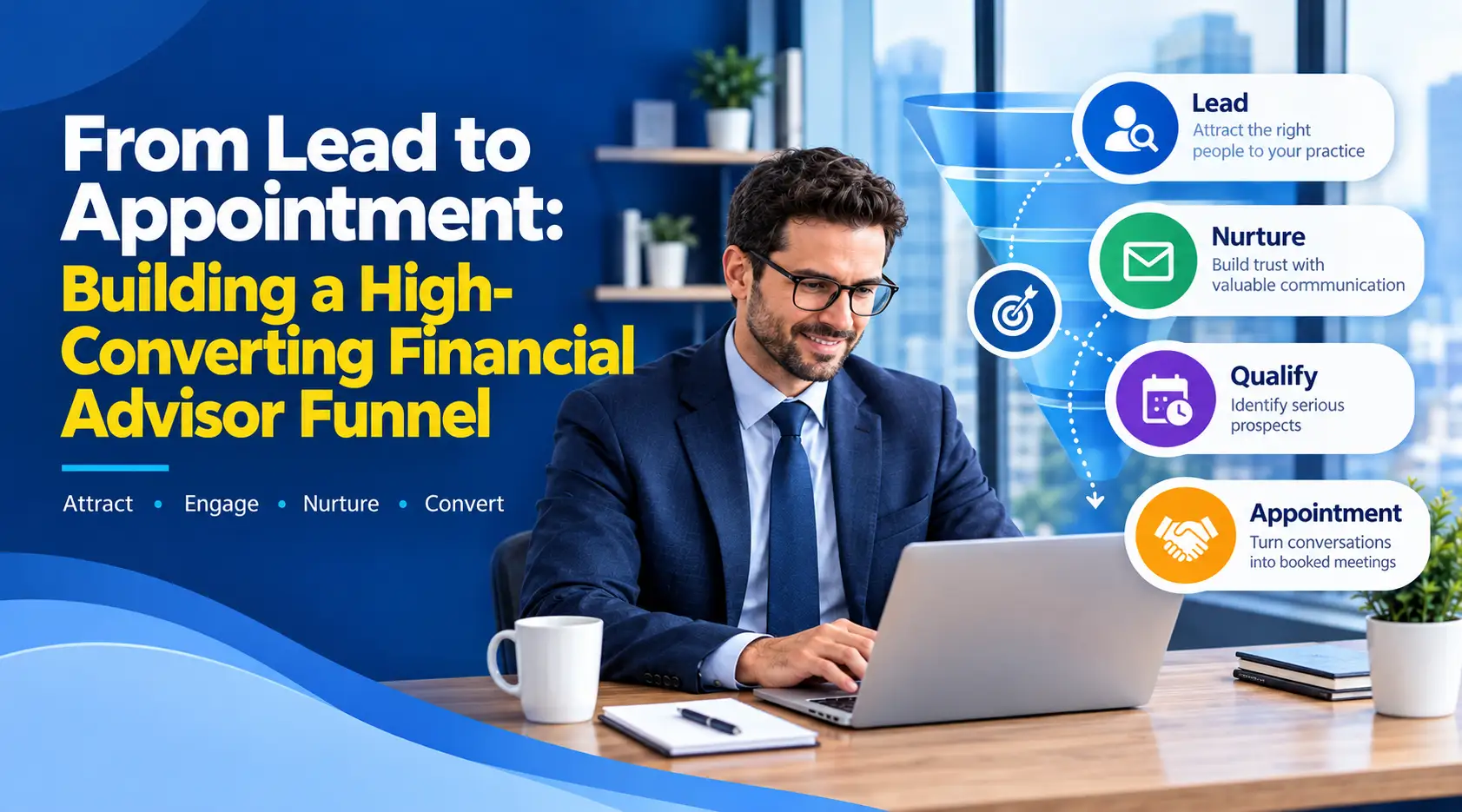
What Does an Automated Financial Advisor Lead Funnel Look Like?
An automated lead funnel guides prospects from discovering content to booking an appointment.
- Discover Content: A prospect finds an educational article.
- Download a Resource: They submit a form to access a guide.
- Record the Lead: Their details enter the CRM.
- Follow Up: The system delivers the resource and next steps.
- Nurture the Lead: Relevant educational emails build engagement.
- Offer an Appointment: The prospect can schedule a conversation.
- Send Reminders: Automated messages confirm the appointment.
- Advisor Takes Over: The advisor leads the conversation and determines the next steps.
Key takeaway: Automation manages the workflow, while people build relationships.
What Are the Most Useful Financial Advisor Marketing Automation Workflows?
The right workflow depends on the firm’s goals, but common financial advisor marketing automation workflows include:
- New Lead: Inquiry → CRM entry → Qualification → Follow-up → Appointment
- Consultation: Booking → Confirmation → Reminder → Preparation
- Webinar: Registration → Reminders → Attendance → Follow-up
- Lead Magnet: Download → Resource delivery → Educational emails → Next step
- No-Show: Missed appointment → Follow-up → Rescheduling option
- Re-Engagement: Inactive prospect → Educational content → Follow-up → Appointment option
Automation should follow the customer journey rather than simply automate tasks because the technology allows it.
What Technology Do Financial Advisors Need for Marketing Automation?
Financial advisors generally need only a few connected tools:
- CRM: Organizes prospect information and activity.
- Email Platform: Sends scheduled and triggered communications.
- Scheduling Software: Handles bookings and reminders.
- Forms & Landing Pages: Capture prospect information.
- Analytics: Tracks leads and funnel performance.
- Integrations: Connect different systems when needed.
The goal should be a simple, connected system, not a large collection of tools.
What Should You Look for in Financial Services Marketing Automation?
When choosing an automation platform or partner, consider:
- Compliance awareness
- CRM compatibility
- Flexible workflows
- Useful reporting
- Easy human handoffs
- Responsible data management
The technology should support the firm’s marketing process rather than make it unnecessarily complicated.
Common Financial Advisor Marketing Automation Mistakes
Common mistakes include:
- Automating everything instead of keeping important conversations human.
- Sending too many emails simply because automation makes it easy.
- Using generic messaging for every prospect.
- Ignoring compliance requirements.
- Choosing technology before mapping the customer journey.
- Using inaccurate or incomplete CRM data.
- Failing to provide human follow-up.
- Measuring activity instead of meaningful outcomes.
Useful metrics include qualified leads, booked appointments, show rates, lead sources, follow-up completion, and cost per qualified opportunity.
How Do You Know What to Automate First?
A simple way to prioritize automation is to look for activities that are:
High volume + repetitive + predictable + time-sensitive
For example:
Task | Automation Priority |
Appointment reminders | High |
New lead acknowledgment | High |
Webinar reminders | High |
CRM data entry | High |
Basic lead nurturing | High |
Personalized financial conversations | Low |
Complex prospect questions | Low |
Individualized financial advice | Keep human-led |
Starting with a few high-value workflows can be more manageable than trying to automate the entire marketing operation at once.
How to Build a Financial Advisor Marketing Automation Strategy
- Identify Repetitive Tasks: Find tasks such as emails, reminders, and lead follow-ups.
- Map the Customer Journey: Understand how prospects move from discovery to appointments.
- Choose a Workflow: Start with lead follow-ups or appointment reminders.
- Create Useful Messaging: Prepare relevant, helpful content for each stage.
- Connect Your Tools: Integrate your CRM, email, forms, and scheduling systems.
- Define Human Handoffs: Decide when staff should take over.
- Test Everything: Check emails, links, triggers, and notifications.
- Measure and Improve: Track results and refine workflows regularly.
When Should a Financial Advisor Consider Marketing Automation?
Marketing automation may become useful when a firm notices that:
- Leads are not receiving consistent follow-up.
- Team members spend significant time sending repetitive emails.
- Appointment scheduling involves too much back-and-forth.
- Webinar follow-up is inconsistent.
- Prospect information is spread across multiple systems.
- Leads frequently become inactive without follow-up.
- Marketing volume is increasing.
- The firm cannot easily determine where prospects are in the funnel.
However, not every advisor needs a complex automation system.
A smaller firm with a low lead volume may only need a few basic workflows. The right level of automation depends on the firm’s process, audience, technology, and resources.
How Can a Financial Services Digital Marketing Agency Help With Automation?
A financial services digital marketing agency may help a firm connect its marketing strategy with the systems needed to manage prospect journeys.
Depending on the agency, services may include:
- Marketing strategy
- SEO
- Content creation
- Email workflows
- Landing pages
- Lead-generation campaigns
- CRM integration
- Webinar promotion
- Appointment funnels
- Reporting and optimization
When evaluating an agency, financial firms should look beyond the number of software platforms it uses.
The more important question is whether the agency understands the firm’s audience, marketing objectives, customer journey, and applicable compliance considerations.
How Does SEO Fit Into Financial Advisor Marketing Automation?
SEO for financial advisors attracts people searching for relevant financial information, while marketing automation manages follow-ups after they engage.
Typical process:
SEO → Educational Content → Lead Capture → Email Nurturing → Appointment
Both work together to support lead generation. However, automation cannot replace quality content, relevant traffic, or a clear value proposition.
How Does Content Marketing Fit Into Financial Advisor Marketing Automation?
Financial services content marketing can provide the educational material used throughout automated campaigns.
For example:
Blog article → Related guide → Email sequence → Webinar → Appointment opportunity
A firm can also repurpose educational content into different formats, such as:
- Blog posts
- Guides
- Email content
- Webinar topics
- FAQs
- Short educational resources
This allows the marketing system to continue providing useful information without requiring the team to create an entirely new campaign for every interaction.
How Should Financial Advisors Measure Marketing Automation?
Focus on metrics that show whether automation improves marketing and follow-up:
- Lead metrics: Leads, sources, qualified leads, cost per lead
- Engagement: Email engagement, content activity, webinar registrations and attendance
- Appointments: Requests, bookings, show rates, qualified appointments
- Efficiency: Response time, follow-up completion, and time saved
The goal is to create a more organized, consistent, and efficient process for turning appropriate prospects into conversations.

Final Thoughts: Automate the Process, Not the Relationship
Financial advisor marketing automation can make repetitive marketing and follow-up tasks easier to manage, especially for agencies and IMOs looking to improve their marketing processes. However, automation should always have a clear purpose.
The most useful starting points are generally predictable tasks such as lead capture, initial follow-up, email nurturing, appointment reminders, webinar communication, CRM updates, and re-engagement.
At the same time, financial advisors should keep professional judgment, personalized conversations, and relationship-building human-led.
The strongest approach is not to automate everything. It is to identify the parts of the customer journey that can be handled consistently by technology and then create clear opportunities for people to step in when their involvement matters most, helping turn qualified prospects into booked appointments.
When automation, content, SEO, email, and lead-generation activities work together, a financial firm can create a more organized marketing process without losing the personal element that remains important in financial services.
FAQs About Financial Advisor Marketing Automation
1. What is financial advisor marketing automation?
Financial advisor marketing automation uses software to automate repetitive tasks such as lead capture, email follow-up, appointment reminders, and CRM updates. It helps advisors stay consistent while keeping personalized conversations and professional judgment human-led.
2. What should financial advisors automate first?
Start with repetitive tasks that save time, such as new-lead follow-up, appointment reminders, webinar communication, email nurturing, and CRM updates. Begin with one or two workflows and expand as the process becomes more effective.
3. Can financial advisors automate email marketing?
Yes. Advisors can automate welcome emails, educational sequences, webinar reminders, and lead-nurturing campaigns. Automated communication should still follow the firm’s applicable compliance processes and be reviewed appropriately.
4. How does automation help financial advisor lead generation?
Automation helps manage leads after they enter the marketing funnel. It can capture inquiries, organize prospects, deliver follow-up content, and provide appointment opportunities, creating a more consistent path from lead to conversation.
5. Can marketing automation replace a financial advisor?
No. Automation can handle repetitive marketing and administrative tasks, but it cannot replace professional judgment or relationship-building. Advisors should remain involved in personalized conversations, complex questions, and individualized financial guidance.
Disclaimer:
This article is for general informational and educational purposes only. Marketing automation tools and workflows should be implemented according to your firm’s applicable legal, regulatory, privacy, and compliance requirements. This content does not provide financial, investment, legal, or compliance advice, and it does not replace guidance from qualified professionals.