
- Written & Reviewed by Jeremy
- Published
- Last Updated Sep 30, 2026
A financial advisor website can attract hundreds or even thousands of visitors every month and still generate very few leads. Why your financial advisor website gets traffic but no leads usually comes down to a gap between attracting visitors and giving the right visitors a clear, credible reason to take the next step.
Traffic measures attention. Leads measure action.
For financial advisors and wealth management firms, that distinction matters. Someone searching for a general retirement definition is different from someone actively looking for a financial advisor. Likewise, someone who reads three articles and leaves may need more information before booking a consultation.
A successful financial advisor website needs to connect search intent, useful content, trust, conversion paths, lead capture, and follow-up. If one of those pieces is missing, traffic may not translate into qualified appointments.
Traffic Doesn’t Automatically Mean Qualified Leads
One of the biggest misconceptions in digital marketing is that more website traffic automatically means more potential clients.
It doesn’t.
A typical financial advisor marketing funnel looks something like this:
Search → Relevant visitor → Engaged visitor → Lead → Qualified lead → Appointment
A website can receive plenty of traffic at the first stage while losing potential clients at every stage that follows.
For example, an article about IRA contribution rules might attract a large audience. However, many of those visitors may simply want a quick answer and have no intention of hiring an advisor.
By contrast, someone searching for “financial advisor for retirement planning” is demonstrating a different type of intent.
This is why financial advisor marketing should focus not only on increasing traffic, but on attracting relevant traffic with a realistic path toward becoming a lead.
Why Your Financial Advisor Website Gets Traffic but No Leads
A financial advisor website can get plenty of traffic but few inquiries when the wrong visitors arrive, the website lacks clear messaging, or there is no simple path to conversion.
1. Your Website Attracts the Wrong Traffic
High-traffic keywords don’t always bring potential clients. Searches like “What is an IRA?” or “How does a 401(k) work?” may attract informational visitors who aren’t ready to hire an advisor.
More commercial searches, such as “financial advisor for retirement planning” or “financial advisor for business owners,” show stronger intent.
The goal of SEO for financial advisors should be attracting relevant visitors and guiding them toward appropriate services.
2. Your Website Doesn’t Clearly Explain Who You Help
Visitors should quickly understand who your firm serves and what you offer.
Instead of a generic message like:
“We provide comprehensive financial solutions for your future.”
Explain your target audience, services, location, and the problems you help solve. Clear positioning helps visitors determine whether your firm is right for them.
3. Your Calls to Action Are Too Generic
Buttons such as “Contact Us” or “Learn More” may not tell visitors what to do next.
Consider more specific CTAs, such as:
- Schedule a Financial Planning Consultation
- Discuss Your Retirement Goals
- See How Our Advisory Process Works
The right CTA should match the visitor’s intent and make the next step clear.
Your Website May Be Building Traffic but Not Enough Trust
Financial decisions involve money, long-term goals, and personal circumstances, so visitors often need confidence before contacting an advisor.
Your website should clearly explain:
- Who your advisors are
- Who you serve
- What services you offer
- How your process works
- What to expect from the first conversation
- Where you operate
What Trust Signals Should a Financial Advisor Website Include?
Useful trust elements can include:
- Advisor bios and credentials
- Clear service descriptions
- Transparent contact information
- Relevant disclosures
- Educational resources
- Client experiences where permitted
- FAQs
The goal is simple: give visitors enough information to feel confident taking the next step without overwhelming them with promotional claims.
Your Content May Be Answering Questions but Not Creating Next Steps
Educational content can attract traffic and demonstrate expertise, but traffic alone doesn’t generate leads.
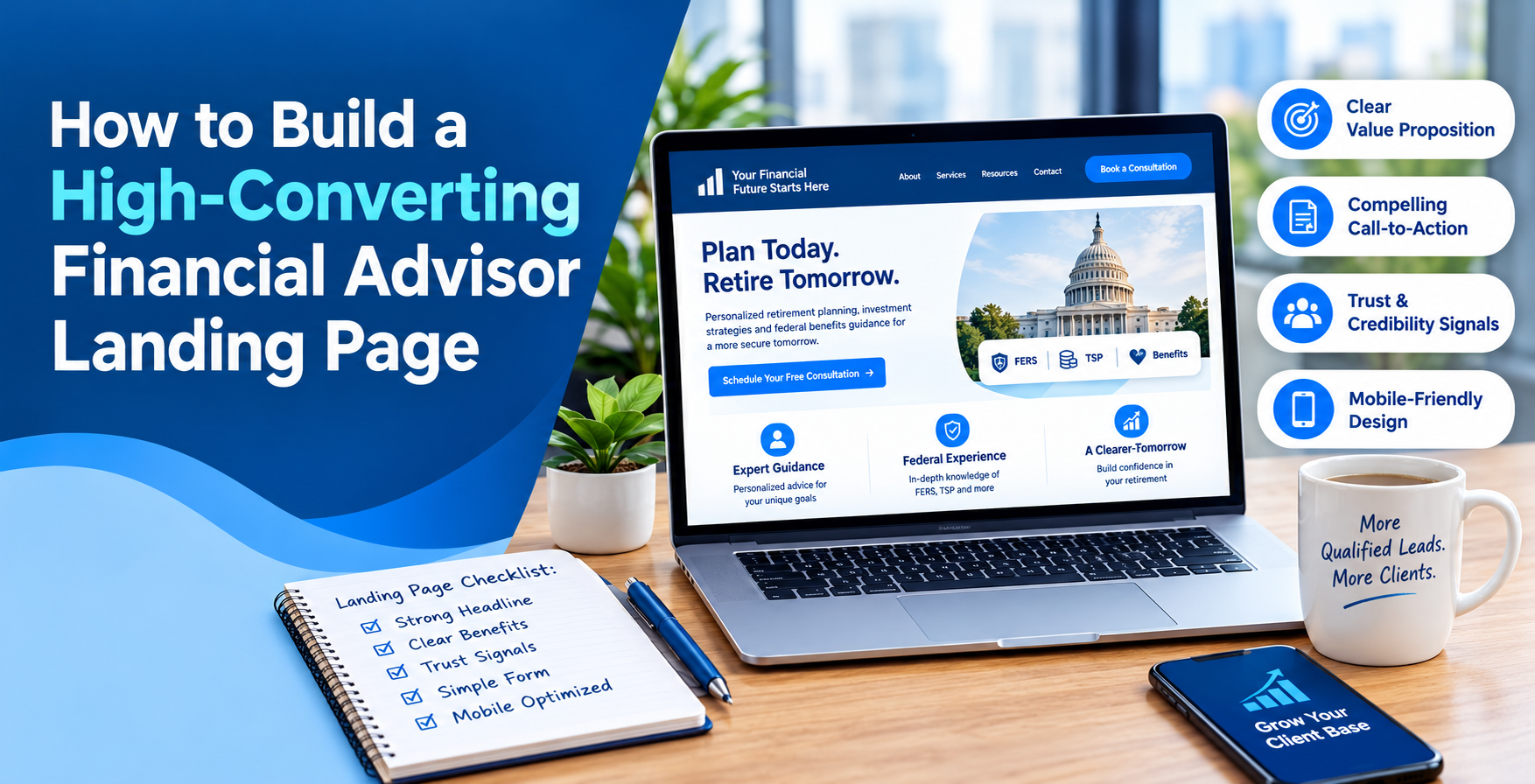
With content marketing for financial advisors, every article should give interested readers a relevant next step. For example, an article about retirement savings could link to the firm’s retirement planning service.
Use relevant internal links and CTAs to guide readers from informational content → related service → potential inquiry.
The goal isn’t to make every article promotional. It’s to help interested visitors easily find the information or service they need next.
SEO for Financial Advisors: Are You Optimizing for Intent or Just Rankings?
SEO performance is often measured through rankings, impressions, and organic sessions.
Those metrics are useful, but they don’t tell the entire story.
A financial advisor should also ask:
Are the people finding my website actually relevant potential clients?
Consider the difference:
Search Intent | Example Query | Recommended Page | Potential Next Step |
Informational | How does retirement planning work? | Educational guide | Related planning resource |
Problem-aware | How can I create retirement income? | Detailed guide | Retirement planning service |
Commercial | Financial advisor for retirement | Service/location page | Consultation |
Transactional | Book financial planning consultation | Booking page | Appointment |
A website doesn’t need to abandon informational content.
Instead, it should build a logical relationship between informational, commercial, and transactional content.
That can help SEO become part of a broader financial advisor lead generation system rather than an isolated traffic-generating activity.
Your Service Pages May Not Be Designed to Convert
A service page shouldn’t simply list everything the firm offers.
It should help a visitor understand whether that service is relevant to their situation.
A useful service page can answer:
- What is the service?
- Who is it for?
- What financial problem does it address?
- How does the process work?
- What should a prospective client expect?
- What is the next step?
For example, a retirement planning page could explain the planning process, common planning considerations, who the service is intended for, and how someone can start a conversation.
The page can then direct visitors toward a consultation or another appropriate resource.
Essential Elements of a Financial Advisor Service Page
A conversion-focused service page may include:
- Clear headline
- Specific audience or problem
- Service explanation
- Process overview
- Advisor or firm credibility
- Relevant FAQs
- Supporting educational content
- Clear CTA
- Simple contact or booking option
The objective isn’t to make every visitor convert.
It’s to make the decision easier for visitors who are already interested.
Your Appointment Process May Be Creating Friction
Sometimes the problem isn’t attracting visitors.
It’s what happens after someone decides to contact the firm.
Imagine a prospective client clicks “Schedule a Consultation” and then encounters:
- A long form
- Too many required fields
- An unclear calendar
- A broken booking experience
- A slow-loading page
- No mobile-friendly option
- No explanation of what happens next
Even a highly interested visitor may abandon the process.
The appointment experience should therefore be treated as part of the marketing funnel.
Make the next step clear.
Tell visitors what information they need to provide.
Explain what happens after they submit the form or select a time.
And make sure the experience works properly on both desktop and mobile devices.
For firms focused specifically on generating scheduled conversations, a dedicated booked appointments process can also help connect marketing activity with actual sales opportunities.
Your Website Traffic May Be Ready for Nurturing, Not an Immediate Appointment
Not everyone who visits a financial advisor website is ready to schedule a meeting.
Someone may be researching financial planning today and comparing advisors several weeks later.
That makes lead nurturing important.
Email Marketing for Financial Advisors
Email marketing for financial advisors can provide a way to stay connected with people who have voluntarily provided their contact information but aren’t ready to speak with an advisor.
Useful resources might include:
- Retirement planning guides
- Educational newsletters
- Financial planning checklists
- Tax-planning resources
- Webinar invitations
- Market education
- New articles and research
The emphasis should be on providing useful information rather than sending repetitive promotional messages.
A visitor who isn’t ready today may become more engaged as they learn more about the firm and its approach.
How Marketing Automation Can Turn Interest Into Follow-Up
Manual follow-up becomes difficult when a firm receives leads from several channels.
This is where marketing automation for financial advisors can support the process.
For example, automation can help trigger appropriate actions when someone:
- Downloads an educational resource
- Submits a contact form
- Registers for an event
- Requests additional information
- Completes a particular website action
Automation can help organize communication and notify the appropriate team member when a new inquiry arrives.
However, automation shouldn’t replace human interaction.
Financial planning is relationship-driven. Automated communication should support the process while leaving room for personalized conversations.
How SEO, Content, Email, and Automation Work Together
Your marketing channels work better when they support one another.
- SEO attracts relevant visitors.
- Content answers their questions.
- Service pages explain your solutions.
- CTAs guide the next step.
- Forms and booking tools capture leads.
- Email and automation support follow-up.
Together, they create a simple funnel:
SEO → Content → Service Page → Lead Capture → Follow-Up → Appointment
This connected approach helps turn website traffic into meaningful opportunities.
What Role Do Tools and Analytics Play?
If you don’t measure where visitors drop out, it is difficult to know what needs fixing.
A financial advisor should look beyond total website sessions.
Useful metrics can include:
That tells you something important.
The acquisition side may be growing, but the conversion side hasn’t necessarily improved.
Likewise, if visitors frequently reach a service page but rarely click the CTA, the issue may be messaging, page structure, trust, or the offer itself.
Tools can help identify these patterns.
Common Mistakes That Kill Pre-Set Appointments
Even with good website traffic, small conversion issues can cost financial advisors potential appointments.
Common problems include:
- Weak first impressions: An outdated or confusing website can reduce trust.
- Generic messaging: Visitors may not understand who you serve.
- Weak CTAs: Interested visitors may not know what to do next.
- Slow follow-up: Delayed responses can reduce engagement.
- Complicated booking: Too many steps can cause drop-offs.
- Poor mobile experience: A difficult mobile experience can discourage inquiries.
- No lead nurturing: Visitors who aren’t ready today may be lost.
- Irrelevant pages: Visitors should easily find services related to their needs.
Small improvements to messaging, CTAs, forms, navigation, and follow-up can make the conversion journey clearer.
What Should a Financial Advisor Website Conversion System Look Like?
A simple conversion system should guide visitors from discovery to appointment:
- Attract the right audience with relevant SEO and content.
- Match search intent with useful, focused pages.
- Build trust through clear services, credentials, and processes.
- Provide clear CTAs that show visitors what to do next.
- Make lead capture simple with easy forms and booking.
- Follow up through email and marketing automation.
- Measure results by tracking leads and appointments, not just traffic.
The goal is to turn your website from a traffic source into a measurable lead-generation system.
How to Diagnose Why Your Website Isn’t Generating Leads
A simple audit can reveal where the biggest gaps may be.
Question | If the Answer Is No | Potential Issue |
Are visitors finding pages relevant to your services? | No | Search intent |
Is your target audience obvious quickly? | No | Positioning |
Does each important page have a logical CTA? | No | Conversion path |
Can visitors easily request information or book? | No | Friction |
Does the website establish credibility? | No | Trust |
Are leads followed up consistently? | No | Nurturing |
Can you identify where appointments came from? | No | Measurement |
This framework can help separate a traffic problem from a conversion problem.
If almost nobody relevant is reaching the site, acquisition may need attention.
Helpful content can educate prospects and build familiarity with a firm before they schedule a consultation.
If relevant visitors arrive but don’t take action, the website and conversion experience deserve closer examination.
When Should You Invest in Professional Financial Advisor Marketing?
Not every firm needs the same level of marketing support.
However, professional help may be worth evaluating when:
- Organic traffic is growing but leads aren’t
- Content publishing is inconsistent
- The firm lacks internal SEO expertise
- Website conversion rates are unclear
- Lead follow-up is fragmented
- Marketing data isn’t connected
- Advisors are spending significant time managing marketing
- The firm wants to expand into new audiences or markets
When evaluating a marketing partner, look beyond promises of rankings or traffic.
Ask how the agency connects marketing activity to measurable business outcomes.
How to Choose a Financial Advisor Marketing Partner
A financial services marketing agency should understand the specific needs of financial advisors, not just general digital marketing.
Look for Financial Services Experience
Check whether the agency understands:
- Financial advisors and wealth management
- Financial planning audiences
- Search behavior and buying decisions
- Trust and compliance considerations
- Longer client decision cycles
Relevant experience can help an agency better understand your audience and marketing challenges.
Ask How Success Is Measured
Look beyond rankings, impressions, and traffic. Ask whether the agency tracks:
- Qualified leads
- Consultation requests
- Appointment bookings
- Conversion rates
- Lead sources
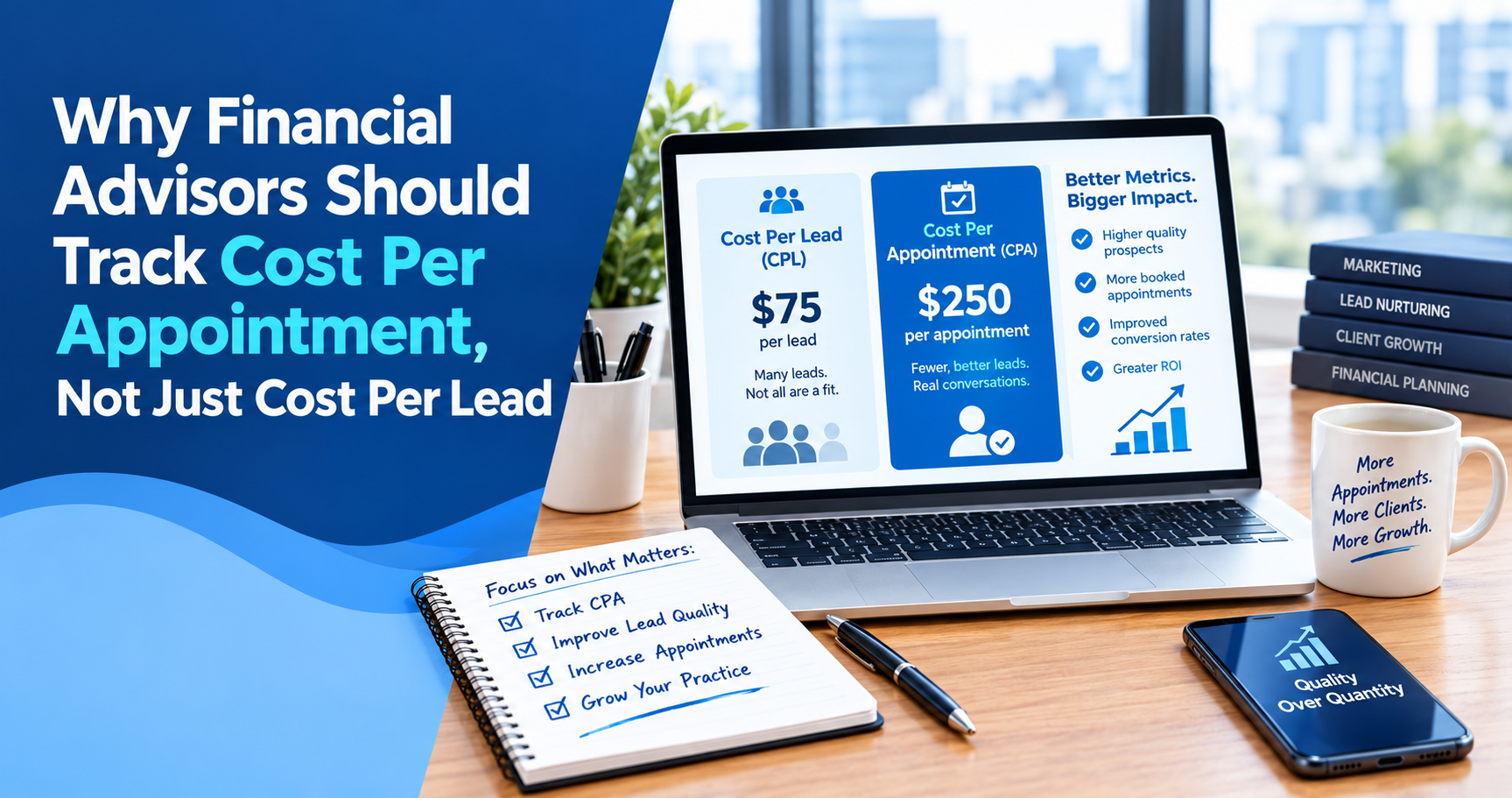
- Cost per qualified lead
Relevant experience can help an agency better understand your audience and marketing challenges.
Ask How SEO Supports Lead Generation
Look beyond rankings, impressions, and traffic. Ask whether the agency tracks:
- Qualified leads
- Consultation requests
- Appointment bookings
- Conversion rates
- Lead sources
- Cost per qualified lead
Ask How SEO Supports Lead Generation
A strong strategy should connect:
SEO → Content → Conversion → Lead Capture → Follow-Up → Appointment
This helps you evaluate whether the agency is focused on generating meaningful opportunities, not just website traffic.

Final Thoughts: Traffic Is Only the Beginning
A financial advisor website can have strong search visibility and still struggle to generate leads.
The issue isn’t always a lack of traffic.
Sometimes the traffic isn’t relevant. Sometimes visitors don’t immediately understand who the firm serves. Sometimes the website doesn’t establish enough trust. Other times, the CTA, contact form, booked appointments process, or follow-up system creates unnecessary friction.
The goal should therefore be bigger than simply increasing website sessions.
A stronger financial advisor marketing system connects:
Relevant traffic + useful content + trust + clear positioning + conversion paths + lead capture + follow-up
When those elements work together, website traffic has a clearer path toward becoming meaningful business opportunities through the right agencies and IMOs.
The first question shouldn’t be, “How can we get more traffic?”
It should be:
“Are the right people visiting, and what happens after they arrive?”
FAQs About Financial Advisor Website Leads
Why does my financial advisor website get traffic but no leads?
A website can get traffic without leads if it attracts the wrong audience, has unclear messaging, weak CTAs, limited trust signals, or a complicated lead and booking process.
How can financial advisors turn website traffic into leads?
Focus on relevant search intent, clear service pages, strong trust signals, clear CTAs, simple forms and booking, and timely follow-up.
Does SEO help financial advisors generate leads?
SEO can attract relevant organic visitors, but traffic alone doesn’t guarantee leads. Strong content, service pages, CTAs, and a clear conversion process are also needed.
How important are calls to action on a financial advisor website?
CTAs give visitors a clear next step, such as scheduling a consultation, requesting information, or learning about a specific service. The CTA should match the visitor’s intent.
What should financial advisors track besides website traffic?
Track CTA clicks, form submissions, appointment bookings, qualified leads, lead sources, and conversion rates to understand whether website traffic is producing meaningful opportunities.
Disclaimer:
This article is for general informational and educational purposes only. It does not constitute financial, investment, legal, tax, or professional advice. Results from marketing strategies may vary depending on the business, audience, market, and implementation.