
- Written & Reviewed by Jeremy
- Published
- Last Updated Sep 04, 2026
Choosing a marketing agency can feel like a major decision for a financial advisor. You may see agencies promising more traffic, more leads, higher rankings, and rapid business growth, but those promises do not always translate into qualified appointments or long-term clients.
The right marketing partner should do more than make your website look better or increase social media activity. A strong agency should understand your audience, your business goals, and the journey a potential client takes before deciding to schedule a conversation.
Why Financial Advisors Need the Right Marketing Partner
Financial services are different from many other industries.
Someone looking for a restaurant, a new pair of shoes, or a software tool may make a decision quickly. A person looking for a financial advisor often takes more time. They may research your services, read educational content, compare advisors, check credentials, and evaluate whether they trust your firm before ever filling out a contact form.
That means successful marketing needs to support several stages of the client journey.
A potential client may first find your website through Google. They may then read a blog, download a guide, subscribe to your newsletter, attend a webinar, or visit several service pages before deciding to book an appointment.
This is why choosing a financial services marketing agency should involve more than comparing monthly prices or looking at a list of services.
The agency should be able to explain how its strategy can help move the right people through a journey like this:
Search or Advertisement → Website Visit → Educational Content → Lead → Qualified Prospect → Appointment → Client
What Should You Look for in a Marketing Agency for Financial Advisors?
When evaluating agencies, it helps to look beyond a general service list.
Almost every agency can say it offers SEO, content marketing, social media, paid advertising, or web design. The more important question is whether the agency understands how those services work together for your specific business.
Here are several areas worth evaluating.
1. Experience With Financial Services
A financial services digital marketing agency should understand the unique challenges involved in attracting financial clients.
For example, your audience may include:
- Federal employees
- Pre-retirees
- Retirees
- Business owners
- High-net-worth individuals
- Families planning for retirement
- Insurance prospects
- Young professionals
Each audience has different concerns, questions, and motivations.
A marketing strategy designed for retirees approaching retirement should look very different from one targeting young professionals who are beginning to invest.
When speaking with an agency, ask whether it has worked with financial advisors or related financial businesses before. More importantly, ask what it learned from those campaigns.
Relevant experience can help an agency understand the types of questions prospects ask, the importance of trust-building content, and the difference between generating a large number of inquiries and attracting people who may actually be a good fit for your services.
2. A Clear Understanding of Your Ideal Client
One of the biggest marketing mistakes is trying to reach everyone.
A good agency should ask questions about who you want to work with before recommending channels or campaigns.
For example:
- Who is your ideal client?
- What stage of life are they in?
- What financial concerns do they have?
- Where do they search for information?
- What services are most valuable to your firm?
- What makes a prospect a qualified fit?
Without these answers, marketing can become broad and unfocused.
An agency that immediately recommends a list of services without first understanding your business may be focused more on selling a package than on building a strategy.
3. A Full-Funnel Strategy
Marketing channels should not operate independently.
For example, an SEO campaign may bring someone to a blog article. That article should then help the visitor discover a relevant service, guide, newsletter, or next step.
A paid advertisement may send someone to a landing page. The landing page should explain the offer clearly and provide a logical path toward scheduling a conversation.
A useful strategy often connects multiple activities:
SEO → Content → Website → Lead Capture → Email Follow-Up → Appointment
The exact funnel will vary from firm to firm, but your agency should be able to explain how different activities support one another.
4. Transparent Communication
Marketing can become frustrating when business owners receive reports full of technical terminology but still have no idea whether the work is helping the company grow.
Look for an agency that communicates clearly about:
- What work is being completed
- Why that work matters
- What results are being measured
- What challenges are appearing
- What changes are planned
- How performance relates to your goals
You should not need to become an SEO or advertising expert to understand what your marketing partner is doing.
How Do You Evaluate an Agency’s Financial Services Expertise?
Many agencies claim that they can work with any industry. That may be true to some extent, but financial services experience can still make a meaningful difference.
Before hiring an agency, ask for examples of relevant work.
You might ask:
- Have you worked with financial advisors or financial firms?
- What types of campaigns have you managed?
- What challenges did those businesses face?
- How did you approach content and audience targeting?
- What metrics did you use to evaluate performance?
Don’t focus only on client logos or general testimonials.
Try to understand the actual work behind the results.
An agency may have experience increasing website traffic, for example, but that does not necessarily mean it understands financial advisor lead generation.
Traffic is useful, but qualified traffic is more valuable.
You can also review the agency’s own website and content. If it claims to specialize in financial marketing, does its content demonstrate an understanding of the industry?
Look at the topics it covers and the advice it provides. Strong content can give you a better idea of how the agency thinks before you become a client.
Another important area is compliance awareness.
A marketing agency does not replace your firm’s compliance team, legal counsel, or regulatory responsibilities. However, an agency working with financial professionals should understand that financial marketing may require additional review and should build that reality into the content and campaign process.
Does the Agency Offer SEO for Financial Advisors?
SEO can be an important part of a long-term growth strategy, particularly for advisors who want to attract people actively searching for financial information or professional help.
However, SEO for financial advisors should involve more than publishing a few articles and adding keywords to a website.
A stronger strategy may include:
- Keyword and search-intent research
- Service page optimization
- Educational content
- Local SEO
- Technical website improvements
- Internal linking
- Website structure
- Conversion optimization
- Authority-building efforts
- Performance measurement
Common examples include:
- Accidentally blocking important pages
- Leaving old URLs without appropriate redirects
- Publishing duplicate service pages
- Ignoring mobile performance
- Uploading oversized images
- Creating complicated website navigation
- Forgetting to update XML sitemaps after major changes
- Using excessive redirects
- Failing to monitor indexing issues
- Treating technical SEO as a one-time project
The goal should not simply be to rank for as many keywords as possible.
A financial advisor may receive significant traffic from broad informational searches while generating very few qualified inquiries. On the other hand, a smaller amount of highly relevant traffic may lead to more valuable conversations.
When evaluating an agency, ask how it measures SEO success.
Useful questions include:
- Are we attracting the right audience?
- Is non-branded organic traffic increasing?
- Which pages are generating inquiries?
- Are visitors taking meaningful actions?
- Are leads from organic search becoming appointments?
A report showing increased traffic is helpful, but it should not be the end of the conversation.
How Does Content Marketing Fit Into a Financial Advisor’s Strategy?
Financial decisions often involve questions, uncertainty, and trust.
Potential clients may search for answers long before they are ready to contact an advisor. This is where financial services content marketing can become valuable.
Useful content may address questions such as:
- How much do I need to retire?
- When should I claim Social Security?
- What are my retirement account options?
- How should I prepare for retirement?
- What happens when I change jobs?
- Do I need professional financial advice?
The goal is not to turn every article into a sales pitch.
Instead, content should demonstrate expertise, answer relevant questions, and help the right readers understand when professional guidance may be useful.
A strong agency should think about how each piece of content fits into a larger strategy.
For example:
Blog Article → Related Resource → Email Subscription → Educational Follow-Up → Consultation Opportunity
When evaluating an agency, ask whether its content strategy considers both search visibility and conversion.
Great content can attract readers. Strategic content can also help guide the right readers toward the next step.
What Role Does Email Marketing Play?
Not every potential client who visits your website is ready to schedule an appointment immediately.
Someone may find your content while researching retirement, download a guide, or register for an educational event. They may need more time before deciding to speak with an advisor.
This is one reason email marketing for financial advisors can support a broader marketing strategy.
Email may help firms:
- Stay connected with interested prospects
- Share educational content
- Promote webinars or events
- Follow up with leads
- Nurture prospects who are not ready to act
- Maintain relationships with existing contacts
The important question when choosing an agency is whether it sees email as part of the customer journey rather than simply sending promotional messages.
Can the Agency Help Generate Qualified Appointments?
For many financial advisors and insurance professionals, the ultimate goal is not more website visitors.
It is more conversations with qualified prospects.
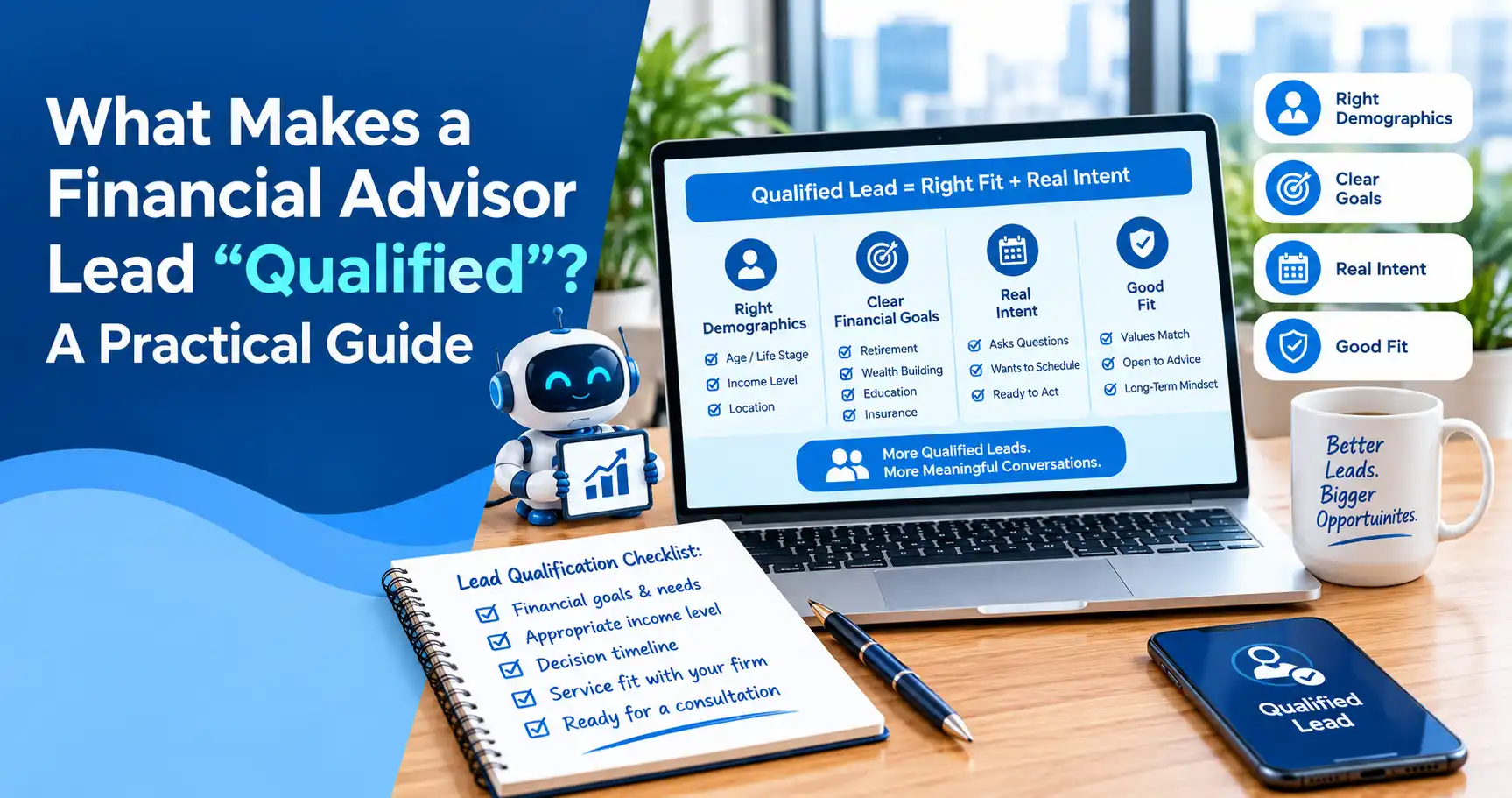
This is why you should ask an agency how it approaches lead quality.
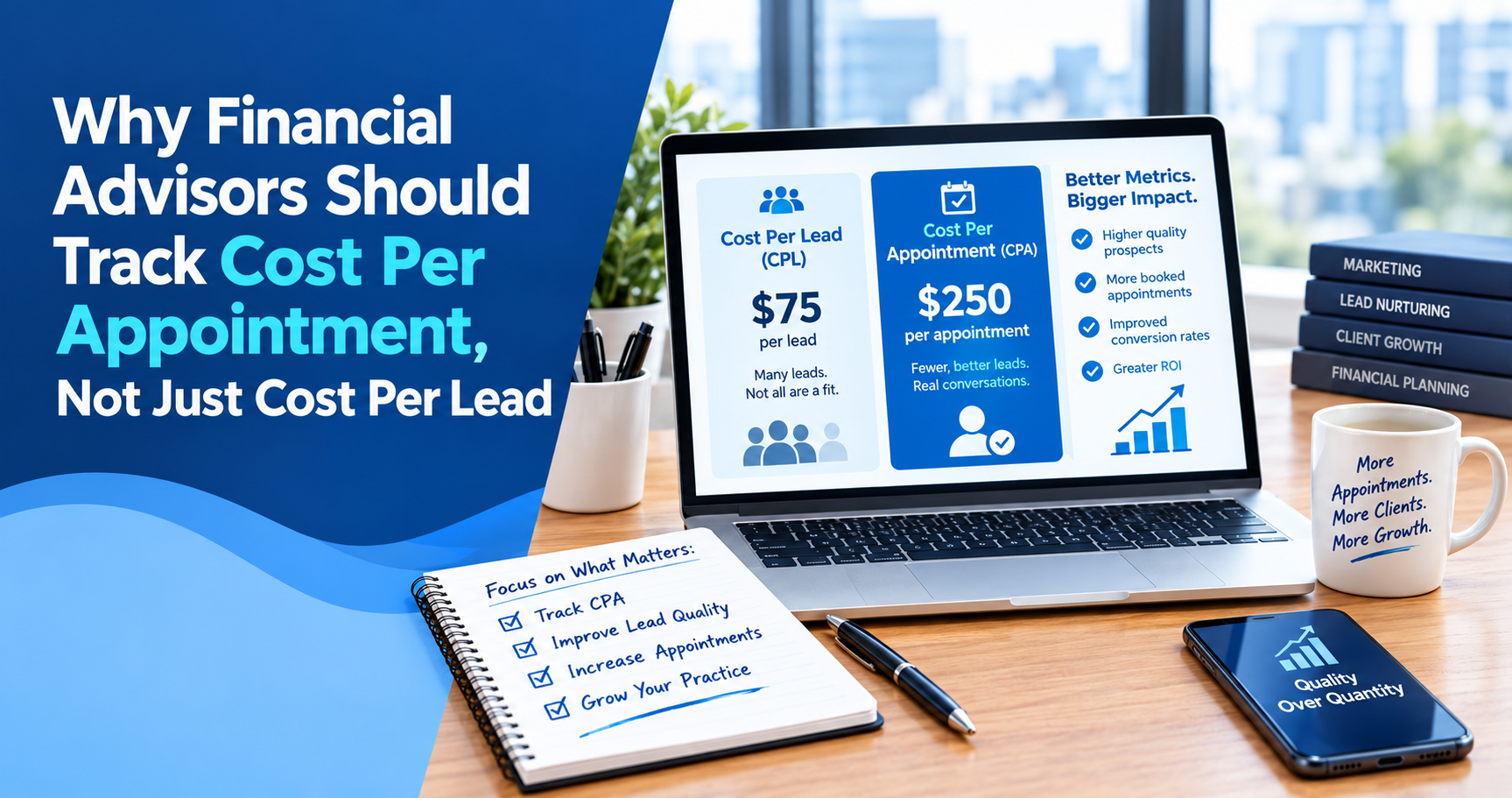
A campaign generating 100 leads may look successful on paper. But if most of those leads are not a good fit, do not respond, or never schedule an appointment, the campaign may not be delivering meaningful business value.
Ask the agency:
- What qualifies as a lead?
- How will lead quality be measured?
- How are appointments tracked?
- What happens after someone submits a form?
- How will underperforming campaigns be improved?
- How do you distinguish between inquiries and qualified opportunities?
A good strategy should consider the entire journey:
Impression → Click → Website Visit → Lead → Qualified Lead → Appointment → Client
Each stage can reveal a different problem.
For example, if a campaign receives many clicks but few leads, the landing page or offer may need improvement.
If the campaign generates many leads but few appointments, the targeting or qualification process may need attention.
If appointments are being booked but few prospects become clients, the issue may be outside the marketing campaign itself.
The agency may not control every stage, but it should understand how marketing performance connects to the broader sales and appointment process.
Financial Services Marketing Agency vs. General Marketing Agency
A general agency is not automatically a poor choice. Some agencies have strong strategic and technical skills that can transfer across industries.
However, a specialized agency may already understand many of the challenges involved in financial marketing.
Factor | Financial Services Marketing Agency | General Marketing Agency |
Industry knowledge | Understands financial audiences and common concerns | May need time to learn the industry |
Compliance awareness | More likely to consider compliance during planning | May require additional guidance |
Content strategy | Can focus on financial questions and client concerns | May use a broader content approach |
SEO strategy | Understands relevant financial search behavior | May apply a general SEO framework |
Lead generation | May focus more on qualified financial prospects | May prioritize overall lead volume |
Messaging | Often emphasizes trust, expertise, and credibility | May use more general conversion messaging |
Audience targeting | Can work with specific financial client profiles | May begin with broader targeting |
Reporting | More likely to connect activity with appointments and leads | May focus more heavily on traffic and engagement |
The key is not simply whether an agency calls itself specialized.
The real question is whether it understands your business well enough to build an effective strategy.
What Questions Should You Ask Before Hiring a Marketing Agency?
Before signing a contract, take time to ask detailed questions.
Strategy Questions
Ask:
- How would you approach marketing for my firm?
- Who do you believe my ideal clients are?
- Which marketing channels would you prioritize?
- Why are those channels appropriate for my goals?
- What would the first few months of work look like?
A good agency should be able to explain its reasoning.
Experience Questions
Ask:
- Have you worked with financial advisors or similar firms?
- Can you share relevant examples or case studies?
- What marketing challenges have you encountered in financial services?
- How do you approach trust-building content?
Lead Generation Questions
Ask:
- How do you define a qualified lead?
- How will leads and appointments be tracked?
- How do you improve lead quality?
- What happens when a campaign generates traffic but not appointments?
Reporting Questions
Ask:
- What information will be included in monthly reporting?
- Which KPIs will you prioritize?
- How often will we review strategy?
- How will you connect marketing performance with business outcomes?
The answers can tell you a great deal about how the agency works.
What Red Flags Should Financial Advisors Watch For?
Some warning signs are easier to identify than others.
Guaranteed Rankings
SEO involves many factors, including competition, search demand, website quality, and changing search algorithms.
Be cautious when an agency guarantees specific rankings without understanding your market.
Guaranteed Lead Numbers Without Context
Lead quantity does not automatically equal business growth.
An agency should be able to explain where the leads are coming from, how they are being targeted, and how quality will be evaluated.
No Clear Strategy
If an agency simply says it will publish blogs, manage social media, and improve SEO without explaining how those activities connect, ask for more detail.
You should understand the purpose behind the work.
Too Much Focus on Vanity Metrics
Metrics such as impressions, likes, followers, and page views can provide useful information.
However, they should not be the only measures of success.
Ask how those activities contribute to:
- Qualified traffic
- Leads
- Appointments
- Client opportunities
Poor Communication
If communication is unclear during the sales process, it may not improve after you become a client.
Pay attention to whether the agency answers questions directly and explains its recommendations clearly.
How Much Does a Marketing Agency for Financial Advisors Cost?
The cost of hiring an agency can vary significantly.
Pricing may depend on:
- SEO scope
- Content production
- Website improvements
- Paid advertising management
- Advertising budget
- Email marketing
- Webinar promotion
- Lead-generation campaigns
- Reporting and strategy support
For this reason, it is difficult to determine whether one agency is a better value simply by comparing monthly retainers.
A lower-priced agency may provide fewer services, a limited strategy, or less hands-on support.
A more expensive agency may offer a broader strategy, but that does not automatically mean it will deliver better results.
Instead of asking only, “Which agency costs less?” consider asking:
What am I receiving for the investment, and how will success be measured?
The long-term goal is to understand the relationship between:
Marketing Investment → Qualified Leads → Appointments → New Clients → Revenue
That provides a more meaningful framework for evaluating value.
How Long Does It Take to See Marketing Results?
The timeline depends on the marketing channels being used.
SEO
SEO usually requires patience. Content, website improvements, and authority-building efforts can take time to influence search visibility.
Paid Advertising
Paid campaigns can potentially begin generating traffic and leads more quickly. However, results still depend on targeting, messaging, offers, landing pages, and budget.
Content Marketing
Content often builds value over time. A useful article may support SEO, email marketing, social content, and lead nurturing.
Email Marketing
Email can provide quicker opportunities for engagement when a firm already has an audience or an existing lead database.
Be cautious of agencies that promise immediate results from every marketing channel.
A better approach is to establish realistic milestones and evaluate performance consistently.
How to Compare Multiple Marketing Agencies
If you are considering two or three agencies, create a simple comparison system.
You can score each agency based on the following areas:
Evaluation Area | Score |
Financial services experience | /5 |
Understanding of your target audience | /5 |
Overall strategy | /5 |
SEO capabilities | /5 |
Content marketing expertise | /5 |
Lead generation approach | /5 |
Compliance awareness | /5 |
Reporting and measurement | /5 |
Communication | /5 |
Pricing transparency | /5 |
Potential business impact | /5 |
This framework does not replace your judgment, but it can prevent decisions from being based entirely on a polished sales presentation.
The agency with the highest score may not always be the best choice. Your priorities may vary depending on whether your immediate goal is improving SEO, generating appointments, building an email list, or developing a more complete marketing system.
When Is It Time to Hire a Marketing Agency?
- Heavy reliance on referrals
- Limited time to manage marketing internally
- Low website traffic
- Website traffic that does not convert
- Inconsistent content production
- Difficulty generating qualified appointments
- Poor results from previous advertising campaigns
- No clear marketing strategy
- Limited internal marketing expertise
However, an agency may not solve every business problem immediately.
If your target audience is unclear, your services are poorly defined, or your website does not explain why someone should choose your firm, those issues may need to be addressed first.
The best agency relationships often begin with a clear understanding of where the business is today and where it wants to go.
How to Choose a Marketing Agency for Financial Advisors: Final Checklist
Before making a decision, make sure you understand whether the agency can:
- Explain your target audience clearly
- Demonstrate relevant financial services experience
- Build a strategy around your specific goals
- Support SEO and content marketing
- Generate and nurture qualified leads
- Track appointments and meaningful conversions
- Communicate clearly
- Provide understandable reporting
- Discuss compliance considerations appropriately
- Set realistic expectations
- Explain pricing and deliverables transparently
- Connect marketing activity with business outcomes
The best agency is not necessarily the one promising the fastest rankings, the largest number of leads, or the lowest monthly cost.
The right partner is the one that understands your business, asks thoughtful questions, communicates clearly, and develops a strategy focused on attracting the right prospects.
Marketing should ultimately support business growth—not simply create more activity.

Final Thoughts
Learning how to choose a marketing agency for financial advisors starts with looking beyond a list of services and impressive promises.
The right agency should understand that financial marketing is built around more than clicks and traffic. Trust, education, audience targeting, follow-up, and qualified conversations all play an important role.
Whether you are evaluating a digital marketing agency financial services firm for SEO, content, email campaigns, advertising, or a complete growth strategy, take the time to understand how the agency plans to connect its work with your actual business goals.
Ask questions. Review the strategy. Look beyond vanity metrics. And make sure the agency understands the difference between generating attention and generating meaningful opportunities.
The right marketing partnership should help your firm build a more consistent system for reaching, educating, and converting the people you are best positioned to serve.
Yes. For this article, I’d keep the 5 strongest FAQs focused on search intent, agency selection, cost, results, and lead quality.
FAQs About Choosing a Marketing Agency for Financial Advisors
1. What should I look for in a marketing agency for financial advisors?
Look for an agency that understands your target audience, has relevant financial-services experience, communicates clearly, and can explain how its strategy supports your business goals. It should also be able to support areas such as SEO, content marketing, lead generation, website optimization, and performance reporting.
2. Do financial advisors need a specialized marketing agency?
Not necessarily, but relevant industry experience can be valuable. Financial services often involve complex topics, trust-building, and additional compliance considerations. An agency familiar with financial marketing may be able to understand these challenges more quickly and create a strategy that better fits your audience and services.
3. How much does a marketing agency for financial advisors cost?
Costs vary depending on the services involved, such as SEO, content creation, paid advertising, website improvements, email marketing, and lead generation. Rather than comparing agencies by price alone, evaluate their deliverables, strategy, reporting, and how they plan to measure business results.
4. How long does it take to see results from financial advisor marketing?
The timeline depends on the channels and strategy being used. Paid advertising may generate traffic and leads sooner, while SEO and content marketing generally require a longer-term approach. A good agency should establish realistic expectations, measurable milestones, and regular performance reviews rather than promise instant results.
5. How can I tell if a marketing agency is generating quality leads?
Look beyond the total number of leads. Track how many leads match your qualification criteria, schedule appointments, attend those appointments, and eventually become clients. A strong marketing partner should help you understand where leads originate and which campaigns or channels contribute to meaningful opportunities.
Disclaimer:
This article is for educational and informational purposes only and does not constitute financial, investment, legal, tax, or regulatory advice.
Marketing strategies and compliance requirements may vary based on a firm’s services, registration status, and applicable regulations.
The strategies discussed do not guarantee specific results, leads, rankings, appointments, clients, or revenue.
Financial professionals should review their marketing activities with their compliance team, legal counsel, or other qualified professionals when appropriate.
Revenx does not provide financial, legal, tax, or regulatory advice or guarantee marketing outcomes.