- Written & Reviewed by Jeremy
- Published
- Last Updated Oct 05, 2026
Financial advisors are under increasing pressure to generate qualified leads while spending more time with prospects and existing clients. The challenge is that many leads require several follow-ups before they are ready to schedule a conversation.
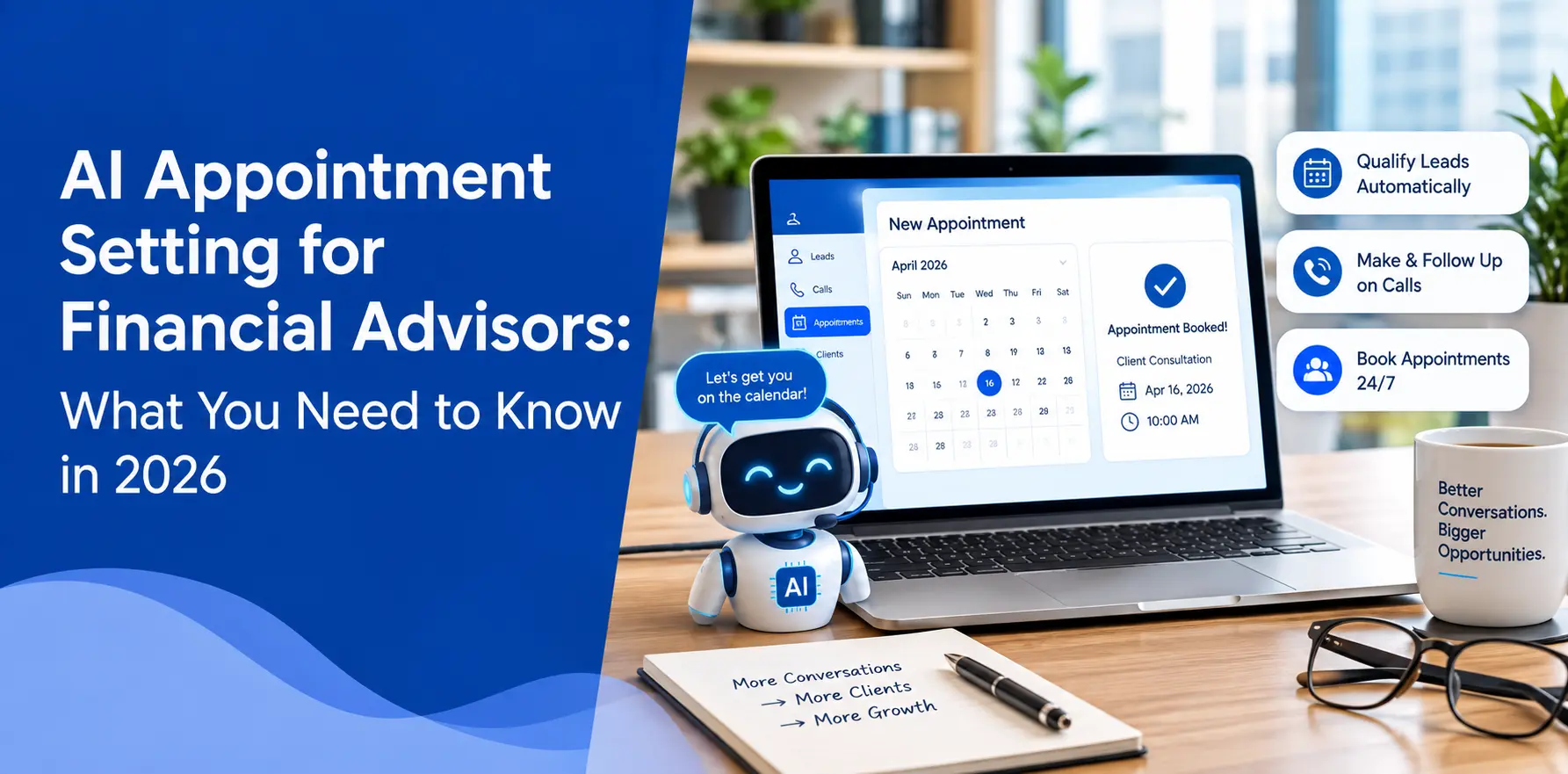
This is where AI appointment setting for financial advisors can become useful. AI-powered systems can respond to inquiries, ask qualifying questions, follow up with prospects, and help schedule appointments without requiring an advisor or staff member to handle every initial interaction manually.
However, AI is not a replacement for financial expertise or human relationships. For most advisory firms, the better approach is to use AI for repetitive, time-sensitive tasks while allowing people to handle complex questions and important client conversations.
What Is AI Appointment Setting for Financial Advisors?
AI appointment setting is the use of artificial intelligence to help move prospects from an initial interaction toward a scheduled appointment with a financial advisor.
Depending on the system, AI can respond to a website inquiry, engage with a prospect, ask basic qualification questions, answer predefined questions, follow up with someone who has not responded, and offer available appointment times.
A typical process might look like this:
Lead enters → AI responds → Prospect is qualified → AI follows up → Appointment is scheduled → Human advisor takes over
The purpose is not simply to put more appointments on a calendar. The goal is to make the journey from lead to qualified appointment more consistent and efficient.
Why Are Financial Advisors Using AI for Appointment Setting?
Generating a lead is only the first step. Without timely follow-up, prospects can lose interest and opportunities may go cold.
AI appointment setting helps financial advisors:
- Respond faster to new inquiries.
- Maintain consistent follow-up with prospects.
- Reduce administrative work such as scheduling and reminders.
- Turn more leads into appointments through automated qualification and follow-up.
Ultimately, financial advisor lead generation is not just about acquiring leads it’s about effectively moving those prospects toward a conversation.
How Does AI Appointment Setting Work?
AI appointment setting typically moves a prospect through six simple stages:
Step 1: Capture the Lead
Leads can come from website forms, landing pages, ads, social media, webinars, referrals, or email campaigns. Their information can then enter the firm’s CRM.
Step 2: Start the Conversation
AI responds using approved messaging and asks relevant questions based on the prospect’s inquiry.
Step 3: Qualify the Prospect
AI can ask basic questions about the prospect’s needs, goals, and preferred consultation method to determine whether they fit the firm’s criteria.
Step 4: Identify Appointment Readiness
The system can distinguish between prospects who are still researching and those ready to speak with an advisor.
Step 5: Schedule the Appointment
Qualified prospects can select an available time. AI can also send confirmations, reminders, and rescheduling options.
Step 6: Hand Off to a Human
Once the appointment is booked, the advisor takes over for complex questions, professional guidance, and relationship building.
What Are the Benefits of AI Appointment Setting for Financial Advisors?
AI appointment setting can help financial advisors streamline lead follow-up and scheduling while spending more time with qualified prospects.
- Faster Lead Response: AI can respond to new inquiries quickly.
- Consistent Follow-Up: Automated workflows help maintain timely communication.
- More Advisor Time: Advisors spend less time on repetitive scheduling tasks.
- Easier Scheduling: Prospects can book available appointments without lengthy back-and-forth.
- Better Lead Qualification: AI can ask predefined questions before scheduling.
- Improved Funnel Visibility: CRM integration can help track leads and appointments.
However, AI works best when supported by strong targeting, messaging, and a clear marketing strategy.
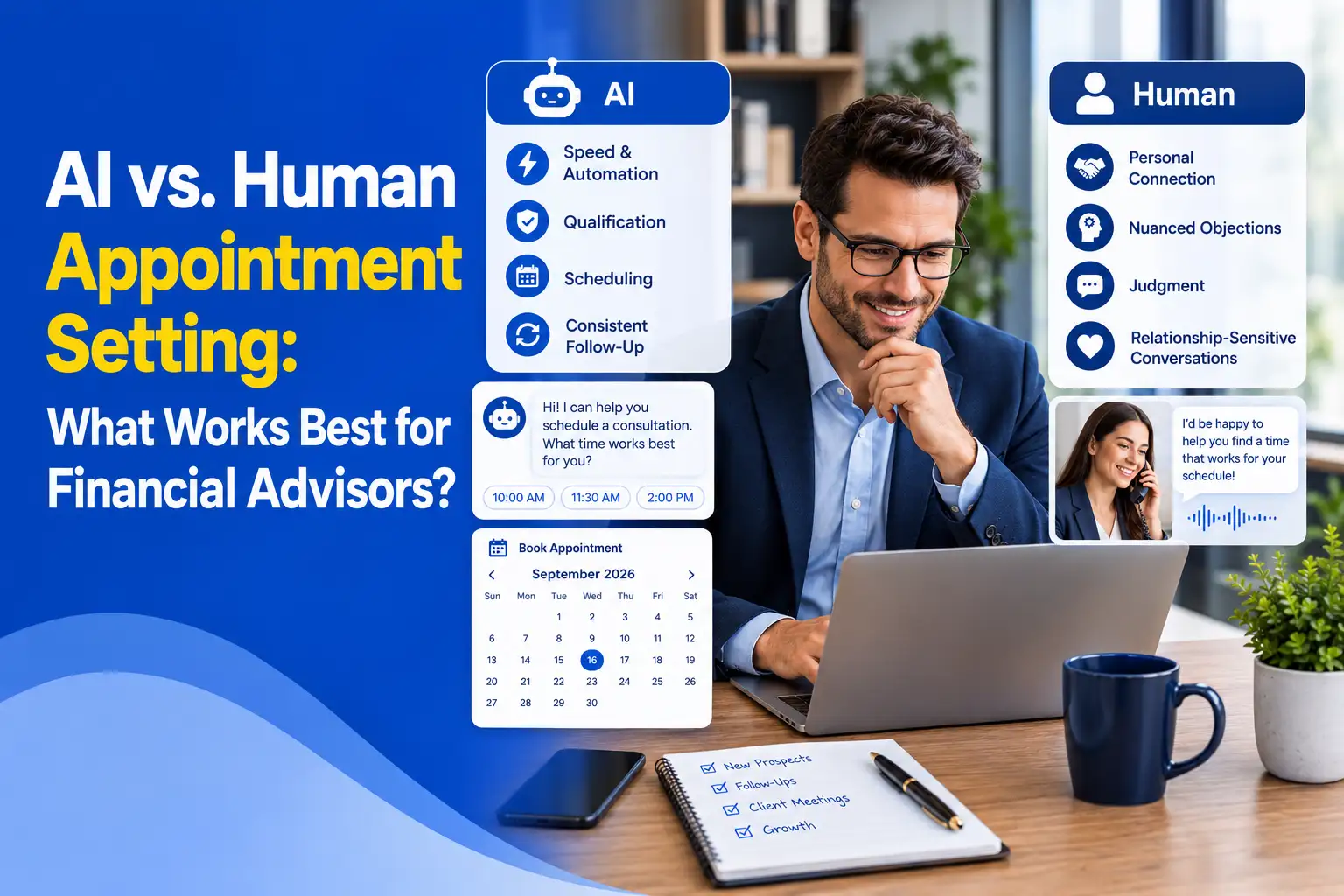
AI Appointment Setting vs. Human Appointment Setting
The question is not always whether a financial advisor should choose AI or people.
In many cases, the better question is how the two can work together.
Factor | AI Appointment Setting | Human Appointment Setting |
Response speed | Can respond quickly | Depends on staff availability |
Availability | Can operate outside business hours | Usually limited by working hours |
Repetitive follow-up | Highly scalable | Requires staff time |
Basic qualification | Consistent workflow | Human judgment |
Complex conversations | Should escalate | Can handle directly |
Scheduling | Can be automated | Manual or assisted |
Relationship building | Limited | Stronger personal interaction |
Scalability | High | Requires additional resources |
Best use | Initial engagement and scheduling | Complex conversations and relationship building |
For many firms, a hybrid model can provide the best balance.
How Can AI and Human Appointment Setting Work Together?
A practical hybrid system divides responsibilities between technology and people.
AI Can Handle:
- Initial lead responses
- Basic questions
- Qualification questions
- Follow-up
- Appointment scheduling
- Appointment reminders
- Rescheduling
- CRM updates
Humans Can Handle:
- Complex financial questions
- Sensitive conversations
- Detailed objections
- High-value prospects
- Relationship building
- Financial advice
- The actual consultation
How Does AI Appointment Setting Fit Into a Financial Advisor Marketing Strategy?
AI appointment setting connects marketing activity with booked consultations.
A typical funnel is:
Traffic → Lead → Qualification → Appointment → Consultation → Client
SEO for financial advisors, paid ads, webinars, and email marketing can attract and nurture prospects. AI then helps respond to those prospects, qualify them, and move them toward a scheduled conversation.
Can AI Appointment Setting Generate Qualified Leads?
AI appointment setting does not replace lead generation. Instead, it helps qualify and convert existing leads into appointments.
The workflow can consider factors such as:
- Services needed
- Target client profile
- Location
- Planning needs
- Retirement stage
- Appointment preferences
Clear qualification criteria help ensure advisors spend more time with relevant prospects.
What Should AI Ask Financial Advisor Prospects?
AI should use simple questions focused on appointment qualification, such as:
- What type of financial guidance do you need?
- What prompted you to seek an advisor?
- Are you currently working with an advisor?
- Would you prefer a phone or video meeting?
- What time works best for you?
AI should not provide unauthorized personalized financial advice, make investment promises, or replace a qualified financial professional.
Compliance and Privacy Considerations for AI Appointment Setting
Financial firms should consider privacy, consent, disclosures, data security, communication preferences, and human oversight when using AI.
AI workflows should clearly define what the system can communicate and when a conversation must be transferred to a human.
For email-specific considerations, see our guide to financial email marketing compliance.
Firms should also review their applicable regulatory requirements and internal compliance policies before deploying automated communication.
How Can Webinars and Content Work With AI Appointment Setting?
AI appointment setting becomes more useful when it is connected to a broader content and demand-generation strategy.
For example, a financial advisor could host an educational webinar about retirement planning.
A prospect registers but does not immediately book a consultation.
The marketing funnel could then:
Webinar registration → Educational content → Follow-up → Qualification → Appointment
AI can assist with the follow-up and scheduling stages.
Webinars can be particularly useful because they allow advisors to demonstrate expertise before asking a prospect to schedule a consultation.
Our guide on financial advisor webinar marketing and turning attendees into qualified appointments covers this process in more detail.
Content marketing can play a similar role by answering the questions prospects have before they are ready to speak with an advisor.
Our content marketing strategy for financial advisors provides a broader look at how content can support attraction and conversion.
What Are the Limitations of AI Appointment Setting?
AI appointment setting can improve efficiency, but it has limitations:
- Context Errors: AI may misunderstand questions, so human oversight is important.
- Poor Lead Quality: AI cannot fix weak targeting or unsuitable leads.
- Human Preference: Some prospects prefer speaking with a person immediately.
- Poor Automation: Generic or excessive messages can hurt the customer experience.
- Limited Expertise: AI supports communication and scheduling but does not replace professional financial judgment.
Common AI Appointment-Setting Mistakes Financial Advisors Should Avoid
Financial firms should avoid:
- Automating every interaction
- Using generic scripts
- Measuring only appointment volume
- Ignoring lead sources
- Failing to monitor AI conversations
- Treating AI as a replacement for marketing
The goal should be better-quality appointments, not simply more appointments.
How to Choose an AI Appointment Setting Solution for Financial Advisors
Look for a solution that offers:
- Financial Services Experience: Understands the industry’s needs and compliance considerations.
- CRM Integration: Connects with your existing systems.
- Calendar Integration: Makes scheduling and rescheduling simple.
- Custom Qualification: Supports your ideal-client criteria.
- Human Escalation: Allows prospects to reach a person when needed.
- Reporting: Tracks qualification, appointments, show rates, and outcomes.
- Data Security: Protects prospect information.
- Workflow Customization: Adapts to your firm’s services and processes.
Questions to Ask Before Hiring an AI Appointment-Setting Provider
Before signing an agreement, financial advisors should ask:
- How do you qualify prospects?
- Can workflows be customized?
- Can prospects speak with a human?
- Which CRM systems do you integrate with?
- How does calendar scheduling work?
- How do you handle sensitive prospect information?
- Can conversations be reviewed?
- How do you measure appointment quality?
- What happens when AI cannot answer a question?
- How do you handle cancellations and rescheduling?
- What reporting is included?
- How is the system monitored after launch?
The answers can reveal whether a provider is offering a genuine appointment-setting solution or simply a chatbot with a calendar link.
How Much Does AI Appointment Setting Cost?
There is no single price for AI appointment setting.
Pricing can vary based on the technology, lead volume, integrations, customization, and whether human appointment setters are included.
Common pricing structures can include:
- Monthly software subscriptions
- Per-user pricing
- Per-conversation pricing
- Per-qualified-lead pricing
- Per-appointment pricing
- Managed-service pricing
- Hybrid pricing
A financial firm should evaluate the cost against meaningful business outcomes rather than looking only at the software fee.
For example, a lower-cost system may not be useful if it generates large numbers of unqualified appointments.
When Should a Financial Advisor Consider AI Appointment Setting?
AI appointment setting may make sense when a firm:
- Receives a consistent flow of leads
- Struggles with rapid follow-up
- Has a high volume of inquiries
- Spends significant time scheduling meetings
- Wants more structured lead qualification
- Already has a defined sales process
- Uses a CRM
- Wants to scale lead follow-up
It may be less useful when a firm has almost no lead flow.
If there are very few prospects entering the funnel, automating appointment setting may not solve the underlying problem.
The firm may first need to improve its positioning, website, advertising, SEO, content, or overall lead-generation strategy.
A Practical AI Appointment-Setting Workflow for Financial Advisors
A simple AI appointment-setting workflow can look like this:
- Lead Captured: A prospect submits a website form.
- AI Responds: The prospect receives an immediate response.
- Lead Qualified: AI asks basic questions to assess fit.
- Appointment Offered: Qualified prospects see available times.
- Appointment Confirmed: Confirmation and reminders are sent.
- Human Handoff: The advisor receives relevant prospect details.
- Consultation: The advisor handles the professional discussion.
- CRM Updated: The outcome is recorded for follow-up.
This creates a smoother path from marketing lead to advisor conversation.
How Should Financial Advisors Measure AI Appointment-Setting Performance?
Appointment volume is only one metric.
Financial firms should consider tracking:
- Lead response time
- Contact rate
- Qualification rate
- Appointment-booking rate
- Qualified appointment rate
- Appointment show rate
- Cost per booked appointment
- Cost per qualified appointment
- Consultation-to-client conversion
- Lead-to-client conversion
A system that books 100 appointments may appear successful.
But if only a small percentage are qualified or attend the meetings, the result may be less valuable than a system that produces fewer but better appointments.
The goal should be qualified conversations, not simply a fuller calendar.
What Can Financial Advisors Expect From AI Appointment Setting in 2026?
AI appointment-setting technology is becoming more focused on conversations rather than simple rule-based automation.
Financial firms may increasingly use AI for:
- Faster lead response
- More personalized follow-up
- Automated lead qualification
- CRM-based workflows
- Appointment scheduling
- Lead scoring
- Conversation analysis
- Human handoffs
At the same time, firms should expect greater attention to privacy, data security, transparency, oversight, and responsible use.
The technology may become more capable, but the fundamentals of financial services marketing remain important: reaching the right audience, building trust, demonstrating expertise, and providing a clear next step.

Final Thoughts: Is AI Appointment Setting Right for Financial Advisors?
AI appointment setting for financial advisors can help firms improve the process between generating a lead and holding a conversation.
It can respond quickly, maintain follow-up, ask qualification questions, coordinate scheduling, and reduce repetitive administrative work. This can help financial advisors generate more booked appointments and spend more time focused on qualified prospects.
But AI should not be treated as a replacement for financial advisors or human relationship building.
For many firms, the strongest approach is a hybrid model: AI handles speed, consistency, qualification, and scheduling while human professionals handle complex questions, advice, trust, and client relationships.
The technology works best when it is connected to a larger marketing strategy that includes strong positioning, quality lead generation, useful content, effective follow-up, and a clear path from prospect to appointment. For agencies and IMOs looking to build a more scalable approach, marketing strategies for agencies and IMOs can help connect these efforts into a more consistent growth system.
Ultimately, the goal isn’t to automate every conversation. It is to make it easier for the right prospects to have the right conversation with the right advisor.
FAQs About AI Appointment Setting for Financial Advisors
1. What Is AI Appointment Setting for Financial Advisors?
AI appointment setting uses artificial intelligence to help financial firms respond to prospects, qualify inquiries, follow up, and schedule appointments. It can automate repetitive parts of the appointment-setting process while allowing financial advisors to focus on qualified prospects and client conversations.
2. How Does AI Appointment Setting Work?
A typical workflow begins when a prospect enters the firm’s marketing funnel through a website, advertisement, webinar, or other channel. AI can respond to the inquiry, ask predefined qualification questions, follow up with the prospect, and offer available appointment times. Once an appointment is booked, the conversation can be handed over to a human advisor.
3. Can AI Replace Human Appointment Setters?
AI can automate many repetitive appointment-setting tasks, but it does not necessarily replace human appointment setters. A hybrid approach can allow AI to handle initial responses, qualification, follow-up, and scheduling while humans manage complex questions, objections, sensitive conversations, and relationship building.
4. Is AI Appointment Setting Compliant for Financial Advisors?
Compliance depends on the firm’s business model, jurisdiction, communication methods, and applicable requirements. Financial firms should establish appropriate processes for consent, privacy, disclosures, data handling, record keeping, and human oversight. AI should also be carefully configured so it does not provide unauthorized personalized financial advice or make misleading claims.
5. How Much Does AI Appointment Setting Cost?
The cost varies depending on the provider, lead volume, integrations, customization, and whether human appointment-setting services are included. Pricing may be based on a monthly subscription, number of users, leads, conversations, qualified appointments, or a managed-service model. Firms should evaluate the cost alongside metrics such as qualified appointments, show rates, and client conversion rather than appointment volume alone.
Disclaimer:
This article is for general informational purposes only and does not constitute financial, investment, legal, or compliance advice. Financial firms should review applicable regulations and internal compliance policies before implementing AI appointment-setting tools.