- Written & Reviewed by Jeremy
- Published
- Last Updated Nov 25, 2026
Getting more leads does not always mean getting more clients. Financial advisors may receive dozens of inquiries through their websites, paid campaigns, referrals, and social media, but not every person who reaches out is ready to schedule a conversation.
Some prospects are actively looking for financial guidance. Others are still researching their options, comparing advisors, or simply exploring what services are available.
The challenge is knowing which inquiries deserve attention first.
This is where AI-powered lead qualification for financial advisors comes into the picture. By analyzing prospect information, organizing inquiries, and supporting follow-up activities, AI can help financial firms manage their lead pipelines more efficiently. As AI continues to influence how potential clients discover financial services online, understanding how AI changes Google Search for financial advisors can also help firms adapt their visibility and client acquisition strategies.
But does it actually improve lead quality, or is it another marketing technology that sounds better than it performs?
Let’s look at how it works, where it helps, and what financial advisors should consider before implementing it.
What Is AI-Powered Lead Qualification for Financial Advisors?
AI-powered lead qualification is the process of using artificial intelligence to analyze prospect information and help determine which inquiries are more likely to match a firm’s target client criteria.
Traditionally, financial advisors or their sales teams review incoming inquiries manually. They check the information provided, understand the prospect’s needs, and decide whether to arrange an introductory conversation.
AI can assist with several parts of this process.
For example, when someone submits a contact form requesting information about retirement planning, an AI-enabled system can organize the submitted details, identify the service they are interested in, and route the inquiry to the appropriate team member. It can also help firms recover lost leads through automated follow-up by maintaining consistent communication with prospects who haven’t responded.
Some systems can also assign lead scores based on predefined criteria, previous interactions, or engagement signals.
However, a high lead score does not automatically mean someone is ready to become a client. It simply helps the firm decide which inquiries may deserve earlier attention.
The objective is not to let AI make every decision. It is to help advisors spend less time organizing inquiries and more time having meaningful conversations with potential clients.
Why Are Financial Advisors Turning to AI for Lead Qualification?
Generating leads matters, but managing and qualifying them effectively matters just as much. Many financial advisors receive inquiries through SEO, paid ads, social media, and referrals, but not every prospect is ready to book an appointment.
AI can help address some common challenges:
1. Too Much Time Spent Screening Leads
AI can categorize incoming inquiries by prospect interests and service needs, reducing manual screening.
2. Delayed Responses to Potential Clients
AI-assisted workflows can send initial acknowledgments, notify team members, and help ensure timely follow-ups.
3. Inconsistent Follow-Up Processes
Automated reminders and communication workflows help financial firms maintain consistent contact with interested prospects.
4. Difficulty Prioritizing Inquiries
AI-powered lead scoring helps identify higher-priority inquiries, allowing advisors to focus on prospects who better match their services.
What Types of Videos Should Financial Advisors Create?
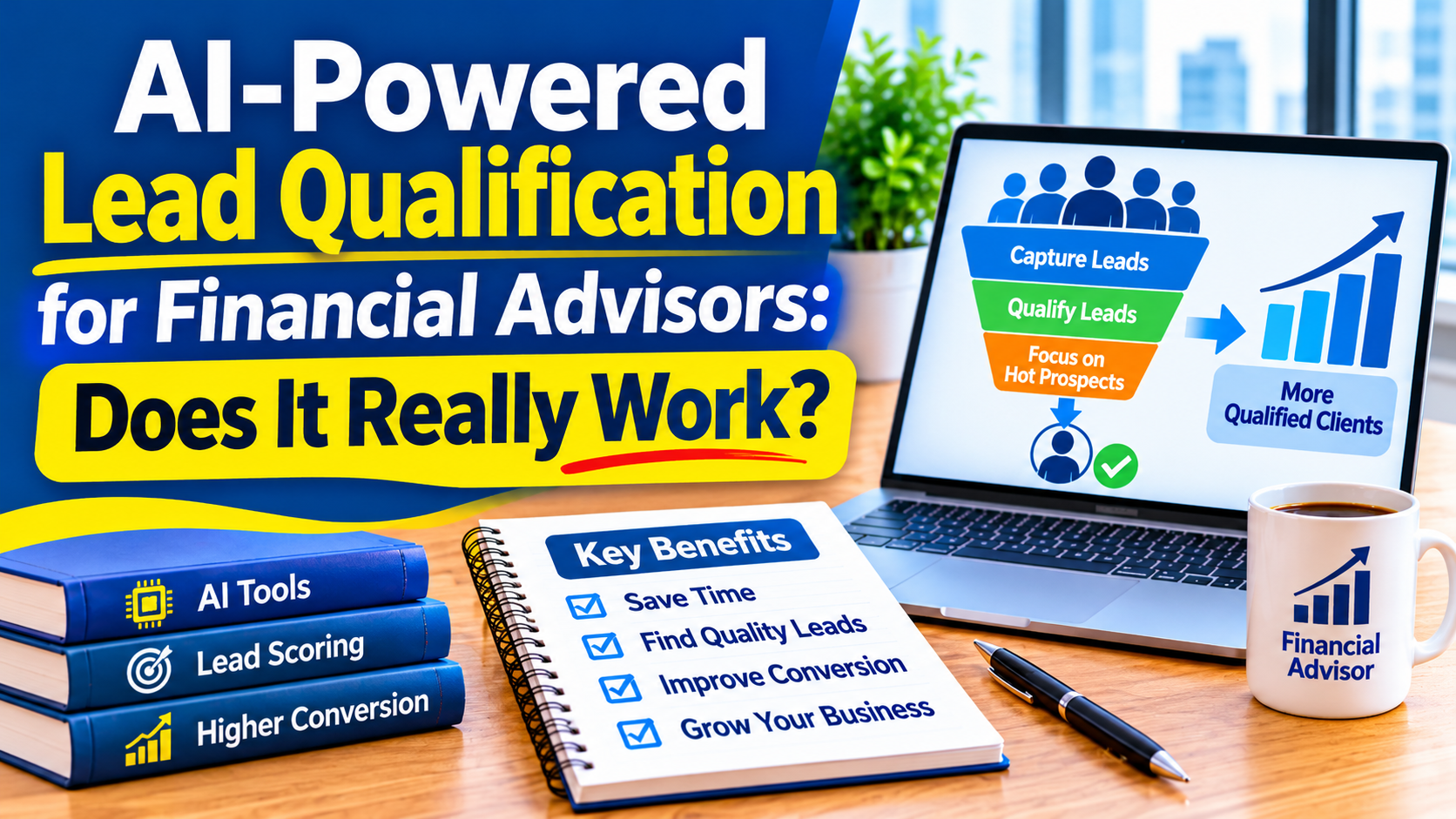
AI-powered lead qualification follows a series of steps to collect prospect information, evaluate inquiries, and organize follow-ups.
Step 1: Capture Leads From Different Channels
AI systems collect inquiries from website forms, Google Ads, social media, webinars, emails, and referral forms.
Step 2: Collect Relevant Prospect Information
The system organizes details such as contact information, service interests, communication preferences, and appointment requests.
Step 3: Analyze and Score the Lead
AI evaluates available information against predefined criteria to help identify higher-priority prospects.
Step 4: Segment Leads Into Different Categories
Leads can be grouped based on their interest and engagement.
Lead Category | Suggested Action |
High priority | Prompt advisor follow-up |
Interested | Relevant follow-up |
Early research | Educational nurturing |
Incomplete inquiry | Request clarification |
Step 5: Trigger Relevant Follow-Ups
Automated workflows can send acknowledgments, reminders, and relevant information based on prospect preferences and consent.
Step 6: Route the Inquiry for Human Review
The system forwards relevant inquiries to the appropriate advisor, who reviews the information and determines the next steps.
The goal: Help financial advisors manage inquiries efficiently while keeping human judgment at the center of the qualification process.
What Factors Should AI Consider When Qualifying Financial Advisor Leads?
AI qualification works best when it evaluates inquiries using clear business criteria. Financial advisors should consider the following factors:
1. Prospect’s Financial Planning Needs
Understand whether the prospect’s requirements match the firm’s services, such as retirement planning or investment management.
2. Interest in Specific Financial Services
Identify which services the prospect is interested in to ensure relevant follow-ups.
3. Readiness to Schedule an Appointment
Prioritize inquiries from prospects who have requested consultations or expressed interest in speaking with an advisor.
4. Engagement With Marketing Content
Consider website visits, webinar registrations, and email interactions to better understand prospect interests.
5. Communication Preferences
Record whether prospects prefer email or phone calls to support more relevant communication.
What Are the Benefits of AI-Powered Lead Qualification?
AI can help financial advisors manage inquiries more efficiently and maintain a consistent follow-up process.
1. Faster Lead Screening
Automatically organizes and categorizes incoming inquiries, reducing manual work.
2. More Consistent Follow-Ups
Automated reminders and acknowledgments help prevent missed communication opportunities.
3. Better Lead Organization
Groups prospects based on their interests, engagement, and appointment requests.
4. Improved Appointment Preparation
Provides advisors with relevant prospect information before introductory conversations.
5. More Efficient Marketing Workflows
Connects lead capture, CRM management, email follow-ups, and appointment scheduling in one organized process.
AI Lead Qualification vs. Traditional Lead Qualification: What’s the Difference?
Traditional lead qualification relies heavily on manual review and individual team members’ judgment. AI-powered qualification uses technology to assist with data organization, scoring, and workflow management. These processes can become more effective when integrated into an AI-powered client acquisition funnel for financial advisors, helping firms organize prospect interactions and manage leads throughout the acquisition journey.
Neither approach is automatically better in every situation.
The right choice depends on the firm’s lead volume, available resources, and existing processes.
Comparison factor | Traditional qualification | AI-powered qualification |
Lead screening | Primarily manual | Automated assistance |
Lead scoring | Manually assessed | Rules-based or AI-assisted |
Response management | Staff-managed | Can trigger automated responses |
Lead segmentation | Manual categorization | Automated categorization |
Follow-up reminders | Manually scheduled or CRM-based | Can be automated |
Personal judgment | Human-led | Requires human oversight |
Managing higher volumes | Requires additional staff capacity | Can support larger workflows |
The important distinction is that AI supports the process rather than replacing professional judgment.
A smaller advisory firm with a manageable number of inquiries may be perfectly comfortable using a traditional CRM process. A firm receiving inquiries from several campaigns may benefit more from automation.
How Does AI-Powered Lead Qualification Improve Appointment Booking?
AI helps financial advisors organize inquiries and move potential clients toward meaningful conversations. For firms working with insurance agencies and Independent Marketing Organizations (IMOs), partnering with specialized financial services marketing agencies can further support lead management, marketing coordination, and client acquisition efforts.
1. Identifying Prospects Who Are Ready to Talk
AI can prioritize prospects who request consultations or show clear interest in the firm’s services.
2. Reducing Delays Between Inquiry and Follow-Up
Automated notifications and acknowledgment messages help teams respond to inquiries more consistently.
3. Preparing Advisors Before Appointments
AI-assisted CRM summaries help advisors understand a prospect’s interests before the conversation.
4. Supporting Better Lead Routing
AI can direct inquiries to the appropriate advisor based on the prospect’s stated needs.
What Tools Can Financial Advisors Use for AI-Powered Lead Qualification?
Financial advisors can use different tools to organize leads and automate qualification tasks.
- AI-Powered CRM Systems: Manage contact records, track interactions, and organize leads.
- Marketing Automation Platforms: Automate email sequences, reminders, and follow-ups.
- AI Chatbots: Answer basic questions and collect prospect information.
- Lead Scoring Tools: Evaluate inquiries based on predefined qualification criteria.
- Appointment Scheduling Tools: Help prospects book meetings and coordinate availability.
Choose tools that integrate with existing systems and meet the firm’s security and compliance requirements.
What Are the Limitations of AI-Powered Lead Qualification?
Although AI improves lead management, it has limitations that financial advisors should understand.
1. AI Can Misinterpret Incomplete Information
Limited or unclear prospect information can lead to inaccurate categorization.
2. Lead Scores Do Not Guarantee Buying Intent
A high score does not necessarily mean someone is ready to become a client.
3. Poor Data Can Produce Poor Results
Outdated or duplicate CRM records can affect qualification accuracy.
4. Automation Cannot Replace Human Conversations
Financial discussions require professional judgment and an understanding of individual needs.
5. AI Requires Ongoing Monitoring
Financial firms should regularly review scoring criteria, automated messages, and qualification results to maintain accuracy.
Is AI-Powered Lead Qualification Safe and Compliant for Financial Advisors?
Compliance should be considered before introducing AI into a financial firm’s marketing and lead management process.
AI tools may collect, organize, analyze, or communicate information about prospects. That makes data handling and communication oversight important.
Financial firms should pay attention to several areas.
- Data privacy: Collect only necessary prospect information and explain how it will be used.
- Consent: Follow applicable requirements for email, text messages, and other marketing communications.
- Information security: Review how technology providers store, process, and protect prospect data.
- Communication review: Check AI-generated messages for accuracy, appropriate language, and misleading statements.
- Recordkeeping: Maintain required records of communications and marketing activities.
- Human oversight: Ensure that automated workflows do not make inappropriate financial or suitability-related decisions.
For firms subject to SEC or FINRA requirements, applicable rules and supervisory obligations should be considered when implementing AI-enabled marketing and communication systems.
Using AI does not automatically make a marketing process compliant.
Financial advisors should also understand the relevant requirements for financial email marketing compliance before automating email communication.
How Can Financial Advisors Implement AI-Powered Lead Qualification?
Financial advisors can introduce AI gradually without replacing their existing marketing systems.
Step 1: Define Qualified Leads
Identify the prospect characteristics and service requirements that match your firm’s offerings.
Step 2: Review Your Existing Lead Generation Process
Evaluate your website forms, advertising campaigns, CRM, and follow-up activities.
Step 3: Select Suitable AI and CRM Tools
Choose tools that integrate with your existing systems and meet your business needs.
Step 4: Create Qualification Criteria
Set clear questions and scoring rules to categorize inquiries based on their interests.
Step 5: Automate Follow-Ups
Set up acknowledgment messages, reminders, and internal notifications.
Step 6: Test the System
Check whether leads are categorized correctly and routed to the right team members.
Step 7: Monitor Performance
Review results regularly and adjust your qualification process when needed.
What Metrics Should Financial Advisors Track to Measure AI Lead Qualification?
Financial advisors should monitor these key metrics to understand whether AI is improving lead management:
- Lead-to-Qualified-Lead Conversion Rate: Percentage of inquiries that meet qualification criteria.
- Qualified Lead-to-Appointment Rate: Percentage of qualified leads that book appointments.
- Cost Per Qualified Lead: Marketing cost for acquiring a qualified lead.
- Cost Per Booked Appointment: Marketing cost associated with securing an appointment.
- Lead Response Time: Time taken to respond to incoming inquiries.
- Appointment Attendance Rate: Percentage of booked appointments that take place.
- Lead-to-Client Conversion Rate: Percentage of leads that become clients.
Tracking these metrics helps firms identify opportunities to improve their lead generation and appointment-booking processes.
When Should a Financial Advisor Consider AI-Powered Lead Qualification?
AI-powered qualification may be worth considering when a firm experiences recurring challenges with its lead management process.
For example:
- Your firm receives inquiries from several marketing channels.
- Your team spends too much time reviewing leads manually.
- Follow-ups are frequently delayed or missed.
- You struggle to organize prospects based on their service interests.
- Your CRM contains leads but lacks a consistent qualification process.
- Your advisors need better information before introductory appointments.
However, AI may not be necessary for every firm.
If you receive a small number of inquiries and can manage them effectively through a basic CRM and manual follow-up process, a complex AI system may add unnecessary costs.
Start with the problem you want to solve, then determine whether AI is the right solution.

Final Thoughts: Does AI-Powered Lead Qualification Really Work for Financial Advisors?
Yes, AI-powered lead qualification can help financial advisors organize inquiries, prioritize follow-ups, and create a more consistent process for generating booked appointments. However, its effectiveness depends on how well the system is designed, the quality of the information it receives, and the firm’s ability to monitor its results.
AI alone will not turn every inquiry into a qualified prospect or guarantee more booked appointments.
Financial firms still need a clear marketing strategy, relevant content, effective communication, and a well-managed follow-up process. Platforms like Revenx Advise can support financial professionals with marketing-focused solutions designed to strengthen their online presence and client acquisition efforts.
At Revenx, we understand that successful financial advisor marketing involves more than generating inquiries. It also requires building a structured process that helps firms manage prospects and move appropriate opportunities toward meaningful conversations.
Whether your firm needs better lead generation, marketing automation, or a more organized appointment-setting process, the right strategy starts with understanding where your current system needs improvement.
Want to improve how your firm attracts and manages potential clients? Connect with Revenx to explore a more structured financial advisor marketing strategy.
FAQs About AI-Powered Lead Qualification for Financial Advisors
1. What is AI-powered lead qualification for financial advisors?
AI-powered lead qualification uses artificial intelligence to analyze prospect information, organize inquiries, and help identify leads that match a financial firm’s target criteria. It can support lead scoring, segmentation, and follow-up workflows, helping advisors prioritize inquiries and manage their marketing pipeline more efficiently.
2. How does AI qualify financial advisor leads?
AI can analyze information submitted through website forms, campaign landing pages, and other inquiry channels. Based on predefined criteria and available data, it can categorize prospects, assign lead scores, and recommend follow-up actions. Financial advisors should review the results before making important decisions about individual prospects.
3. Can AI help financial advisors generate better-quality leads?
AI does not automatically generate better leads, but it can help financial advisors identify which incoming inquiries are more relevant to their services. When combined with targeted marketing campaigns, clear qualification questions, and consistent follow-ups, it can improve how firms manage and prioritize potential clients.
4. Does AI lead scoring improve appointment booking rates?
AI lead scoring can help firms prioritize prospects who demonstrate relevant interest, such as requesting a consultation or responding to a service-related inquiry. However, higher scores do not guarantee appointments. Results also depend on lead quality, response time, communication, and the firm’s appointment-setting process.
5. What information does AI need to qualify a financial advisor lead?
Depending on the firm’s qualification process, AI may use contact details, stated service interests, preferred communication methods, appointment requests, and relevant engagement information. Firms should collect only necessary information, obtain appropriate consent, and protect prospect data.
Disclaimer:
This article is for informational and educational purposes only and does not constitute financial, investment, legal, or compliance advice. The information about AI-powered lead qualification is provided to help financial advisors understand marketing automation and lead management strategies. AI tools and their results may vary depending on data quality, technology, and implementation. Financial advisors should independently evaluate AI solutions and ensure their use complies with applicable data privacy, security, and regulatory requirements. Revenx does not guarantee specific lead generation, conversion, or appointment-booking results.