- Written & Reviewed by Jeremy
- Published
- Last Updated Nov 23, 2026
Generating leads is an important part of growing a financial advisory business, but getting someone to submit an inquiry does not automatically mean they are ready to become a client. Some prospects need more information, others are comparing financial advisors, and many simply need time before making a financial decision.
This is where follow-up matters.
Financial advisors who communicate consistently can build familiarity, answer questions, and help prospects understand the value of a potential working relationship. A structured insurance lead follow-up strategy can also help businesses maintain consistent communication and create more opportunities to book calls. However, following up too frequently or sending messages that feel overly promotional can have the opposite effect. Prospects may lose interest or avoid responding altogether.
The goal is not to convince someone to book a consultation immediately. It is to make every interaction useful enough that they feel comfortable taking the next step.
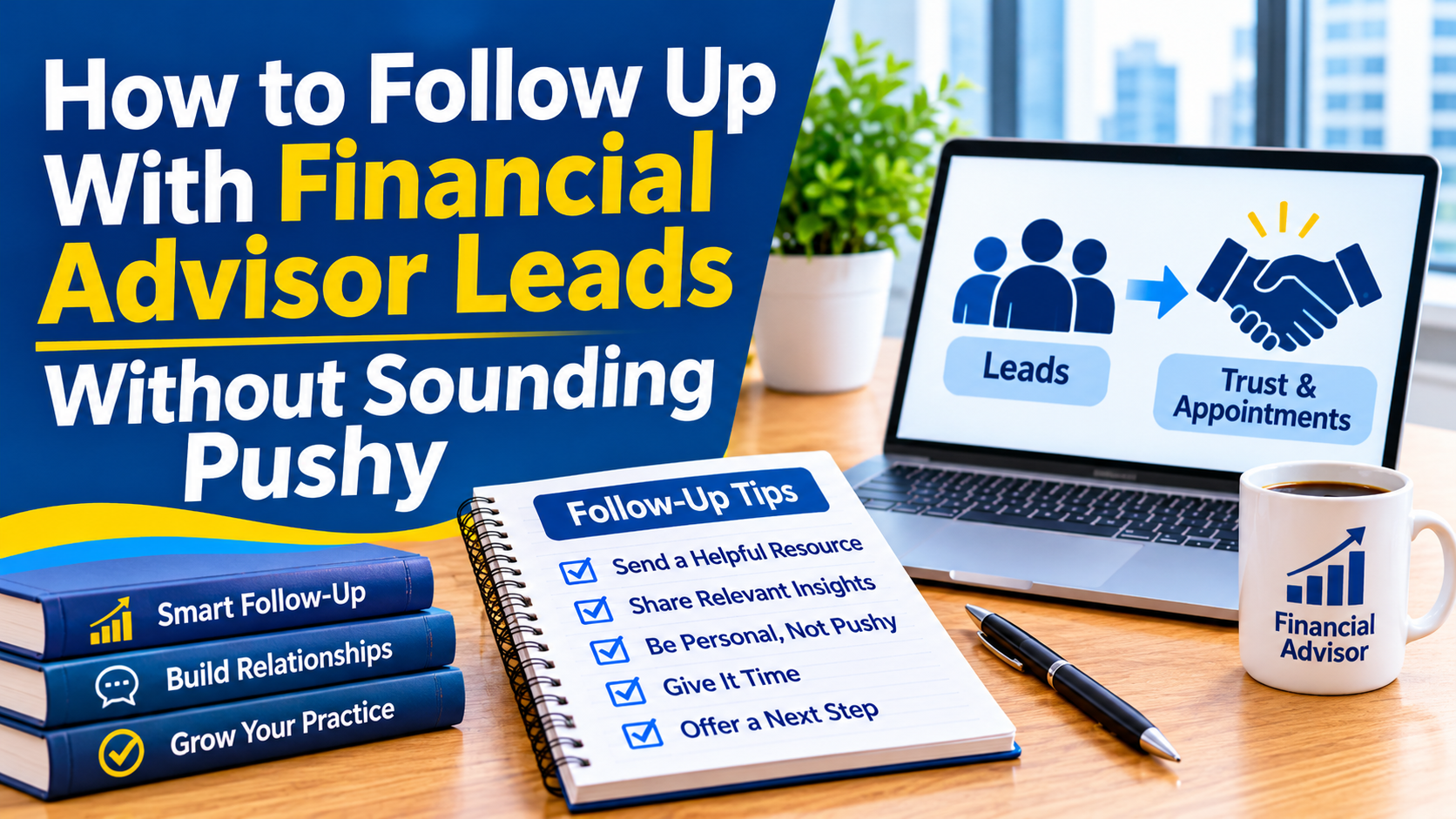
In this guide, we’ll explain how to follow up with financial advisor leads without sounding pushy, including practical communication strategies, email templates, follow-up timelines, and ways to turn interested prospects into qualified appointments.
Why Following Up With Financial Advisor Leads Is Important
Generating a new inquiry is only the beginning of the client acquisition process. A prospect might visit your website, download a financial planning guide, attend a webinar, or request a consultation. However, they may not be ready to schedule a meeting immediately. Tracking the cost per booked appointment can help financial advisory firms understand how efficiently their marketing efforts turn inquiries into scheduled consultations.
Financial decisions often involve personal information, long-term goals, and significant financial considerations. Prospects may want to understand your services, compare different advisors, or discuss their options with family members before moving forward.
Consistent follow-up helps financial advisors stay connected during this decision-making process.
A financial services content marketing strategy may include:
Here are a few reasons why it matters:
- Builds familiarity and trust: Regular, helpful communication makes your firm more recognizable when prospects are ready to explore their options.
- Keeps conversations active: A thoughtful follow-up gives prospects an opportunity to ask questions or continue a conversation they may have postponed.
- Improves lead conversion opportunities: Some prospects need several interactions before they feel comfortable scheduling an appointment.
- Identifies genuine interest: Responses, questions, and engagement can help advisors understand which prospects are more likely to move forward.
- Creates a better prospect experience: Timely responses show that your firm takes inquiries seriously and values potential clients’ time.
Without a consistent process, interested prospects can easily get overlooked. Understanding what makes a financial advisor lead qualified helps firms prioritize promising inquiries and tailor their communication. A well-planned follow-up strategy helps ensure that opportunities do not disappear simply because someone was not ready to respond immediately.
Why Financial Advisor Leads Sometimes Stop Responding
Not every unanswered message means a prospect has lost interest. Several factors may explain why financial advisor leads stop responding.
1. They Are Not Ready to Make a Financial Decision
Prospects may still be researching their options or evaluating their financial needs. Give them time and share helpful resources instead of pushing for an immediate appointment.
2. Your Follow-Up Feels Too Sales-Focused
Repeatedly asking prospects to book a consultation can feel overwhelming. Focus on answering their questions and providing useful information.
3. They Are Comparing Multiple Financial Advisors
Prospects may be evaluating different advisors based on services, experience, and communication. Clearly explain what your firm offers and how it addresses their needs.
4. They Do Not Understand Your Services
Unclear service descriptions or consultation processes can create hesitation. Explain what your firm offers and what prospects can expect from an initial conversation.
5. Your Follow-Up Timing Is Inconsistent
Waiting too long can cause prospects to lose interest, while contacting them too frequently can feel pushy. Maintain a consistent follow-up schedule that respects their preferences.
How to Follow Up With Financial Advisor Leads Without Sounding Pushy
Effective follow-up focuses on building trust and understanding prospects’ needs rather than pushing them to book an appointment. A high-converting financial advisor landing page can support this process by providing prospects with relevant information, clear next steps, and an easy way to connect with your firm. Here are six simple ways to make communication more natural.
1. Start With a Personalized Message
Avoid generic messages. Reference the prospect’s original inquiry to make your communication relevant.
For example:
“Hi Sarah, thanks for reaching out about retirement planning. I wanted to check whether you have any questions about the information you requested.”
2. Reference Their Original Inquiry
Mention the service, resource, or webinar that initially attracted their interest. This makes your follow-up feel personal rather than automated.
3. Focus on Providing Value Instead of Selling
Share useful resources such as educational articles, retirement planning checklists, FAQs, or webinar invitations. Give prospects helpful information before asking them to schedule a consultation.
4. Ask Simple, Relevant Questions
Keep conversations easy to respond to. Ask whether they need additional information, have questions about your services, or would like to discuss their options.
5. Give Prospects Enough Time to Respond
Avoid sending repeated messages within a short period. Allow reasonable intervals between follow-ups and respect their preferred communication schedule.
6. Make Scheduling an Appointment Easy
When prospects show interest, provide a direct scheduling link and explain what they can expect during the initial conversation.
For example
“If you’d like to explore our services, you can schedule an introductory conversation at a convenient time. There’s no obligation to move forward.”
What Is the Best Follow-Up Timeline for Financial Advisor Leads?
There is no single follow-up schedule that works for every financial advisory firm. The right approach depends on how the lead was generated, the prospect’s level of interest, and their preferred communication method.
However, the following timeline provides a useful starting point.
Follow-Up Timing | Recommended Action | Purpose |
Within 5–15 minutes | Send an initial acknowledgment | Confirm receipt of the inquiry |
Day 1 | Send a personalized email or make an appropriate call | Understand the prospect’s needs |
Day 3 | Share a relevant educational resource | Provide additional value |
Day 5–7 | Send a short follow-up message | Continue the conversation |
Day 10–14 | Offer an introductory consultation | Encourage the next step |
Day 21–30 | Send a helpful check-in | Maintain the relationship |
After 30 days | Continue occasional relevant communication | Stay connected over time |
This is a suggested framework rather than a mandatory sequence. Advisors should adjust the frequency based on prospect engagement, consent, communication preferences, and applicable requirements.
For example, someone who requests an immediate consultation may need a faster response than someone who downloads an educational guide for future reference. An AI-powered client acquisition funnel for financial advisors can help firms organize prospects based on their interests, engagement, and readiness to schedule a consultation.
The important thing is to maintain a consistent process without making prospects feel that they are being chased.
How to Follow Up With Financial Advisor Leads Through Different Channels
Financial advisors can use different communication channels to stay connected with prospects. The right approach depends on their preferences, original inquiry, and communication consent.
1. Follow-Up Emails
Email helps advisors share information and maintain communication. Keep messages short, personalized, and focused on one clear next step.
2. Follow-Up Phone Calls
Phone calls allow more personal conversations. Introduce yourself, reference the prospect’s inquiry, and ask whether it’s a convenient time to talk.
Example: “Hi John, this is Alex from ABC Financial. You recently requested information about our retirement planning services. I wanted to see if you had any questions.”
3. Text Message Follow-Ups
Text messages are useful for appointment confirmations and brief updates. Follow applicable consent requirements, respect opt-out requests, and avoid sharing sensitive financial information.
4. LinkedIn and Social Media Follow-Ups
Social media helps advisors build professional relationships. Share educational content, respond to relevant comments, and engage naturally instead of repeatedly sending promotional messages.
Financial Advisor Follow-Up Email Templates That Do Not Sound Pushy
Use these short templates to follow up professionally without pressuring prospects.
1. Initial Follow-Up
Subject: Following Up on Your Inquiry
Hi [First Name], just checking whether you have any questions about [specific service]. Happy to help!
2. After No Response
Subject: Just Checking In
Hi [First Name], just checking whether you have any questions about [specific service]. Happy to help!
3. After a Discovery Call
Following Up on Our Conversation
Hi [First Name], it was great speaking with you. Please reach out if you have any questions.
4. When a Prospect Is Not Ready
Subject: Staying Connected
Hi [First Name], I understand you need more time. Feel free to reconnect whenever you’re ready.
5. Final Follow-Up
Subject: Closing the Loop
Hi [First Name], I’ll step back for now. You’re welcome to reconnect whenever the time is right.
Note: Personalize messages and honor all applicable opt-out requests.
How to Personalize Follow-Ups Based on a Prospect’s Interest
Not every financial advisor lead has the same needs or level of interest. Personalizing follow-ups based on their interactions helps make communication more relevant. Automated follow-up strategies for recovering lost leads can help financial advisory firms reconnect with prospects who have stopped responding or abandoned the inquiry process.
1. Prospects Who Requested a Consultation
Acknowledge their request, explain what happens during the first meeting, and provide an easy scheduling option.
2. Prospects Who Downloaded a Financial Guide
Share related educational articles or resources that help them understand the topic without immediately pushing for an appointment.
3. Prospects Who Attended a Webinar
Reference the webinar, share additional resources, and invite questions. See our guide on financial advisor webinar marketing.
4. Prospects Who Asked About Specific Financial Services
Tailor your message to their interests, whether retirement planning, investment management, or insurance. This makes follow-ups more useful and relevant.
4. Prospects Who Asked About Specific Financial Services
How CRM and Marketing Automation Can Improve Financial Advisor Lead Follow-Up
Managing multiple inquiries manually can lead to missed messages and inconsistent follow-ups. A CRM and marketing automation system can help financial advisors organize communication and save time. Choosing the right platform is equally important, which is why advisors may want to compare HubSpot vs. GoHighLevel for financial advisors to understand which solution better supports their lead management and marketing automation needs.
Track Every Lead and Previous Interaction
Store prospect details, inquiry sources, and communication history in one place to avoid repetitive conversations.
Set Follow-Up Reminders
Use automated reminders to ensure your team contacts prospects at appropriate times.
Create Personalized Email Sequences
Share relevant educational content based on prospect interests while keeping communication personal.
Identify Engaged and Unresponsive Prospects
Maintain Consistent Communication Across Channels
Track replies, consultation requests, and webinar participation to understand prospect engagement.
Coordinate emails, calls, and appointment updates to provide a smoother prospect experience.
Common Follow-Up Mistakes Financial Advisors Should Avoid
Avoiding common mistakes can make your follow-up strategy more effective.
1. Sending Too Many Messages
Frequent emails and calls can overwhelm prospects. Maintain reasonable intervals and respect opt-out requests.
2. Using Generic Messages
Personalize templates based on each prospect’s inquiry and interests.
3. Asking for Appointments Too Early
Provide helpful information before encouraging prospects to schedule a consultation.
4. Ignoring Previous Conversations
Review communication history to avoid repeating questions or sharing the same information.
5. Giving Up After One Unanswered Message
Use a reasonable follow-up schedule, but avoid contacting prospects indefinitely.
6. Making Unverified Financial Promises
Keep marketing communication accurate, transparent, and consistent with applicable financial advertising requirements.
How to Turn Financial Advisor Leads Into Qualified Appointments
The goal of follow-up is to identify interested prospects and guide them toward a meaningful conversation.
Understand the Prospect’s Needs
Learn about their financial concerns and determine whether your services are relevant.
Explain the First Meeting
Tell prospects what to expect during an introductory consultation to reduce uncertainty.
Focus on Lead Quality, Not Just Volume
Prioritize relevant prospects who match your firm’s target audience rather than focusing only on inquiry numbers.
Offer Convenient Scheduling
Provide a direct booking link and flexible appointment options.
Connect Marketing With Follow-Up
Combine lead generation, personalized communication, and appointment setting to create a consistent process. Explore our guide to financial advisor marketing strategies that actually bring clients for more insights.
How to Measure the Success of Your Financial Advisor Follow-Up Strategy
A consistent follow-up process should also be measurable.
Tracking the right metrics helps financial advisors identify where prospects are engaging and where opportunities are being lost.
Consider monitoring these indicators:
- Lead response time: How quickly does your team acknowledge new inquiries?
- Email response rate: How many prospects reply to your follow-up emails?
- Call connection rate: How often do attempted calls result in actual conversations?
- Lead-to-appointment conversion rate: What percentage of leads schedule a consultation?
- Appointment attendance rate: How many scheduled prospects actually attend?
- Lead-to-client conversion rate: How many qualified prospects eventually become clients?
For example, if your firm generates a high volume of inquiries but receives very few consultation bookings, the problem may involve lead quality, communication, or the scheduling process. Using a platform like Revenx Advise can help financial advisory firms streamline lead management and improve the process of turning inquiries into booked appointments.
If prospects book appointments but frequently fail to attend, appointment reminders and clearer meeting expectations may help.
Review these metrics regularly instead of relying only on the total number of messages sent.
When Should Financial Advisors Consider Professional Lead Follow-Up Support?
Managing lead generation, prospect communication, and appointment scheduling can take considerable time.
As an advisory firm grows, handling every activity internally may become difficult.
Professional marketing and appointment-setting support may be worth considering when:
- Your firm generates inquiries but struggles to convert them into appointments.
- New leads are not receiving timely responses.
- Advisors spend too much time managing repetitive follow-up tasks.
- Your marketing campaigns and sales processes are disconnected.
- Your team needs a more organized lead nurturing strategy.
- You want to improve appointment quality rather than simply increase inquiry volume.
A specialized financial services marketing agency can help connect lead generation, content marketing, email communication, and appointment-setting processes.
The important thing is to choose a partner that understands the financial services industry and can work within your firm’s compliance requirements.

Final Thoughts: Build Trust Before Asking for the Appointment
Following up with financial advisor leads does not have to feel like a sales process.
Managing multiple inquiries manually can lead to missed messages and inconsistent follow-ups. A CRM and marketing automation system can help financial advisors organize communication and save time. Agencies and IMOs can also benefit from structured lead management and automated communication processes to manage prospect inquiries more efficiently.
A structured follow-up timeline, personalized email communication, CRM organization, and clear appointment-setting process can help financial advisors manage inquiries more effectively.
For firms that want to improve the connection between marketing and booked appointments, Revenx helps financial professionals strengthen their marketing and lead generation processes through strategies designed for the financial services industry. These strategies focus on turning qualified prospects into booked appointments for financial advisors and creating a more consistent appointment pipeline.
Ultimately, the objective is not to contact prospects as frequently as possible. It is to create meaningful interactions that help the right prospects feel comfortable taking the next step.
FAQs About Following Up With Financial Advisor Leads
1. How often should financial advisors follow up with leads?
Financial advisors can start with an initial response shortly after receiving an inquiry, followed by a few relevant follow-ups over the next two to four weeks. The frequency should depend on the prospect’s interest, communication preferences, and consent. Avoid excessive messages or continuing contact after an opt-out request.
2. What is the best way to follow up with financial advisor leads?
The best approach is to send a personalized message that references the prospect’s original inquiry, provides useful information, and offers a clear next step. Advisors can use email, phone calls, or other appropriate communication channels depending on the prospect’s preferences and applicable consent requirements.
3. How do you follow up with a financial advisor prospect who does not respond?
Send a short, polite follow-up that references the prospect’s original inquiry and offers additional help. Allow reasonable time between messages rather than repeatedly contacting them. If there is still no response, consider ending direct outreach and maintaining contact only through appropriate, permission-based communication.
4. What should financial advisors say in a follow-up email?
A follow-up email should acknowledge the prospect’s inquiry, reference their specific financial interest, and offer useful information or assistance. Keep the message conversational and concise. Include a simple invitation to ask questions or schedule an introductory conversation without pressuring the recipient.
5. How long should financial advisors wait before following up?
For a new inquiry, responding within a few minutes when practical can help acknowledge the prospect’s interest. Subsequent follow-ups can be spaced over several days, depending on the situation. A prospect who requests a later response should be contacted according to their stated preference.
Disclaimer:
This content is for informational and educational purposes only and should not be considered financial, investment, legal, or tax advice. Marketing strategies and follow-up practices should be adapted to your firm’s services and applicable regulatory requirements. Financial advisors are responsible for ensuring their communications comply with relevant laws, regulations, and consent requirements.