
- Written & Reviewed by Jeremy
- Published
- Last Updated May 08, 2026
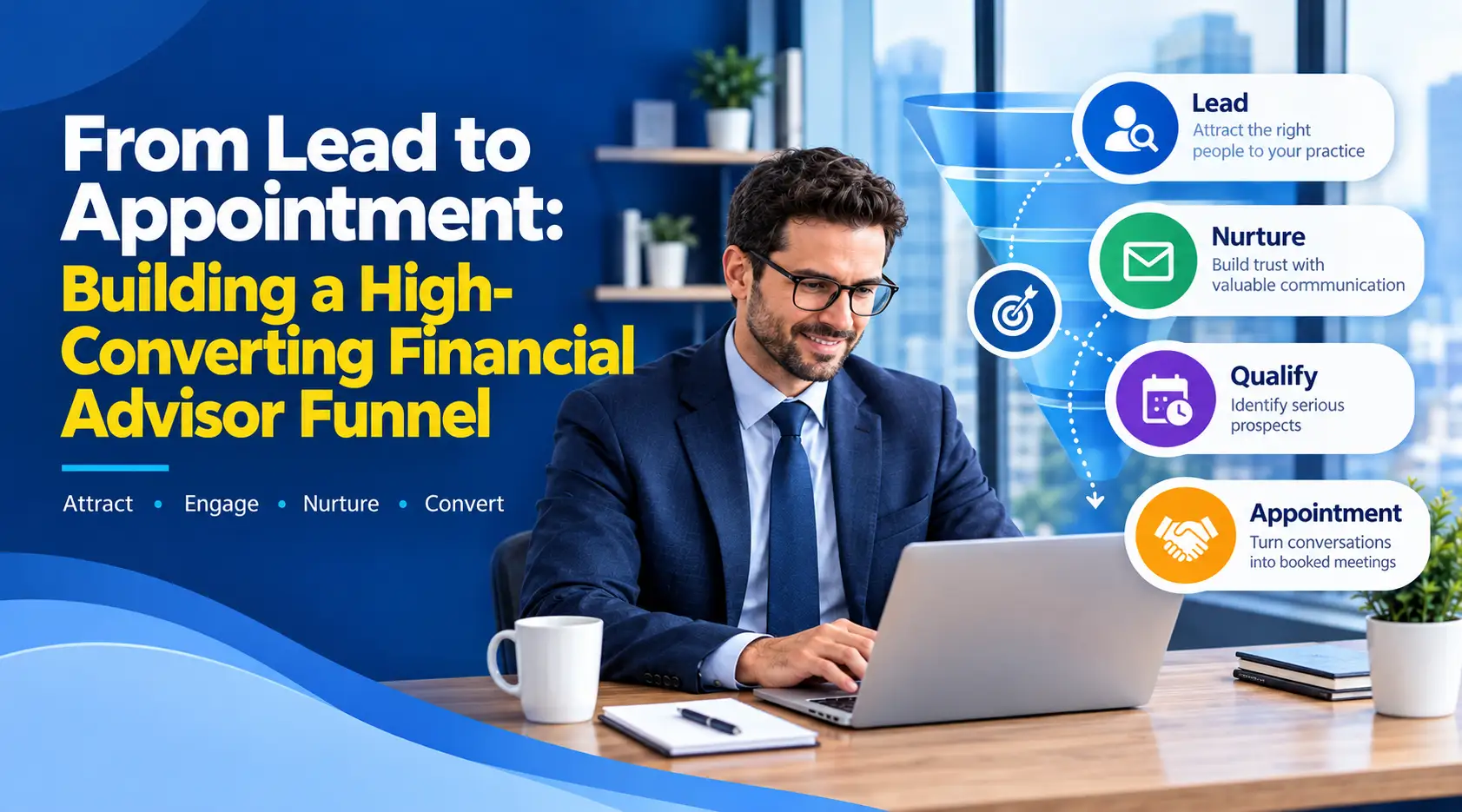
Financial advisor lead generation in 2026 is not about collecting more names. It is about attracting the right prospects, building trust before the first call, following up consistently, and turning qualified leads into booked appointments.
Many financial advisors still struggle because their marketing is disconnected. They may have a website, a CRM, an email tool, a few ads, and a booking link, but no complete system connecting everything together.
That is where a leading advisor marketing platform can help. The platform itself is not the full strategy, but it can support the process by connecting lead capture, automation, CRM follow-up, appointment setting, reporting, and retention.
In 2026, the financial advisors who win are not relying on one tactic. They are using a complete financial advisor marketing system built around visibility, education, automation, and qualified appointments.
What Is Financial Advisor Lead Generation in 2026?
Financial advisor lead generation is the process of attracting potential clients, capturing their interest, nurturing them, and moving qualified prospects toward a consultation.
In 2026, this process will be more complex than before. A prospect may first find an advisor through Google, AI search, LinkedIn, short-form video, a webinar, referral, retargeting ad, or educational blog post.
They may not book a call immediately. They may compare multiple firms, read reviews, ask AI tools for recommendations, watch videos, and return to the website several times before taking action.
That means lead generation is no longer just one campaign. It is a full journey.
A strong financial advisor lead generation system usually includes:
- SEO and AI search visibility
- Short-form video content
- Educational blog content
- Webinar funnels
- Landing pages
- Lead magnets
- Email and SMS follow-up
- CRM-based lead nurturing
- Retargeting campaigns
- Appointment setting
- Client retention campaigns
This is why many firms compare top advisor marketing platforms instead of relying on separate tools that do not communicate with each other.
Why Financial Advisor Lead Generation Has Changed
Financial advisor prospects now research more deeply before contacting a firm.
They are not only searching for a “financial advisor near me.” They are asking specific questions such as:
- How much do I need to retire?
- Should I claim Social Security now or later?
- How do I reduce taxes in retirement?
- What should I do with my 401k before retirement?
- Do I need a financial advisor before I retire?
This creates a longer decision path.
If your firm only has a basic website and contact form, you may miss prospects earlier in the journey. If your follow-up is manual, warm leads may go cold. If your content does not answer real questions, prospects may trust another advisor first.
That is why lead generation in 2026 must combine visibility, education, automation, and appointment conversion.
What Actually Works for Financial Advisor Lead Generation in 2026?
The best lead generation strategies for financial advisors are not random tactics. They work together as one system.
The goal is to get found, educate prospects, capture interest, nurture leads, and convert qualified people into booked appointments.
1. SEO and AI Search Visibility
SEO still matters, but it now needs to support both traditional search and AI-driven discovery.
Prospects are using Google AI Overviews, ChatGPT, Perplexity, Gemini, and other AI tools to research financial planning topics. These tools often surface sources that are clear, specific, trustworthy, and well-structured.
Financial advisors need content that clearly explains:
- Who the firm serves
- What services it provides
- What planning problems it solves
- Where it operates
- Why the firm is credible
- What action a prospect should take next
For example, a generic “Financial Planning Services” page is weaker than a page focused on a specific need, such as:
- Retirement income planning for pre-retirees
- Tax-efficient retirement planning
- Investment management before retirement
- Social Security planning
- Estate planning coordination
A strong SEO and AI search strategy should include service pages, FAQ sections, comparison pages, direct answers, internal links, advisor bios, and schema where appropriate.
SEO is not only about traffic. Done correctly, it builds trust before the prospect ever books a call.
2. Short-Form Video Content
Short-form video is one of the most useful marketing tools for financial advisors in 2026.
Many prospects may not read a full article first, but they may watch a 30 to 60 second video answering one clear question.
Good video topics include:
- One retirement tax mistake to avoid
- Should you claim Social Security at 62?
- Why retirement income planning matters
- What to check before rolling over a 401k
- How to know if your portfolio is too risky before retirement
The goal is not always to go viral. The better goal is to become familiar and trusted by the right audience.
A simple video plan could include:
- 3 educational videos per week
- 1 myth-busting video per week
- 1 short client-scenario style video per week
- Retargeting ads to video viewers
- A CTA to download a guide or book a consultation
Short videos work because prospects can hear the advisor’s tone, understand the advisor’s thinking, and build trust before speaking with the firm.
Keep the videos educational, specific, and compliance-safe. Avoid big promises or fear-based claims.
3. Webinar Funnels
Webinars still work for financial advisors when the topic is specific and the follow-up is strong.
Generic webinars like “How to Plan for Retirement” often attract broad leads. Specific topics usually attract better prospects.
Better webinar topics include:
- How to Turn Retirement Savings Into Monthly Income
- Tax Mistakes to Avoid in the First 5 Years of Retirement
- What to Know Before Rolling Over a 401k
- How to Reduce Retirement Income Risk
- Social Security and Retirement Income Timing
A proper webinar funnel includes:
- Registration page
- Reminder emails and texts
- Live or automated webinar
- Replay follow-up
- Consultation offer
- CRM tracking
- Retargeting ads
- No-show follow-up
- Long-term nurture sequence
For example, if a prospect registers but does not attend, that lead should not be ignored. They may still be interested. The system should send the replay, a related checklist, and a soft invitation to schedule a call.
This is where marketing automation for financial advisors becomes valuable. It keeps the conversation active without requiring the advisor to manually chase every lead.
4. Retargeting Campaigns
Most prospects do not book a call the first time they visit a website.
They may read a blog, visit a retirement planning page, watch a video, and leave. Retargeting helps bring those warm prospects back.
Retargeting can be used for:
- Website visitors
- Webinar registrants
- Video viewers
- Guide downloaders
- Email subscribers
- Past leads
- People who visited the booking page but did not schedule
The message should match the action they already took.
For example, someone who visited a retirement income page could see an ad for a retirement income checklist. Someone who watched a Social Security video could see a webinar invitation about retirement income timing.
Retargeting works because it focuses on people who have already shown interest. These prospects are often more valuable than completely cold audiences.
5. CRM-Based Lead Nurturing
Many financial advisors do not have a lead generation problem. They have a follow-up problem.
A lead comes in. Someone calls once. The prospect does not answer. The lead sits in the CRM and is forgotten.
That is a broken system.
CRM-based nurturing helps advisors track every prospect by source, interest, stage, and next action.
A proper CRM should track:
- Lead source
- Planning interest
- Lead status
- Last contact date
- Next follow-up date
- Appointment status
- Email engagement
- Service interest
- Notes from calls
This makes financial advisor lead nurturing more practical.
For example:
- A lead downloads a retirement checklist → send retirement income emails
- A lead attends a tax webinar → send tax planning content
- A lead clicks the appointment page but does not book → send a booking reminder
- A lead goes cold for 60 days → enter a re-engagement sequence
- A client finishes a review → enter a retention or referral campaign
The goal is not to send more messages. The goal is to send more relevant messages.
6. First-Party Data
First-party data is becoming more important in advisor marketing.
First-party data is information your firm collects directly from prospects and clients, such as:
- Form submissions
- Webinar registrations
- Email clicks
- Appointment history
- Survey responses
- Lead magnet downloads
- CRM notes
- Event attendance
This data helps advisors understand what their audience actually cares about.
For example, if many prospects download content about retirement taxes, that may be a sign to create more tax planning content. If webinar attendees often ask about retirement income, that can become a stronger campaign topic.
Good advisor marketing software should help organize this information so advisors can segment leads properly.
A 45-year-old business owner and a 62-year-old pre-retiree should not receive the same follow-up emails. Their needs, timeline, and concerns are different.
Better data creates better marketing.
7. Compliance-Safe Content Marketing
Financial advisors need content that builds trust without creating unnecessary compliance risk.
That means avoiding exaggerated claims, unsupported promises, or aggressive sales language.
Better content focuses on education.
Examples include:
- Retirement income guides
- Tax planning explainers
- Social Security timing content
- Investment risk articles
- Estate planning coordination topics
- FAQ pages
- Comparison guides
- Client meeting preparation checklists
For example, instead of saying, “We maximize your retirement income,” a stronger compliance-safe message would be:
“Retirement income planning helps coordinate investments, taxes, Social Security, and withdrawals so your income strategy is easier to manage.”
That sounds more credible and less promotional.
Content should support every stage of the funnel.
Funnel Stage | Prospect Question | Best Content Type |
Awareness | What problem do I have? | Blogs, videos, checklists |
Consideration | What are my options? | Webinars, guides, FAQs |
Decision | Why this firm? | Service pages, advisor bios |
Conversion | What happens next? | Appointment pages |
Retention | What should I review now? | Client emails and review reminders |
Compliance-safe content marketing is not separate from lead generation. It supports the full journey from first search to booked appointment.
What Is a Leading Advisor Marketing Platform?
A leading advisor marketing platform is a connected system that helps financial advisors manage lead generation, follow-up, appointment booking, reporting, and retention.
It is not just an email tool, CRM, landing page builder, or calendar link.
A complete platform may include:
- Landing pages
- Lead capture forms
- Email automation
- SMS reminders
- CRM tracking
- Webinar workflows
- Appointment booking
- Retargeting support
- Reporting dashboards
- Retention campaigns
The purpose is to help advisors turn marketing activity into measurable appointments.
For example, if a firm runs a webinar, the platform should track who registered, who attended, who watched the replay, who clicked the booking page, and who needs more follow-up.
Without a connected system, that information is often lost.
If your firm is comparing different providers, this guide on lead generation companies can help you understand what to look for before choosing a partner.
How Does Marketing Automation for Financial Advisors Support Growth?
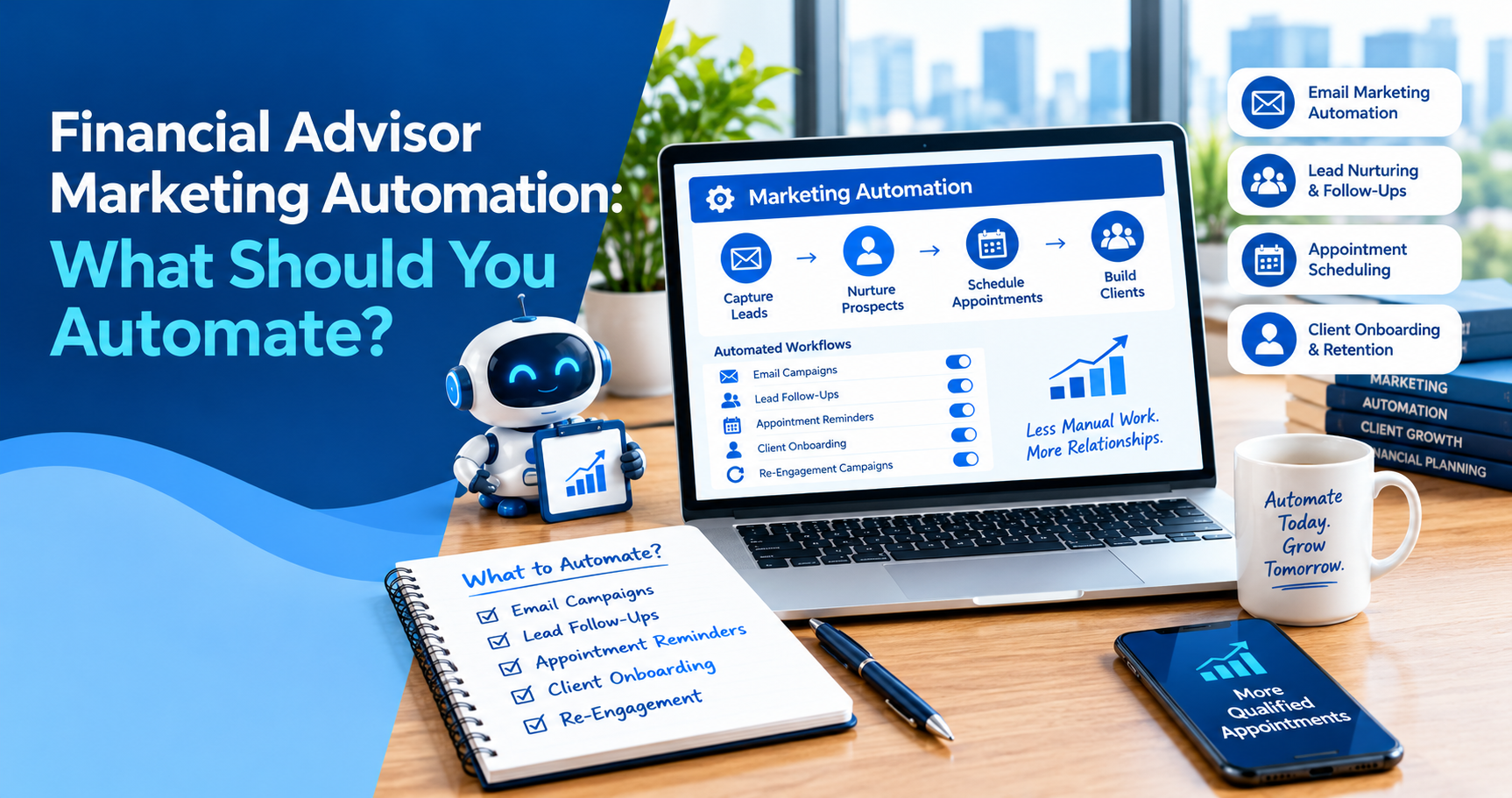
Marketing automation for financial advisors helps firms stay consistent with prospects and clients.
It does not replace the advisor relationship. It supports it.
For example, imagine a prospect attends a webinar about retirement income but does not book a call immediately. Without automation, that person may be forgotten.
With automation, the prospect can receive:
- A replay link
- A webinar summary
- A retirement checklist
- A follow-up email about common mistakes
- A consultation invitation
- A reminder a few weeks later
This is useful because financial decisions often take time. A prospect may need several touchpoints before booking.
Investment advisor automated marketing can support:
- New lead follow-up
- Webinar reminders
- Appointment reminders
- No-show follow-up
- Client review reminders
- Referral campaigns
- Re-engagement campaigns
Poor automation feels generic. Good automation feels timely, helpful, and relevant.
How Do Lead Generation, Retention, and Follow-Up Work Together?
Lead generation, retention, and follow-up should work as one system.
New leads create opportunity. Follow-up turns interest into appointments. Retention keeps existing clients engaged and can create reviews, referrals, and additional planning conversations.
For example, a firm may generate 100 webinar leads. Only 10 may book immediately. That does not mean the other 90 are worthless. Some may need more education. Some may not be ready yet. Some may book months later.
A strong financial advisor marketing platform keeps those prospects in the pipeline.
Retention also matters. Existing clients may need annual reviews, retirement updates, tax planning conversations, referral reminders, or new service discussions.
This is why retention can support consistent appointment flow. Revenx explains this further in its guide on how retention drives consistent pre-booked appointments.
The best systems do not only chase new leads. They also help advisors stay connected with people already in their network.
What Role Do Booked Appointments Play in Financial Advisor Lead Generation?
Booked appointments are one of the most important outcomes in advisor marketing.
A lead shows interest. A booked appointment shows stronger intent.
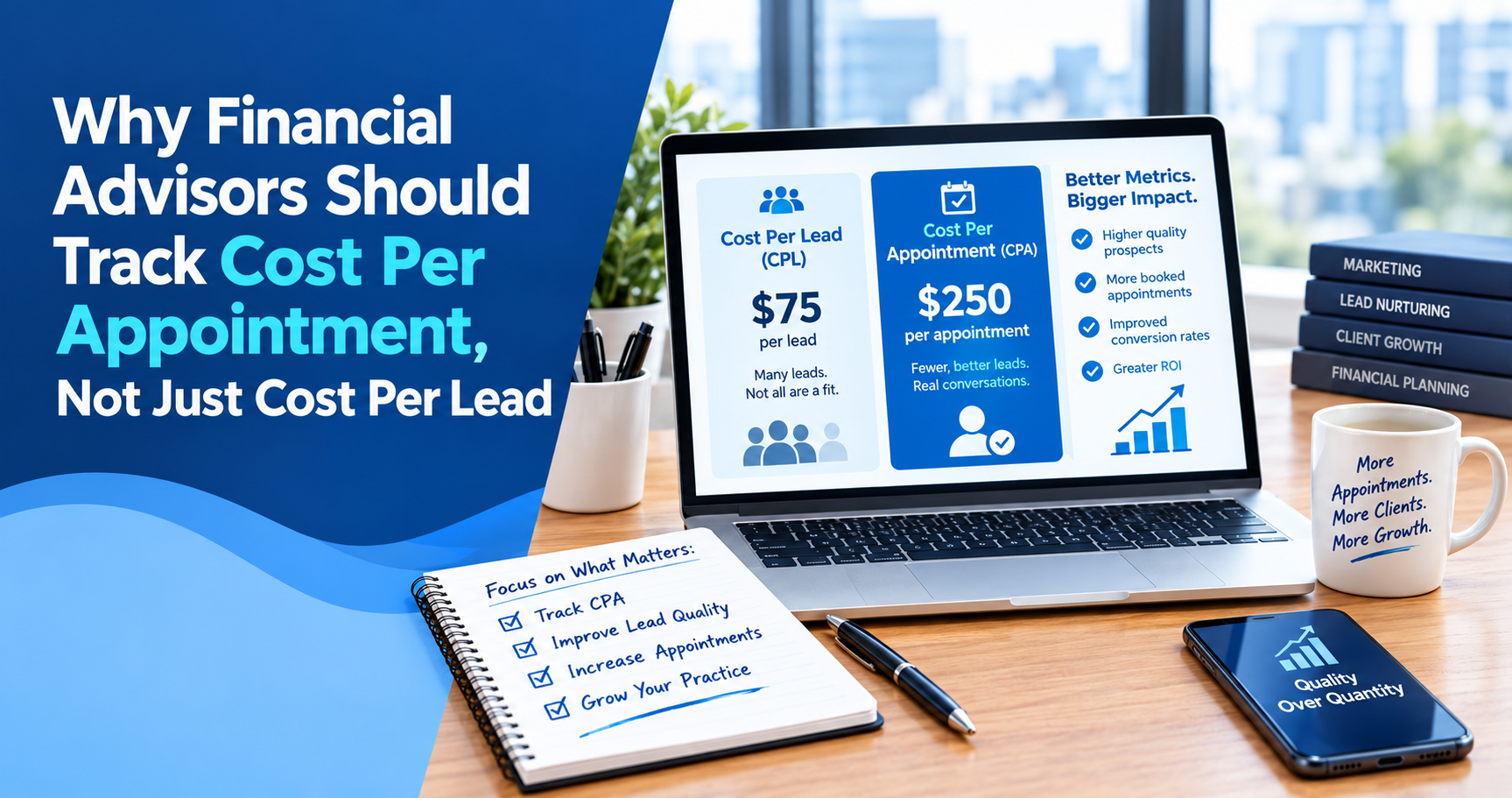
A campaign that generates 300 low-quality leads may look good on paper. But if only a few people book real consultations, the campaign may not be profitable.
A smaller campaign that generates 40 leads and 12 qualified appointments may be much better.
Advisors should track:
- Cost per lead
- Appointment booking rate
- Show-up rate
- Qualified appointment rate
- Cost per booked appointment
- Client conversion rate
A good appointment setting process should include:
- Clear consultation offer
- Simple booking form
- Pre-call qualification questions
- Email and SMS reminders
- No-show recovery
- Post-call follow-up
For example, a retirement planning firm may ask prospects when they plan to retire, what their main concern is, and what they want to discuss on the call. These questions help protect advisor time and improve call quality.
For firms focused on booked consultations, Revenx’s page on booked appointments is a natural next step.
Soft CTA: If your firm is already getting leads but not enough qualified calls, review your appointment flow first. The issue may not be traffic. It may be weak follow-up, unclear qualification, or too much friction in the booking process.
Advisor Marketing Platform vs Marketing Agency
An advisor marketing platform and a marketing agency can both support growth, but they are not the same.
A platform provides tools, automation, workflows, and tracking. An agency usually provides strategy, campaign management, creative work, SEO, or paid ads.
Area | Advisor Marketing Platform | Marketing Agency |
Main role | Organizes lead generation and follow-up | Executes marketing strategy |
Best use | CRM, automation, appointment tracking | Ads, SEO, content, campaign management |
Control | Firm can manage workflows | Agency manages execution |
Follow-up | Usually system-based | Depends on agency process |
Reporting | Tracks leads and appointments | Provides campaign reports |
Scalability | Easier to repeat | Depends on agency capacity |
Some firms need both.
A firm may hire an agency for SEO, paid ads, or content while using a platform to manage leads, automation, and appointments.
The mistake is assuming one automatically replaces the other.
A platform without strategy may sit unused. An agency without a system may generate leads that do not convert.
If your firm is comparing providers, this guide on the best marketing agencies for financial services can help you evaluate the right partner.
Common Mistakes Financial Advisors Make With Lead Generation
Many advisors struggle because they focus on activity instead of quality.
Here are the most common mistakes.
Chasing Lead Volume
More leads do not always mean better results. A low-cost lead with no serious planning need may waste advisor time.
Focus on qualified appointments, not just form fills.
Using Generic Messaging
Generic messaging like “plan your financial future” is too broad.
Better messaging speaks to a specific problem:
- Retiring in the next 5 years?
- Worried about retirement taxes?
- Need a retirement income strategy?
- Not sure when to claim Social Security?
Specific messaging attracts more serious prospects.
Following Up Too Slowly
If a prospect submits a form, they are interested in that moment. Waiting several days can reduce the chance of booking.
Fast follow-up matters.
Sending the Same Message to Everyone
A business owner, retiree, and pre-retiree should not receive the same nurture sequence.
Segment leads by age range, concern, timeline, source, and service interest.
Ignoring Warm Leads
Some of the best prospects are already in your database.
These may include past webinar registrants, old consultation requests, newsletter subscribers, website visitors, and referral contacts.
A strong financial advisor marketing system helps re-engage these people.
How to Choose the Right Advisor Marketing Software
Choosing the right advisor marketing software starts with your main goal.
Do you need more leads, better appointments, stronger follow-up, better retention, or clearer reporting?
Look for software that supports:
- Your main lead sources
- CRM-based nurturing
- Appointment tracking
- Email and SMS automation
- Webinar follow-up
- Retargeting support
- First-party data
- Compliance-safe workflows
- Client retention campaigns
- Clear reporting
The platform should show how prospects move from first contact to booked appointment.
It should also be simple enough for the team to use daily. A powerful system is not helpful if nobody uses it.
A leading advisor marketing platform should help advisors make better decisions, reduce missed follow-ups, and create more consistent qualified appointments.
Final Thoughts: What Actually Works in 2026
Financial advisor lead generation in 2026 works best when it is specific, trust-based, and system-driven.
The strongest firms are combining SEO, AI search visibility, short-form video, webinars, retargeting, CRM-based nurturing, first-party data, compliance-safe content, and appointment setting.
The process looks like this:
- Get found by the right prospects
- Answer specific planning questions
- Capture interest with useful offers
- Nurture leads through CRM workflows
- Retarget warm audiences
- Make booking simple
- Track appointment quality
- Re-engage clients and old leads
- Improve using real data
A leading advisor marketing platform can support this process, but the platform only matters if it helps produce qualified conversations.
The goal is not more marketing activity. The goal is a reliable system that turns interest into booked appointments with prospects who are a good fit for your firm.
Stronger CTA: If your advisory firm wants more qualified appointments, start by reviewing your current lead journey. Look at where prospects first find you, what happens after they submit a form, how quickly they are followed up with, and whether your system is built to turn interest into real booked conversations.
FAQs About Financial Advisor Lead Generation
1. What is financial advisor lead generation?
Financial advisor lead generation is the process of attracting potential clients, capturing their interest, nurturing them, and moving qualified prospects toward a consultation or booked appointment.
2. What works best for financial advisor lead generation in 2026?
The strongest strategies include SEO, AI search visibility, short-form video, webinars, retargeting, CRM-based lead nurturing, first-party data, compliance-safe content marketing, and appointment setting.
3. What is a leading advisor marketing platform?
A leading advisor marketing platform is a system that helps advisors manage lead generation, follow-up, nurturing, appointment booking, reporting, and retention.
4. How does marketing automation for financial advisors work?
Marketing automation sends timely follow-up messages based on a prospect’s actions, interests, or stage in the buying journey. It helps advisors stay consistent without manually chasing every lead.
5. Can advisor marketing software help generate booked appointments?
Yes. Advisor marketing software can support booked appointments through lead capture, qualification, automated reminders, CRM tracking, and follow-up workflows.
6. Why is financial advisor lead nurturing important?
Financial advisor lead nurturing is important because many prospects are not ready to book immediately. Nurturing keeps the firm visible until the prospect is ready for a conversation.
7. How is an advisor marketing platform different from hiring an agency?
A platform provides systems, automation, and tracking. An agency usually provides marketing strategy and execution. Many firms use both together.
8. How do I choose the right advisor marketing software?
Choose software based on your growth goal. Look for CRM nurturing, automation, appointment tracking, reporting, ease of use, compliance-friendly workflows, and retention support.
Disclaimer
This content is for informational and educational purposes only. It does not constitute financial, investment, legal, compliance, or marketing advice. Financial advisors and advisory firms should review all marketing materials, claims, testimonials, endorsements, disclosures, lead handling practices, and client communications with their compliance team or qualified legal counsel before publication or use. Results from any marketing platform, agency, or appointment-setting system may vary based on market conditions, offer, audience, follow-up process, compliance requirements, and firm-specific execution.