- Written & Reviewed by Jeremy
- Published
- Last Updated May 01, 2026
Financial advisors do not need more random leads. They need qualified appointments with people who understand their problem, trust the advisor’s expertise, and are ready to have a serious conversation.
That is where a specialized marketing agency for financial services can make a major difference.
The right agency does not just run ads, post on social media, or send emails. It builds a complete marketing system that attracts the right prospects, educates them, filters out poor-fit leads, and moves serious prospects toward booked appointments.
For financial advisors, wealth firms, RIAs, insurance professionals, and retirement planning specialists, this matters because the sales cycle is different. People are not buying a low-cost product. They are making decisions about retirement, investments, taxes, estate planning, insurance, and long-term financial security.
That requires trust.
A strong financial services marketing agency understands this. It knows how to combine SEO, content, advertising, email follow-up, appointment setting, and marketing automation in a way that supports real advisor growth.
This guide explains what actually drives qualified appointments in financial services and how to choose the right marketing partner.
What Does a Marketing Agency for Financial Services Actually Do?
A marketing agency for financial services helps advisors and financial firms attract, educate, and convert potential clients through digital and offline marketing strategies.
his can include:
- Website strategy
- SEO
- Paid advertising
- Content marketing
- Email marketing
- Landing pages
- Appointment booking systems
- Lead nurturing
- Marketing automation
- CRM setup
- Conversion tracking
- Brand positioning
- Compliance-conscious messaging
A good agency does more than “get your name out there.” It helps build a repeatable system for turning interest into conversations.
For example, a financial advisor may already have a website, but the website may not explain who they help, what problems they solve, or why someone should book a consultation. A specialized agency can fix that by improving the messaging, creating better service pages, adding trust signals, and building stronger calls to action.
A digital marketing agency for financial services may also help advisors show up when people search for topics like retirement planning, wealth management, tax-efficient income, annuities, Medicare planning, or investment guidance.
This is where seo for financial advisors becomes important. When done correctly, SEO helps financial advisors appear in front of people already searching for financial help.
But SEO alone is not enough.
A prospect may read a blog post today and book a call weeks later. That is why content, email, retargeting, and marketing automation all need to work together.
Why Generic Marketing Often Fails Financial Advisors and Wealth Firms
Generic marketing often fails financial advisors because it treats financial services like any other industry.
But financial decisions are personal, sensitive, and high-trust.
A person looking for a retirement advisor is not making the same decision as someone buying shoes online. They may be worried about running out of money, paying too much in taxes, choosing the wrong investment strategy, or making mistakes with Social Security, Medicare, or estate planning.
Generic agencies often miss this emotional and educational layer.
They may focus only on:
- More traffic
- More clicks
- More impressions
- More social media activity
- More form fills
But financial advisors need better conversations, not just better numbers on a report.
A general agency may run ads that generate cheap leads, but those leads may not have the right assets, income level, location, urgency, or intent. That creates wasted time for the advisor and poor campaign performance.
Another issue is messaging.
Many advisor campaigns use generic phrases like:
- “Plan your financial future”
- “Secure your retirement”
- “Grow your wealth”
- “Schedule a consultation”
These phrases are not wrong, but they are too broad. They do not clearly explain why the prospect should choose that advisor over every other option.
Financial advisor marketing needs sharper positioning.
For example, instead of saying:
“We help people plan for retirement.”
A stronger message may be:
“We help federal employees understand their pension, TSP, Social Security, and retirement income options before they leave service.”
That is more specific. It speaks to a defined audience. It also makes the appointment feel more relevant.
This is why a specialized financial advisor marketing agency can often perform better than a generalist agency.
What Actually Drives Qualified Appointments in Financial Services?
Qualified appointments usually come from a complete system, not one isolated tactic.
The main drivers are:
- Clear audience targeting
- Strong offer positioning
- Trust-building content
- High-intent traffic
- Lead qualification
- Fast follow-up
- Appointment reminders
- CRM and automation
- Ongoing campaign optimization
A financial advisor may get leads from paid ads, organic search, referrals, webinars, email campaigns, or social media. But the real question is not where the lead came from.
The real question is:
Was the prospect educated, qualified, and motivated before booking?
For example, a lead who downloads a generic retirement checklist may not be ready to book. But a prospect who reads a detailed guide, watches a short video, receives a follow-up email, and then books a consultation is usually more prepared.
This is where financial advisor lead generation needs to be handled carefully.
Lead generation should not simply mean collecting names and phone numbers. It should mean creating a path that moves the right people toward a real appointment.
A stronger appointment funnel may include:
- A helpful blog post or guide
- A clear call to action
- A focused landing page
- A qualification form
- An automated follow-up email
- A calendar booking page
- SMS or email reminders
- A pre-call confirmation process
The goal is to reduce wasted calls and increase serious conversations.
For advisors who rely on booked appointments, the appointment process itself also matters. Revenx explains this further in its guide on booked appointments, which focuses on the importance of getting prospects from interest to scheduled conversations.
How Is a Financial Services Marketing Agency Different From a General Digital Marketing Agency?
A financial services marketing agency understands the unique trust, compliance, and conversion challenges of the financial industry.
A general agency may understand digital marketing, but that does not always mean it understands financial advisor growth.
Here is a simple comparison:
Area | General Digital Marketing Agency | Financial Services Marketing Agency |
Audience understanding | Broad knowledge across many industries | Understands advisors, wealth firms, retirees, investors, and high-trust buyers |
Messaging | Often generic and benefit-led | More specific, problem-aware, and trust-focused |
Lead quality | May focus on volume | Focuses on qualified appointments and better-fit prospects |
Content strategy | General blog or social content | Educational content tied to financial questions, objections, and search intent |
Compliance awareness | May not understand restrictions | More careful with claims, guarantees, testimonials, and financial language |
Funnel design | Often simple lead capture | Built around education, qualification, follow-up, and appointment setting |
SEO strategy | Broad keyword targeting | Uses intent-based SEO for financial advisors and wealth firms |
Automation | Basic email sequences | Nurture flows based on advisor sales cycles and prospect readiness |
This difference matters because financial services prospects usually need more education before taking action.
A general agency may see a website visitor as a conversion opportunity.
A specialized agency sees the full journey:
- What question brought them to the site?
- What financial concern are they trying to solve?
- Are they ready to book?
- What information do they need before trusting the advisor?
- What follow-up should happen if they do not book immediately?
That is a different way of thinking.
How Do SEO, Content, and Marketing Automation Work Together?
SEO, content, and automation work best when they are connected.
SEO attracts people who are searching for answers. Content educates those people. Marketing automation follows up with them and keeps the advisor top of mind.
This is important because most prospects do not book an appointment the first time they visit a website.
They may compare multiple advisors. They may read several articles. They may talk to a spouse. They may need time to understand the problem before taking action.
SEO for financial advisors helps your website appear for searches your ideal clients are already making.
Examples include:
- retirement planning advisor near me
- financial advisor for business owners
- wealth management for retirees
- how to reduce taxes in retirement
- 401k rollover advisor
- estate planning financial advisor
- financial advisor for federal employees
The best SEO strategy is not just about ranking for broad keywords. It is about matching content to the questions and problems your ideal clients already have.
Content builds trust
Content marketing for financial advisors helps prospects understand their options before they book.
Useful content may include:
- Retirement planning guides
- Tax planning articles
- Investment education
- Case-style examples
- Planning checklists
- Comparison pages
- FAQs
- Video explainers
- Email newsletters
The goal is not to overwhelm the reader. The goal is to make the advisor feel credible, helpful, and relevant.
A strong content strategy should answer the questions prospects are already asking before they speak with an advisor.
For example:
- When should I claim Social Security?
- How much do I need to retire?
- Should I roll over my 401(k)?
- How can I reduce taxes on retirement income?
- What should I do five years before retirement?
These topics create trust because they help the prospect before asking for the appointment.
Automation keeps the conversation moving
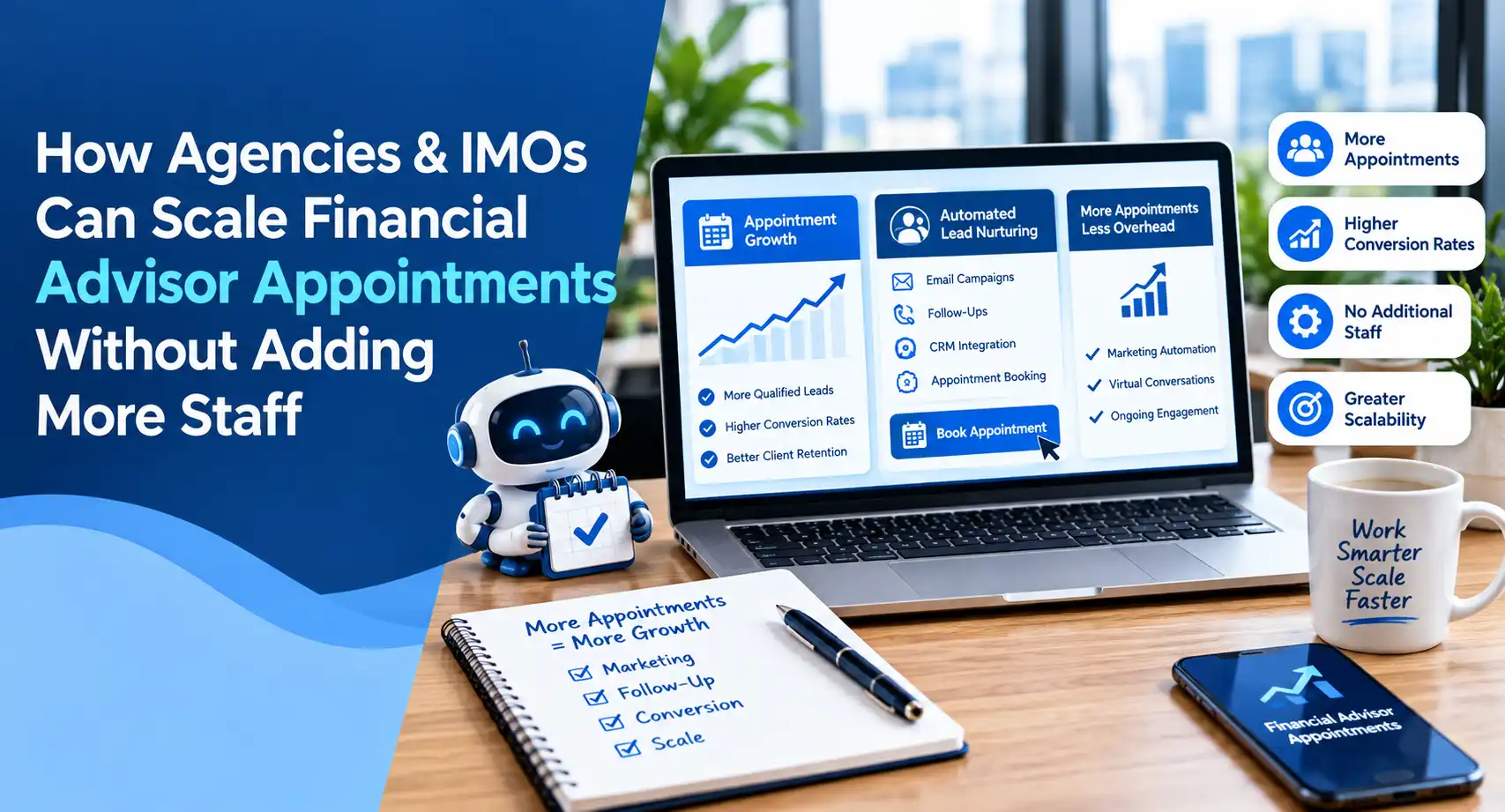
Marketing automation for financial advisors helps turn interest into action.
For example, if someone downloads a retirement guide, they can receive a short sequence of helpful emails that explains:
- Common retirement planning mistakes
- How to prepare for a planning call
- What questions to ask an advisor
- Why timing matters
- How to book an appointment
This keeps the advisor visible without manually following up with every lead.
When SEO, content, and automation work together, the advisor is not relying on one campaign. They are building a system.
What Role Do Tools and Systems Play in Financial Advisor Marketing?
Tools matter because financial advisor marketing can quickly become messy without the right systems.
A firm may have leads coming from Google Ads, Facebook, referrals, webinars, organic search, email, and website forms. Without a proper system, leads can be missed, follow-ups can be delayed, and appointments can fall through.
Important tools may include:
- CRM software
- Email marketing platform
- Calendar booking tool
- Landing page builder
- Call tracking
- Form tracking
- Analytics
- Marketing automation platform
- Review management tools
- Retargeting pixels
- Reporting dashboards
The goal is not to use every tool possible. The goal is to have the right tools connected properly.
A simple, well-built system is better than a complicated tech stack nobody uses.
For example, a lead may fill out a form on the website. That lead should automatically enter the CRM, trigger a follow-up email, notify the advisor or sales team, and offer a simple way to book a call.
If the lead does not book, the system should continue nurturing them.
This is where many firms lose opportunities. The campaign may generate leads, but the backend process fails.
The key point is simple: tools should support the appointment process, not make it harder.
What Mistakes Kill Pre-Set Appointments Before They Happen?
Many financial advisors think the biggest problem is lead generation.
But often, the real problem is what happens after the lead is generated.
Pre-set appointments can fail because of weak qualification, poor follow-up, unclear messaging, or a lack of trust before the call.
Common mistakes include:
- Targeting too broad of an audience
- Using vague offers
- Asking for the appointment too early
- Having a slow response time
- Not confirming the appointment
- Sending weak reminders
- Failing to explain what the call is about
- Not qualifying the lead properly
- Using landing pages that do not build trust
- Not following up with no-shows
A person may book an appointment and still not show up if they do not remember why the call matters.
This is especially true in financial services. If the prospect is not emotionally connected to the problem, they may delay the conversation.
For example, “free consultation” is often weaker than a more specific appointment offer.
A stronger offer may be:
“Schedule a retirement income review to understand how your pension, investments, Social Security, and taxes may work together.”
That gives the prospect a clearer reason to attend.
A good agency should not only generate leads. It should help improve the full appointment journey.
How Should Wealth Management Companies Evaluate a Marketing Partner?
Wealth management companies should evaluate a marketing partner based on strategy, industry understanding, lead quality, reporting, and ability to support the full client acquisition process.
Do not choose an agency only because it promises more leads.
More leads do not always mean more revenue.
A better question is:
Can this agency help us attract the right prospects and turn them into qualified appointments?
Here are areas to review.
Industry experience
Ask whether the agency has experience with financial advisors, wealth management firms, retirement planners, insurance professionals, or investment-related businesses.
They do not need to know every detail of your firm, but they should understand the buying journey.
Messaging quality
Look at how the agency explains your offer.
If they rely on generic language, that is a warning sign. Strong marketing should make your positioning clearer, not more vague.
Funnel strategy
Ask how the agency plans to move a prospect from awareness to appointment.
A good answer should include traffic, landing pages, qualification, follow-up, appointment booking, and reporting.
Lead quality process
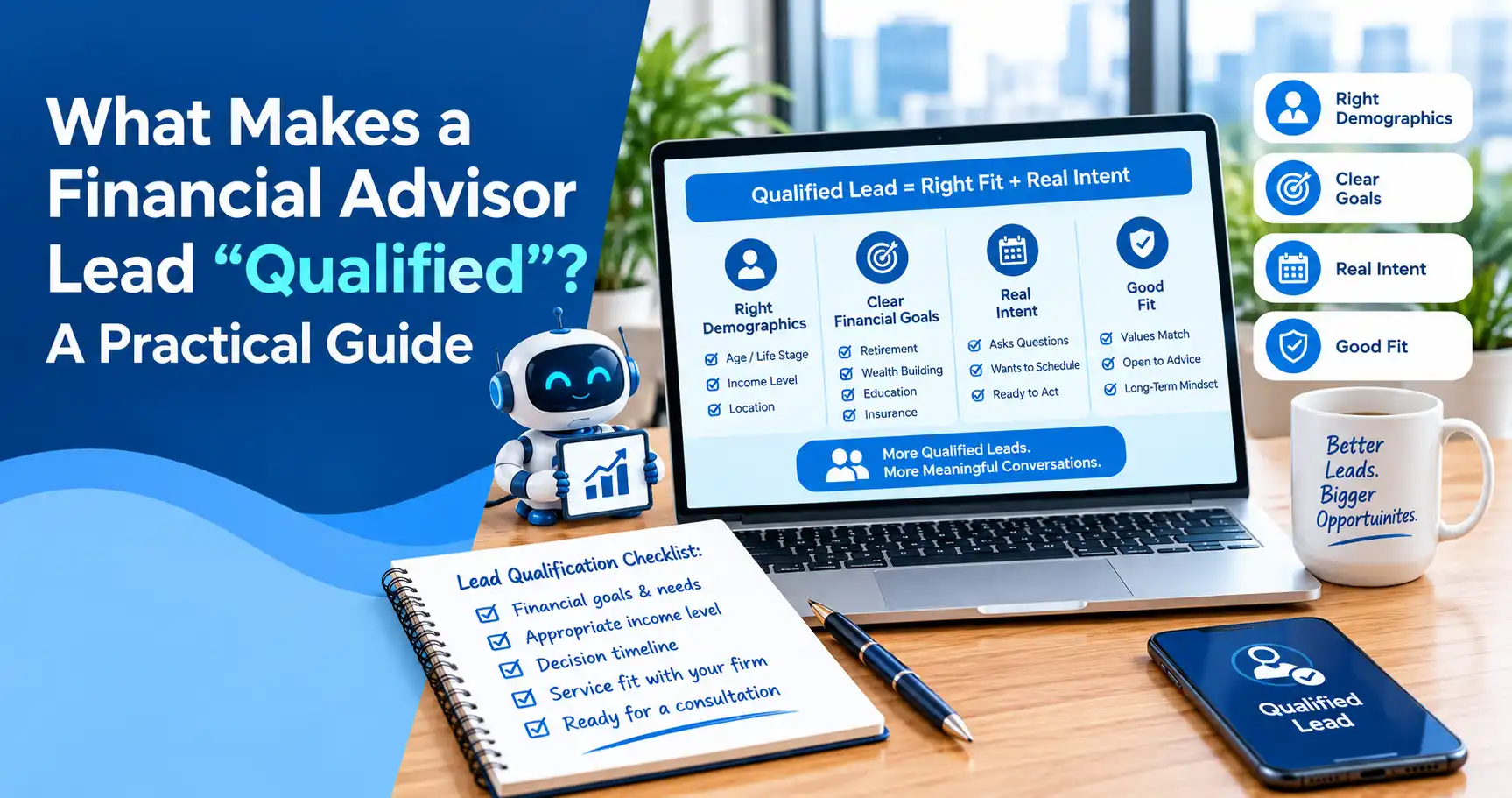
Ask how they define a qualified lead.
For example:
- Does the prospect meet your asset minimum?
- Are they in your target location?
- Are they near retirement?
- Do they need the services you offer?
- Are they willing to book a call?
- Did they confirm the appointment?
These questions matter.
Reporting
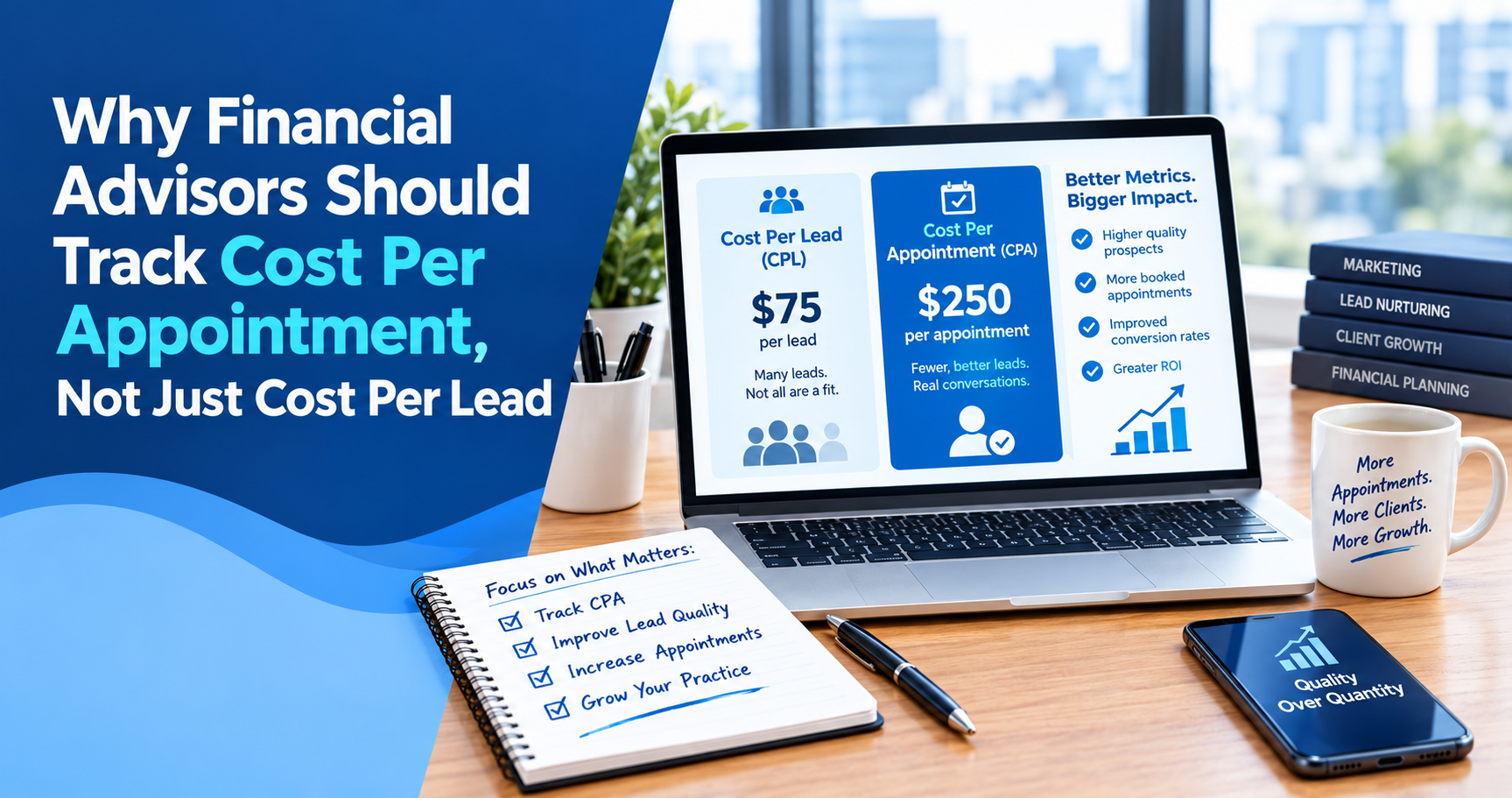
The agency should report on metrics that connect to business outcomes.
Helpful metrics include:
- Qualified appointments booked
- Appointment show rate
- Cost per qualified appointment
- Lead-to-appointment rate
- Website conversion rate
- Source of booked appointments
- Pipeline quality
- Follow-up performance
Traffic and impressions are useful, but they should not be the only focus.
When Should a Financial Firm Hire a Marketing Agency?
A financial firm should consider hiring a marketing agency when referrals are not enough, growth has stalled, or the firm needs a more predictable appointment system.
Many advisors grow through referrals in the beginning. Referrals are valuable, but they can be unpredictable.
A firm may need agency support when:
- The website is not generating leads
- Paid ads are producing poor-quality prospects
- The advisor has no clear follow-up system
- Content is inconsistent
- SEO rankings are weak
- The firm wants to enter a new market
- The firm wants more qualified appointments
- Internal staff does not have time to manage marketing
- The firm needs better tracking and reporting
- The brand message feels unclear
Hiring an agency makes sense when the firm is ready to treat marketing as a growth system, not a random activity.
However, an agency cannot fix everything by itself.
The firm still needs:
- A clear service offer
- A defined ideal client
- A strong sales process
- Fast follow-up
- Willingness to review campaign performance
- A compliant approval process
- A realistic timeline
Marketing works best when the agency and firm are aligned.
How to Choose the Best Marketing Agency for Financial Services
Choosing the best marketing agency for financial services depends on your goals, audience, budget, and growth stage.
The best agency for one firm may not be the best agency for another.
A solo advisor may need a simple SEO and appointment funnel. A larger wealth firm may need multi-location SEO, paid advertising, CRM automation, email nurturing, content strategy, and reporting dashboards.
Here is what to look for.
1. Financial services experience
Choose an agency that understands advisor marketing, wealth management, retirement planning, or similar high-trust services.
They should understand that financial prospects need education before conversion.
2. Clear lead qualification strategy
Ask how the agency separates serious prospects from low-quality leads.
If they only talk about “getting more leads,” be careful.
Qualified appointments are more important than raw lead volume.
3. Strong SEO and content strategy
The agency should understand how to build authority around topics your prospects care about.
For example, content marketing for financial advisors should not be random blogging. It should support real search intent, real client questions, and real appointment opportunities.
4. Automation and follow-up systems
Good campaigns lose value if leads are not followed up properly.
The agency should understand email marketing for financial advisors, CRM workflows, reminders, and lead nurturing.
Email should not be used only for newsletters. It should help move prospects from interest to action.
5. Compliance-conscious messaging
Financial marketing has limits.
Be cautious with agencies that use exaggerated claims, guaranteed results, or aggressive promises. Financial services marketing should be persuasive but responsible.
6. Transparent reporting
The agency should clearly show what is working and what is not.
You should know where leads are coming from, how many appointments are booked, and which campaigns are creating better opportunities.
7. Understanding of paid and organic channels
Some firms need SEO. Some need paid ads. Some need both.
There are many advertising agencies for financial services, but not all of them understand how to connect advertising to the full appointment journey.
Paid ads can create fast visibility, but without the right landing page and follow-up system, they can waste money.
8. Focus on business outcomes
The agency should care about appointments, pipeline, and client acquisition.
Marketing activity is not the same as growth.
A good agency should help you understand which channels are actually producing qualified opportunities.

Final Thoughts: Building a Marketing System That Produces Qualified Appointments
A successful financial services marketing strategy is not built on one tactic.
It is built on a complete system.
SEO helps prospects find you. Content helps them trust you. Email keeps the relationship warm. Automation keeps follow-up consistent. Paid ads can create faster visibility. Landing pages and qualification forms help turn interest into appointments.
But all of these pieces need to work together.
But all of these pieces need to work together.
That is where a specialized marketing agency for financial services can help.
The right agency understands that financial advisors do not just need more clicks or more leads. They need qualified appointments with people who are ready for a serious financial conversation.
The best marketing system should answer three questions clearly:
- Who are we trying to attract?
- Why should they trust us?
- What should they do next?
When those answers are clear, marketing becomes easier to measure, easier to improve, and more likely to produce meaningful appointments.
For financial advisors and wealth firms, that is the real goal.
Not more noise.
More qualified conversations.
FAQs
What does a marketing agency for financial services do?
A marketing agency for financial services helps advisors and financial firms attract prospects, build trust, generate leads, and book qualified appointments through SEO, content, advertising, email, automation, and conversion strategy.
How is a financial services marketing agency different from a general agency?
A financial services marketing agency understands the trust, compliance, and education required in financial decision-making. It focuses more on qualified appointments, prospect education, and long-term nurturing than basic lead volume.
What helps financial advisors generate more qualified appointments?
Financial advisors generate more qualified appointments by using clear positioning, targeted traffic, helpful content, strong landing pages, lead qualification, fast follow-up, and appointment reminders. The entire funnel must support the prospect’s decision-making process.
Why do some advisor marketing campaigns fail to convert?
Advisor marketing campaigns often fail because they target the wrong audience, use vague messaging, lack trust-building content, have weak follow-up, or generate leads without qualifying them properly.
What is marketing automation for financial advisors?
Marketing automation for financial advisors uses email sequences, CRM workflows, reminders, lead scoring, and follow-up systems to move prospects from initial interest toward a booked appointment or consultation.
Do wealth management companies need a specialized marketing agency?
Wealth management companies often benefit from a specialized agency because their prospects require more trust, education, and careful messaging than many other industries. A specialized agency can better support high-value client acquisition.
How long does it take for financial services marketing to work?
Paid ads can generate leads quickly, but SEO and content usually take longer. Many firms begin seeing stronger traction within a few months, but building a reliable appointment system often requires ongoing testing, follow-up improvement, and content development.
What should I look for in the best marketing agency for financial services?
Look for financial services experience, clear strategy, strong SEO and content knowledge, appointment-focused reporting, automation experience, compliance-conscious messaging, and a proven process for improving lead quality.
Disclaimer
This content is for informational and educational purposes only and does not constitute financial, investment, legal, or regulatory advice. While every effort has been made to ensure accuracy, regulations may vary based on jurisdiction and individual circumstances. Financial advisors should consult with their compliance, legal, or regulatory professionals before implementing any email marketing strategies discussed.