- Written & Reviewed by Jeremy
- Published
- Last Updated Sep 08, 2026
When people need a local service, they often turn to Google before making a decision. That makes appearing prominently in search results a valuable opportunity for businesses that depend on local customers.
But Google offers more than one way to reach those customers. Two of the most commonly discussed options are Local Service Ads and Google Ads. While both can help businesses generate leads, they work differently and are designed around different advertising goals.
Understanding the difference between Local Service Ads vs Google Ads can help you decide where your advertising budget is most likely to produce qualified leads, appointments, and customers.
The right choice is not always about finding the platform with the lowest advertising cost. It is about finding the channel that fits your business, target market, services, and conversion goals.
What Are Local Service Ads?
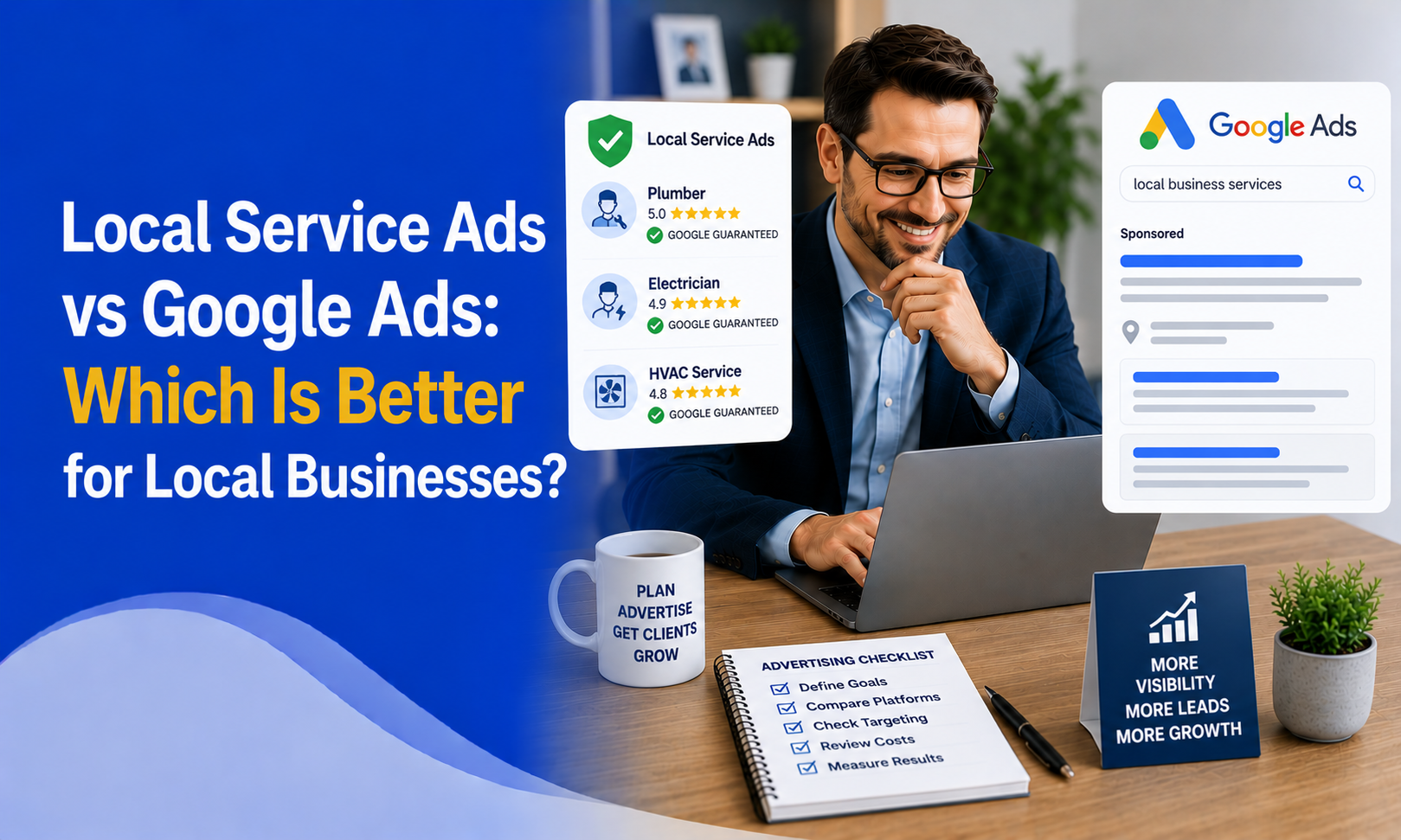
Local Service Ads (LSAs) are Google’s lead-focused ads for eligible local service businesses. They help potential customers quickly find and contact businesses in their area.
Depending on the business and location, customers may be able to call or message a business directly from the ad.
LSAs are useful for services with strong local intent, such as plumbers, electricians, HVAC companies, cleaners, and lawyers.
How Do Local Service Ads Work?
The process is simple:
Customer searches → LSA appears → Customer contacts business → Business follows up
Unlike traditional Google Search Ads, LSAs focus more on generating leads than website clicks.
Businesses should check Google’s current eligibility requirements because LSA availability varies by industry and location.
What Businesses Can Use Local Service Ads?
Eligible businesses may include:
- Plumbers
- Electricians
- HVAC companies
- Cleaning services
- Locksmiths
- Lawyers
- Other local service businesses
Not every business qualifies for LSAs, so eligibility should be confirmed before planning a campaign.
What Are Google Ads?
Google Ads is Google’s advertising platform that helps businesses promote their products and services online. For local businesses, Google Search Ads can appear when people search for specific services or keywords.
For example, a roofing company might target searches such as:
- Roof repair
- Emergency roof repair
- Roof replacement
- Local roofing company
- Commercial roofing services
A typical Google Ads journey looks like:
Customer searches → Ad appears → Customer clicks → Website opens → Customer converts
The conversion could be a phone call, form submission, appointment, or purchase.
How Do Google Ads Work?
Google Ads gives businesses control over keywords, locations, budgets, bidding, ad copy, and landing pages. Businesses can also create separate campaigns for different services and send visitors to relevant pages.
This flexibility and control are key differences when comparing Local Service Ads vs Google Ads.
Local Service Ads vs Google Ads: Key Differences
Although both advertising options can help businesses reach potential customers through Google, their structure and purpose are different.
Factor | Local Service Ads | Google Ads |
Primary purpose | Generate local service leads | Generate clicks, leads, sales, or other conversions |
Common pricing model | Generally pay per lead | Commonly pay per click for Search Ads |
Main focus | Local service customers | Broader advertising objectives |
Keyword control | More limited | Extensive keyword control |
Landing page | Less central to the initial interaction | Often an important part of the conversion journey |
Business eligibility | Limited to eligible categories and areas | Much broader business availability |
Campaign control | Relatively simple | More detailed and flexible |
Lead interaction | Calls/messages and other available lead actions | Website visits, calls, forms, purchases, etc. |
Best suited for | Eligible local service businesses | Businesses needing more advertising flexibility |
Optimization | Lead quality, budget, profile and responsiveness | Keywords, ads, bids, audiences, landing pages and conversions |
Neither platform is automatically better for every business.
The better choice depends on what you sell, who you serve, where you operate, and how you want customers to contact you.
Local Service Ads vs Google Ads: How Do They Compare on Cost?
Cost matters, but Local Service Ads and Google Ads use different pricing models.
How Local Service Ads Charge Businesses
Local Service Ads generally use a lead-based model, meaning businesses pay for customer inquiries rather than simply website clicks.
However, not every lead becomes a customer. Some may be outside your service area, unqualified, or not ready to buy. That’s why lead quality matters as much as lead volume.
How Google Ads Charges Businesses
Google Search Ads commonly use a pay-per-click (PPC) model. Businesses typically pay when someone clicks their ad.
Click costs can vary based on factors such as:
- Keyword competition
- Industry
- Location
- Search intent
- Ad and landing page relevance
A cheaper click is not always a better result if it fails to generate a qualified lead.
Which Is More Cost-Effective?
There is no one-size-fits-all answer. The better option is the one that consistently generates qualified customers at a sustainable acquisition cost.
Instead of asking, “Which is cheaper?”, ask:
“Which platform brings me better customers for my budget?”
Local Service Ads vs Google Ads: Which Gets Better Leads?
Lead quality is often more important than lead quantity.
Local Service Ads can be attractive because users are often searching with strong local service intent. Someone actively looking for a plumber, lawyer, electrician, or another local provider may already have a clear need.
Google Ads can also reach highly qualified prospects, particularly when campaigns are organized around specific commercial-intent keywords.
For example, there is a meaningful difference between someone searching for:
“how to repair a leaking pipe”
and someone searching for:
“plumber near me.”
The first search may indicate research. The second may indicate that the person is actively looking for a service provider.
Google Ads gives advertisers more control over keyword targeting, which can be valuable when businesses want to focus their budget on specific types of searches.
Ultimately, the best lead source is the one that produces qualified prospects who actually become customers.
A useful measurement funnel is:
Lead → Qualified Lead → Appointment → Customer → Revenue
This is more meaningful than measuring advertising success by impressions or clicks alone.
Targeting Differences Between Local Service Ads and Google Ads
Targeting is another major difference between the two platforms.
Local Targeting
Local Service Ads are designed around geographic service areas.
This makes them particularly relevant for businesses that depend on customers within a defined area.
For example, a local HVAC company may primarily want inquiries from nearby homeowners rather than people hundreds of miles away.
Keyword Targeting
Google Search Ads provide greater control over keywords and search intent.
Advertisers can organize campaigns around specific services and search terms.
This can help businesses distinguish between:
- Informational searches
- Commercial searches
- Brand searches
- Service-specific searches
- Location-specific searches
That control can make Google Ads particularly useful for businesses with multiple services.
Audience Targeting
Google Ads also provides a wider range of campaign and audience targeting options depending on the campaign type.
This can be useful when a business wants to build a more customized advertising strategy rather than relying primarily on local service intent.
Local Service Ads vs Google Ads for Different Types of Businesses
The right option can vary significantly by industry.
Home Service Businesses
Businesses such as plumbers, electricians, HVAC companies, and other eligible home-service providers may find Local Service Ads particularly useful.
These businesses often depend on customers searching for immediate or specific local services.
Google Search Ads can also be valuable when the business wants greater control over individual services and keywords.
Professional Services
Professional businesses may have different advertising requirements and eligibility considerations.
For businesses such as law firms and other eligible local professional services, LSAs can potentially provide another way to capture high-intent local searches.
Google Ads can be useful when the business wants to promote individual services, content, consultations, or specific landing pages.
E-commerce Businesses
E-commerce companies will generally have more relevant advertising options through Google Ads because their goals may involve products, online purchases, shopping searches, and broader digital campaigns.
Local Service Ads are not designed to replace e-commerce advertising.
Businesses With Multiple Services
Google Ads can be particularly useful when a company offers many services.
For example, a home-services company could create separate campaigns for:
- Emergency services
- Installation
- Repairs
- Maintenance
- Commercial services
This gives the advertiser greater control over messaging, keywords, landing pages, and budgets.
Advantages of Local Service Ads
Local Service Ads can provide several potential benefits for eligible businesses.
Strong Local Intent
Users are searching for local services, which can make the audience highly relevant.
Lead-Focused Advertising
The format is designed around generating customer inquiries rather than simply driving website traffic.
Direct Customer Contact
Depending on the available features, customers may be able to contact businesses directly through the ad.
Simple Campaign Structure
LSAs can be easier to manage than highly customized Search Ads campaigns because there are fewer campaign elements to control.
Local Visibility
For eligible businesses, LSAs provide another opportunity to appear prominently when people search for relevant local services.
Disadvantages of Local Service Ads
LSAs are not perfect for every business.
Limited Eligibility
Not every industry or location is eligible.
Less Keyword Control
Businesses generally have less granular keyword control than they would with traditional Search Ads.
Lead Quality Can Vary
Receiving a lead does not guarantee that the person is qualified or will become a customer.
Geographic Limitations
LSAs are designed around local service areas, which may not suit businesses with broader markets.
Less Campaign Flexibility
Businesses that need highly customized campaigns may prefer the control offered by Google Ads.
Advantages of Google Ads
Google Ads offers several benefits for businesses that want more control over their advertising strategy.
Greater Targeting Control
Advertisers can build campaigns around specific keywords, services, locations, and other targeting factors.
Flexible Campaign Structure
Businesses can create different campaigns and ad groups based on services, audiences, or locations.
Landing Page Control
Advertisers can direct users to dedicated pages designed around specific services or offers.
Detailed Conversion Tracking
Businesses can track actions such as forms, calls, appointments, purchases, and other conversions when properly configured.
Broader Advertising Options
Google Ads supports more than one advertising objective, making it suitable for a wide range of businesses.
Disadvantages of Google Ads
Greater control also means greater responsibility.
Competition Can Increase Costs
Competitive keywords can become expensive, especially in high-value industries.
Poor Targeting Can Waste Budget
If campaigns are not properly structured, businesses may pay for clicks that have little commercial value.
Landing Pages Matter
Getting someone to click an advertisement is only part of the process. The landing page must make it easy for the visitor to take the next step.
Requires Ongoing Optimization
Successful campaigns often require regular review of keywords, search terms, ads, conversion data, and budgets.
Clicks Are Not Customers
A campaign can generate traffic without generating enough qualified leads.
Can You Use Local Service Ads and Google Ads Together?
Yes. For some eligible businesses, using both platforms can make sense.
The two channels can serve different purposes.
Local Service Ads can help capture customers who are actively looking for an eligible local service.
Google Ads can provide additional control over keywords, services, landing pages, and advertising campaigns.
For example, a local contractor could use LSAs to capture direct local inquiries while using Google Search Ads to promote specific services such as emergency repairs, installations, or commercial projects.
This approach can give the business more opportunities to reach potential customers.
However, running both platforms does not automatically mean better results. Businesses should have enough budget and conversion data to evaluate whether each channel is producing profitable results.
Local Service Ads vs Google Ads: Which One Should You Choose?
There is no single answer for every business.
Choose Local Service Ads If:
- Your business is eligible
- You primarily serve a local market
- Customers frequently contact you directly
- You want to generate service leads
- You prefer a relatively simple advertising structure
- Your customers have strong local search intent
Choose Google Ads If:
- You need greater keyword control
- You offer multiple services
- You want dedicated landing pages
- You need more campaign flexibility
- You serve multiple locations
- You want to support different conversion goals
- Your business does not qualify for Local Service Ads
Consider Using Both If:
- Your business qualifies for LSAs
- You have enough advertising budget
- Local lead generation is important
- You want to reach customers through multiple search advertising formats
- You can properly track lead quality and conversions
How to Measure Which Advertising Channel Performs Better
The best advertising channel should be evaluated using business outcomes.
Do not stop at:
- Impressions
- Clicks
- Leads
- Cost per click
- Cost per lead
Go further.
Track:
Metric | Local Service Ads | Google Ads |
Total leads | ✓ | ✓ |
Qualified leads | ✓ | ✓ |
Appointments | ✓ | ✓ |
Cost per qualified lead | ✓ | ✓ |
Customer acquisition cost | ✓ | ✓ |
Customers generated | ✓ | ✓ |
Revenue generated | ✓ | ✓ |
Return on advertising spend | ✓ | ✓ |
For example, suppose one channel generates 50 leads while another generates only 25.
At first glance, the first channel looks better.
But if only five of those 50 leads become customers while 10 of the 25 leads from the second channel become customers, the second channel may actually be performing better.
This is why businesses should connect advertising data with actual sales outcomes whenever possible.
Common Mistakes Businesses Make With Local Service Ads and Google Ads
Choosing the right platform is only the beginning.
Businesses can still waste advertising budgets through poor execution.
1. Choosing Based Only on Cost
The cheapest lead is not necessarily the most valuable lead.
2. Ignoring Lead Quality
Businesses should determine whether incoming inquiries match their service, location, and ideal customer profile.
3. Targeting Too Broad an Area
A large service area can generate inquiries from people the business cannot realistically serve.
4. Sending Google Ads Traffic to Poor Landing Pages
A relevant advertisement can still fail if the landing page is confusing, slow, or difficult to use.
5. Not Tracking Conversions
Without conversion tracking, it becomes difficult to know which campaigns are actually producing results.
6. Ignoring Missed Calls
For local service businesses, a missed phone call can mean a missed sales opportunity.
7. Focusing Only on Lead Volume
More leads do not automatically mean more revenue.
8. Making Changes Without Enough Data
Constantly changing campaigns without enough information can make it difficult to determine what is actually working.
How to Improve Results From Local Service Ads
Businesses using Local Service Ads can focus on several practical areas.
First, make sure the business information, services, service areas, and profile details are accurate.
Next, pay attention to incoming leads.
Review whether they are:
- Relevant
- Within the service area
- Looking for an offered service
- Qualified
- Turning into appointments
Businesses should also respond promptly.
A high-intent customer may contact several businesses. A slow response can reduce the chance of turning an inquiry into an appointment.
Finally, evaluate performance based on qualified customers rather than raw lead numbers.
How to Improve Results From Google Ads
Google Ads performance can also improve through consistent optimization.
Start by targeting relevant commercial-intent searches.
Then create advertising groups that closely match the services being promoted.
Other useful practices include:
- Writing relevant ad copy
- Reviewing search terms
- Using negative keywords where appropriate
- Creating focused landing pages
- Tracking phone calls and forms
- Testing different messaging
- Reviewing conversion data
- Adjusting budgets based on performance
- Removing or improving underperforming campaigns
The goal is not simply to generate more traffic.
The goal is to generate traffic that has a realistic chance of becoming a qualified customer.
Final Thoughts: Local Service Ads vs Google Ads
The decision between Local Service Ads vs Google Ads should not be based on which platform is universally considered better.
They serve different purposes.
Local Service Ads can be a strong option for eligible local service businesses that want to capture high-intent customers and generate direct inquiries.
Google Ads provides greater flexibility for businesses that want control over keywords, campaigns, services, landing pages, and different conversion goals.
For some businesses, the best strategy may be to use both.
The most important step is to look beyond clicks and raw lead numbers. Measure the complete customer journey:
Lead → Qualified Lead → Appointment → Customer → Revenue
When you evaluate advertising through that lens, it becomes much easier to determine which channel is actually contributing to business growth.
The best advertising platform is ultimately the one that consistently reaches the right customers and turns a reasonable advertising investment into profitable business results.
Frequently Asked Questions
1. Are Local Service Ads better than Google Ads?
Not universally. Local Service Ads can be particularly useful for eligible local service businesses that want to generate direct inquiries, while Google Ads offers greater control over keywords, campaigns, landing pages, and targeting. The better option depends on your business type, location, budget, and conversion goals.
2. Are Local Service Ads cheaper than Google Ads?
Not necessarily. Local Service Ads generally use a lead-based pricing model, while Google Search Ads commonly use pay-per-click pricing. Because the pricing models are different, businesses should compare the cost of qualified leads and customers rather than focusing only on the cost of a lead or click.
3. Do Local Service Ads improve SEO?
No. Local Service Ads and organic SEO are separate marketing channels. Running Local Service Ads does not directly improve a website’s organic search rankings. Businesses can use paid advertising and SEO for local businesses together, but they should measure them as separate channels.
4. Can I run Local Service Ads and Google Ads at the same time?
Yes. If a business is eligible for Local Service Ads, it can potentially use them alongside Google Ads. Using both can help businesses capture local service searches through LSAs while using Google Ads for more specific keywords, services, locations, and landing-page campaigns.
5. Which is better for small businesses: Local Service Ads or Google Ads?
It depends on the business. An eligible local service business may benefit from Local Service Ads because they are designed around local service leads. Google Ads may be a better fit when a business needs greater keyword control, promotes multiple services, serves several locations, or wants more flexibility over its advertising campaigns.
Disclaimer:
This article is provided for general informational and educational purposes only. Advertising platforms, eligibility requirements, pricing models, features, and policies may change over time and can vary by business type and location. Businesses should review the latest information from Google and consider their specific goals, budget, and circumstances before making advertising decisions. The information in this article should not be considered a guarantee of advertising performance or business results.