- Written & Reviewed by Jeremy
- Published
- Last Updated Jun 17, 2026
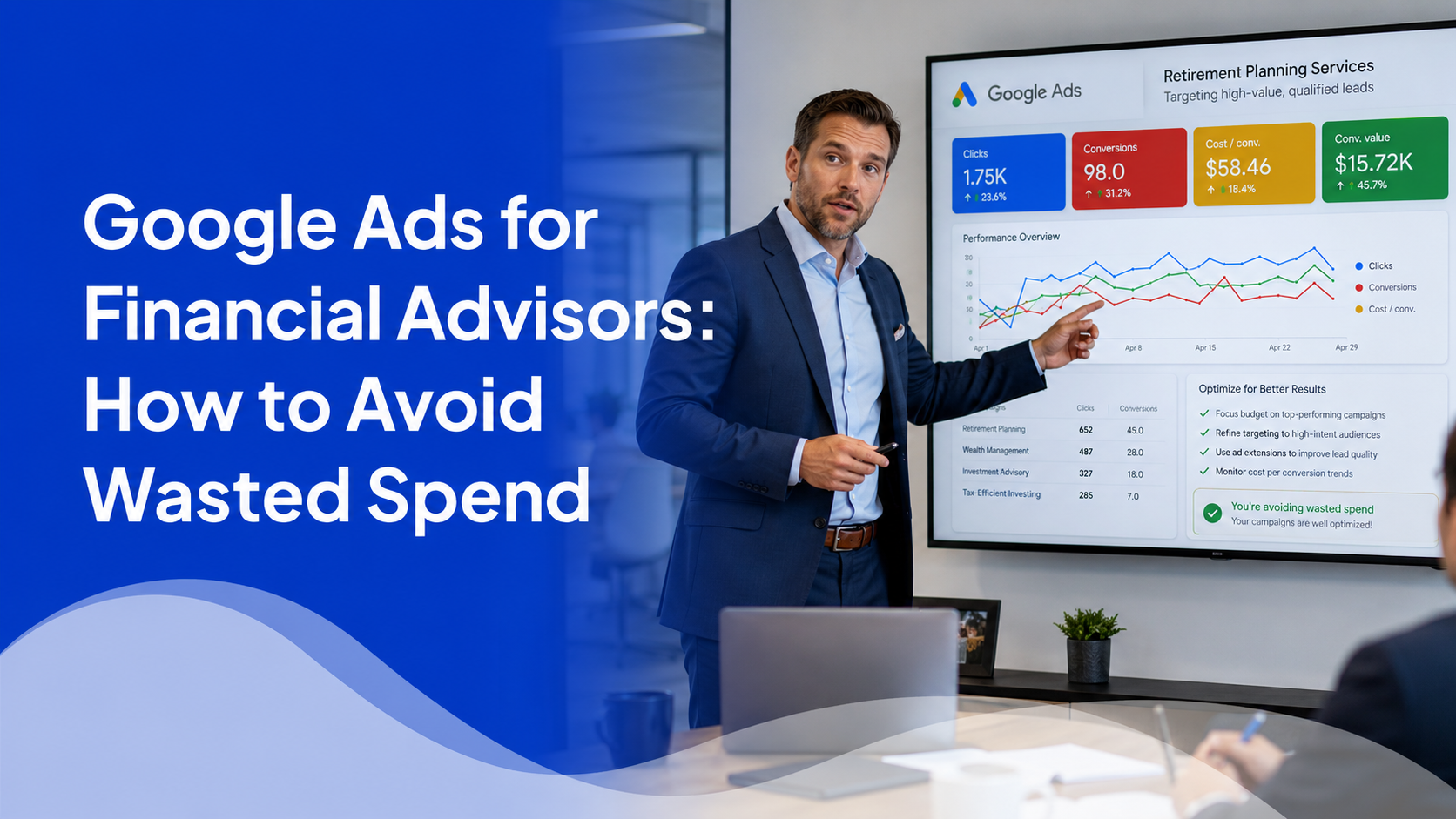
Google Ads can support growth for financial advisors when campaigns are carefully targeted, tracked, and connected to a clear follow-up process.
Many advisors try paid search because they want faster visibility, more leads, and more booked appointments. The problem is that Google Ads can also waste money quickly if the targeting, landing page, follow-up process, or tracking setup is weak.
A financial advisor can spend thousands of dollars on search traffic and still end up with poor-fit leads, low appointment rates, or no clear return. This usually happens when the campaign is treated like a simple advertising task instead of a full financial advisor lead generation system.
This guide explains how Google Ads for financial advisors should work, where wasted spend usually happens, and what advisory firms should fix before scaling paid advertising.
Why Many Financial Advisors Waste Money on Google Ads
Financial advisors often waste money on Google Ads because they focus too much on traffic and not enough on lead quality.
A campaign may bring in clicks, form fills, or calls, but that does not mean those people are qualified prospects. Some may be looking for free advice. Others may not meet your asset minimum. Some may be outside your service area, and others may not be ready to speak with an advisor.
Wasted spend usually comes from a few common issues:
- Broad keywords
- Weak negative keyword lists
- Generic landing pages
- Poor conversion tracking
- Slow follow-up
- No lead qualification process
- No appointment setting system
- No nurturing for prospects who are not ready yet
Google Ads should not be judged only by cost per click. The more important question is: how many qualified appointments did the campaign produce?
Are Google Ads Effective for Financial Advisors?
Yes, Google Ads can work for financial advisors when the campaign is built around search intent, compliance-safe messaging, and a strong appointment process.
Google Ads may be useful when prospects are already searching for help with retirement planning, wealth management, investment management, tax planning, estate planning, or fiduciary advice. These searches often show active intent.
However, Google Ads are not a shortcut. A campaign still needs strong targeting, persuasive landing pages, clear calls to action, and proper follow-up.
Google Ads Advantage | Common Challenge |
Fast visibility in search results | Competitive keywords can be expensive |
Targets people actively searching | Poor targeting can attract bad leads |
Easier to measure than many organic efforts | Tracking must be set up correctly |
Can support local advisor growth | Compliance review may be needed |
Can support consultation requests | Follow-up must be fast and consistent |
Firms often get better visibility into performance when they treat Google Ads as part of a full financial advisor marketing strategy, not a standalone campaign.
What Causes Wasted Ad Spend in Financial Advisor Campaigns?
Wasted spend often starts with poor keyword targeting.
For example, keywords like “financial advice,” “investing,” or “retirement” may bring broad traffic, but they can also attract students, job seekers, DIY investors, or people looking for general information.
Better keywords are usually more specific and tied to intent, such as:
- fiduciary financial advisor near me
- retirement planning advisor
- wealth management firm near me
- financial planner for business owners
- retirement advisor for federal employees
- investment advisor near me
This does not mean every broad keyword is bad. It means broad keywords need careful control, strong negative keywords, and close performance monitoring.
For example, if someone clicks an ad about retirement planning, the page should focus on retirement planning, not every service the firm offers.
What Keywords Should Financial Advisors Target in Google Ads?
Financial advisor Google Ads campaigns usually perform better when keywords are grouped by intent.
The goal is not to bid on every financial term. The goal is to reach prospects who are actively looking for a service your firm provides.
High-intent keyword groups may include:
- local fiduciary advisor keywords
- retirement planning keywords
- wealth management keywords
- investment management keywords
- tax planning and retirement tax strategy keywords
- niche audience keywords, such as business owners or federal employees
Examples of higher-intent searches may include:
- fiduciary financial advisor near me
- retirement planner near me
- wealth management firm for business owners
- financial advisor for retirement planning
- investment advisor for high net worth families
Lower-intent searches may include terms like “how to invest,” “best stock to buy,” or “financial advisor salary.” These searches may generate traffic, but they often do not match commercial intent.
A better PPC for financial advisors strategy is to separate keywords by service, location, and client type so each ad and landing page can match the search more closely.
Example: Retirement Planning Campaign vs Wealth Management Campaign
Not every Google Ads campaign for financial advisors should use the same message.
A retirement planning campaign and a wealth management campaign may attract different users, even if both are relevant to the same advisory firm.
Campaign Type | Search Intent | Landing Page Focus | Example CTA |
Retirement Planning Campaign | User wants help preparing for retirement | Income planning, Social Security, tax planning, retirement timeline | Schedule a retirement planning consultation |
Wealth Management Campaign | User wants help managing assets | Portfolio management, fiduciary process, investment strategy | Request a wealth management consultation |
Local Fiduciary Advisor Campaign | User wants a nearby advisor | Local service area, credentials, trust signals | Book a consultation with a fiduciary advisor |
Business Owner Campaign | User wants planning for business and personal wealth | Exit planning, tax coordination, investment management | Discuss your planning needs |
This kind of campaign separation helps reduce message mismatch. It also gives the firm clearer reporting on which service lines are producing better lead quality.
How to Build a Google Ads Campaign That Generates Qualified Leads
A strong Google Ads campaign for financial advisors starts with clear audience targeting.
Before launching ads, the firm should define who it wants to attract. This may include:
- Pre-retirees
- Retirees
- Business owners
- Physicians
- Federal employees
- High-net-worth families
- Professionals nearing retirement
- People looking for fiduciary guidance
Each audience may need different messaging, keywords, landing pages, and qualification questions.
The campaign should also be separated by service. Retirement planning, wealth management, tax planning, and estate planning should not all be placed into one broad campaign. Separate campaigns make it easier to control budget, test messaging, and measure results.
A strong structure may include:
- Retirement planning campaign
- Wealth management campaign
- Tax planning campaign
- Local fiduciary advisor campaign
- Brand campaign
- Retargeting campaign
This gives the advisor better control over spend and makes reporting much clearer.
Why Landing Pages Matter More Than Ads
The ad gets the click. The landing page earns the conversion.
A common mistake is spending heavily on ads while sending traffic to a page that does not build trust or explain the next step clearly.
A strong landing page for financial advisor paid advertising should include:
- A clear headline
- A specific service focus
- Advisor credentials
- Trust signals
- Simple form
- Calendar or consultation CTA
- Short explanation of who the service is for
- FAQ section
- Compliance-safe testimonials or proof points, if approved
- Clear privacy language
Strong Landing Page | Weak Landing Page |
Focused on one service | Sends users to a general homepage |
Clear appointment CTA | Multiple unclear next steps |
Includes trust signals | Little credibility information |
Mobile-friendly | Hard to use on mobile |
Matches ad copy | Does not match the search intent |
Uses short forms | Asks too much too soon |
For financial advisors, trust is a major conversion factor. People are not just comparing services. They are deciding whether they feel comfortable sharing personal financial details.
How Financial Advisor Lead Generation and Google Ads Work Together
Google Ads can bring qualified traffic, but lead generation depends on what happens after the click.
A complete financial advisor lead generation system includes:
- Targeted ads
- Relevant landing pages
- Lead capture forms
- Qualification questions
- CRM tracking
- Fast follow-up
- Appointment setting
- Lead nurturing
This is why paid traffic should connect to a larger growth system. Advisors comparing lead generation options can also review this guide on financial advisor lead generation.
Without a system behind the ads, even good traffic can turn into wasted spend.
Why Lead Nurturing Prevents Wasted Ad Spend
Some people are researching. Some are comparing advisors. Some are months away from making a decision. If your firm only follows up once, many of those leads are lost.
Financial advisor lead nurturing helps keep your firm in front of prospects after the first interaction. This may include:
- Email follow-up
- SMS reminders
- Retargeting ads
- Educational resources
- Appointment reminders
- Personal outreach
- CRM-based follow-up tasks
The goal is not to pressure prospects. The goal is to stay visible and helpful until they are ready to speak.
Revenx explains this connection further in its guide on how retention drives consistent pre-booked appointments.
How Appointment Setting Improves Google Ads ROI
Clicks do not grow an advisory firm. Booked appointments do.
A Google Ads campaign should be measured by how many qualified consultations it creates. This is where the financial advisor appointment setting becomes important.
A stronger appointment-setting process may include:
- Fast response times
- Clear qualification questions
- Simple calendar booking
- Reminder emails or texts
- Follow-up for no-shows
- CRM tracking
- Sales team visibility
Delayed follow-up can reduce the chance of converting the opportunity, especially when prospects are comparing more than one advisor.
For firms that want to connect marketing with actual conversations, Revenx’s page on booked appointments explains how appointment-focused systems support growth.
Should Financial Advisors Use Google Ads, SEO, or Referral Marketing?
Google Ads is only one part of financial advisor marketing. For many firms, the stronger approach is to use paid search alongside SEO, referrals, and follow-up systems.
Each channel supports a different part of growth.
Channel | Best For | Limitation |
Google Ads | Reaching prospects actively searching now | Can waste budget without strong targeting |
SEO | Building long-term organic visibility | Takes longer to produce results |
Referrals | High-trust introductions | Hard to scale predictably |
Email Nurturing | Staying visible with leads over time | Needs consistent content and segmentation |
Appointment Setting | Turning interest into conversations | Requires process, tracking, and follow-up |
For financial advisors, the question is not always “Which channel is best?” A better question is, “Which channels work together to create qualified conversations?”
Should Financial Advisors Manage Google Ads Internally or Hire Experts?
Some firms manage Google Ads internally. Others hire a paid media team or financial advisor marketing agency.
Both options can work, but the right choice depends on budget, experience, time, and campaign complexity.
In-House Google Ads Management | Professional Management |
More direct control | More platform expertise |
Lower management cost | Faster setup and testing |
Requires time to learn | Better campaign structure |
Risk of tracking mistakes | Stronger reporting process |
May work for small campaigns | Better for scaling spend |
Internal team knows the firm well | External team brings broader experience |
If your firm already has marketing staff, an internal setup may work. But if the campaign needs landing pages, tracking, lead nurturing, and appointment setting, an experienced partner may help reduce wasted spend.
Advisors comparing outside support can review this guide on choosing a marketing partner for financial services.
Key Metrics Financial Advisors Should Track
Many advisors track leads, but not all leads are equal.
Important Google Ads metrics include:
- Cost per click
- Click-through rate
- Landing page conversion rate
- Cost per lead
- Qualified lead rate
- Appointment booking rate
- Show-up rate
- Cost per booked appointment
- Client acquisition cost
- Return on ad spend
The most important metric is usually not the cheapest lead. It is the cost to generate a qualified appointment that has a real chance of becoming a client.
Signs Your Google Ads Campaign Is Wasting Money
Your financial advisor Google Ads campaign may be wasting spend if:
- You get clicks but few leads
- You get leads but few appointments
- Most leads are not qualified
- Your ads are showing for unrelated searches
- Your landing page conversion rate is low
- You are sending traffic to your homepage
- You do not know which keywords produce appointments
- You are not using negative keywords
- You do not have call tracking or form tracking
- Follow-up is slow
- Leads are not added to a CRM
- No one is nurturing undecided prospects
How to Reduce Wasted Spend and Increase Qualified Appointments
To reduce wasted Google Ads spend, financial advisors should focus on the full journey from search to appointment.
Start by tightening keyword targeting. Use service-specific and location-based keywords where relevant. Add negative keywords regularly to block irrelevant traffic.
Next, improve the landing page. Make sure the page matches the ad, explains the offer clearly, and gives visitors one simple next step.
Then, fix tracking. Your firm should know which campaigns, keywords, and ads are producing qualified appointments, not just clicks.
Finally, connect the campaign to a follow-up system. A lead that does not book right away should still receive helpful, consistent communication.
The goal is to build a financial advisor marketing system that turns paid search traffic into real conversations.

Final Thoughts: Successful Google Ads Campaigns Focus on Appointments, Not Clicks
Google Ads for financial advisors can work well, but only when the campaign is built with discipline.
The biggest mistake is treating paid advertising as a traffic source instead of a client acquisition system. Clicks are only valuable when they lead to qualified conversations.
To avoid wasted spend, financial advisors need strong keyword targeting, clear landing pages, accurate tracking, lead nurturing, and appointment setting. When these pieces work together, Google Ads can become a more measurable part of a financial advisor marketing strategy.
For advisory firms, the real goal is not more traffic. It is more qualified to book appointments with people who are a strong fit for the firm.
FAQs About Google Ads for Financial Advisors
1.How much should a financial advisor spend on Google Ads?
The right budget depends on the service, location, competition, and growth goals. A small local campaign may start with a modest monthly budget, while competitive wealth management or retirement planning campaigns may need more spend to collect useful data and generate consistent appointments.
2. Are Google Ads worth it for financial advisors?
Google Ads may be worth testing for financial advisors when the campaign targets qualified prospects, uses strong landing pages, and tracks booked appointments. If the campaign only tracks clicks or basic leads, it may be difficult to measure real ROI.
3. What is a good cost per lead for financial advisors?
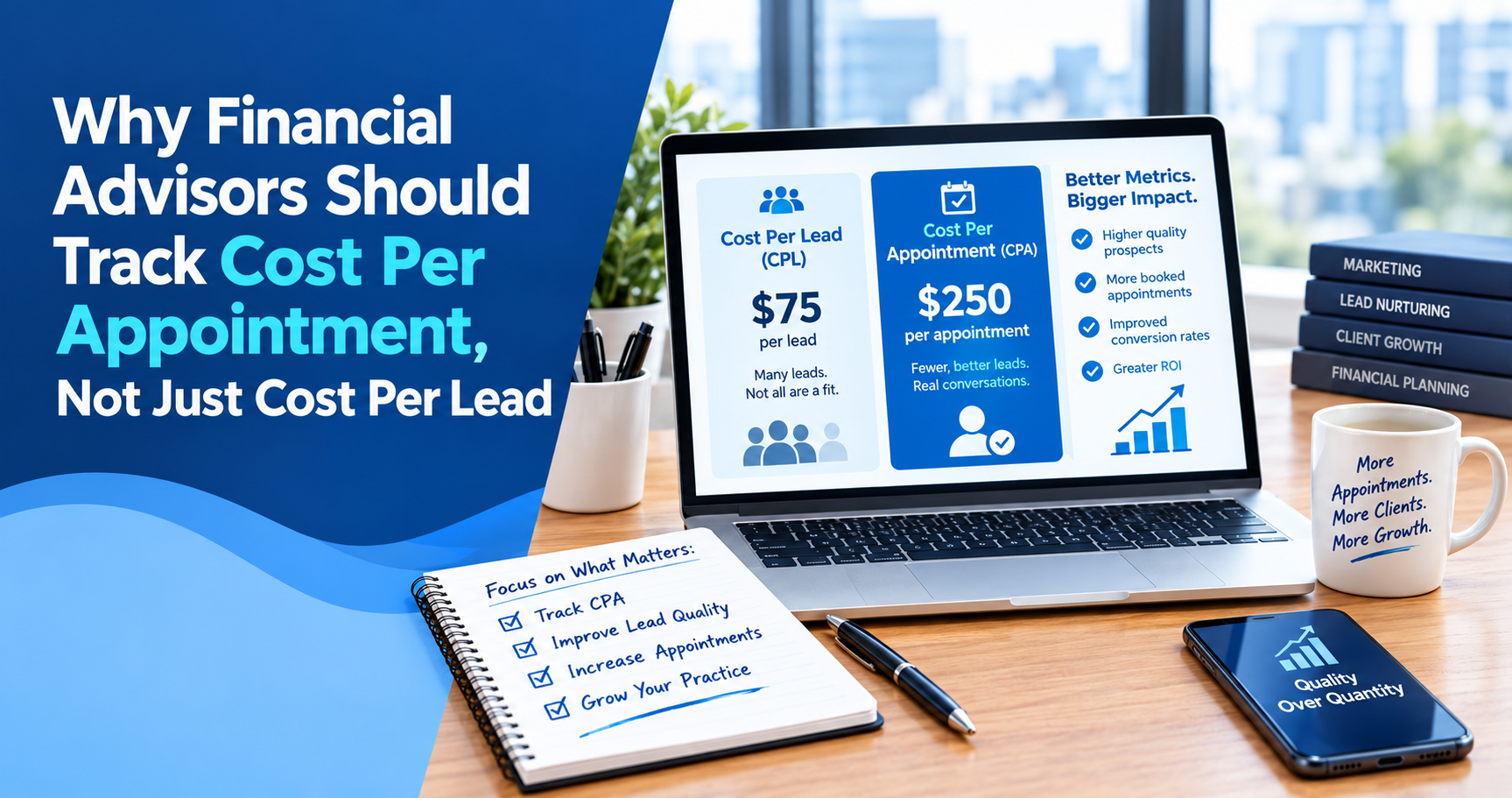
A good cost per lead depends on lead quality. A cheap lead is not always valuable if the person is not qualified. Advisors should track cost per qualified lead and cost per booked appointment instead of only looking at cost per lead.
4. Why are my Google Ads generating leads but not appointments?
This usually happens when the campaign attracts poor-fit prospects, the landing page is too broad, follow-up is slow, or the firm does not have a clear appointment-setting process. Lead nurturing can also help convert prospects who are not ready immediately.
5. Should financial advisors use landing pages instead of their homepage?
Yes, in most cases. A landing page is usually better because it focuses on one service, one audience, and one action. A homepage often has too many distractions and may not match the ad intent.
Disclaimer
This content is for general marketing education only and should not be treated as legal, compliance, or financial advice. Financial advisors should review all advertising, testimonials, lead generation claims, and appointment-setting language with their compliance team before publishing or launching campaigns.