- Written & Reviewed by Jeremy
- Published
- Last Updated Nov 02, 2026
Getting someone to click your Google Ad is only half the job. The real challenge begins when that person lands on your website and decides whether your financial services are worth exploring.
A well-designed financial advisor PPC landing page helps bridge that gap. It connects the promise made in an advertisement with relevant information, builds trust, and gives potential clients a clear next step.
For financial advisors and insurance agents investing in paid advertising, the goal should not simply be to generate more clicks or form submissions. It should be to attract relevant prospects and turn genuine interest into qualified appointments. Using generative AI and traditional business intelligence can also help businesses analyze campaign performance, identify trends, and make more informed marketing decisions.
What Is a Financial Advisor PPC Landing Page?
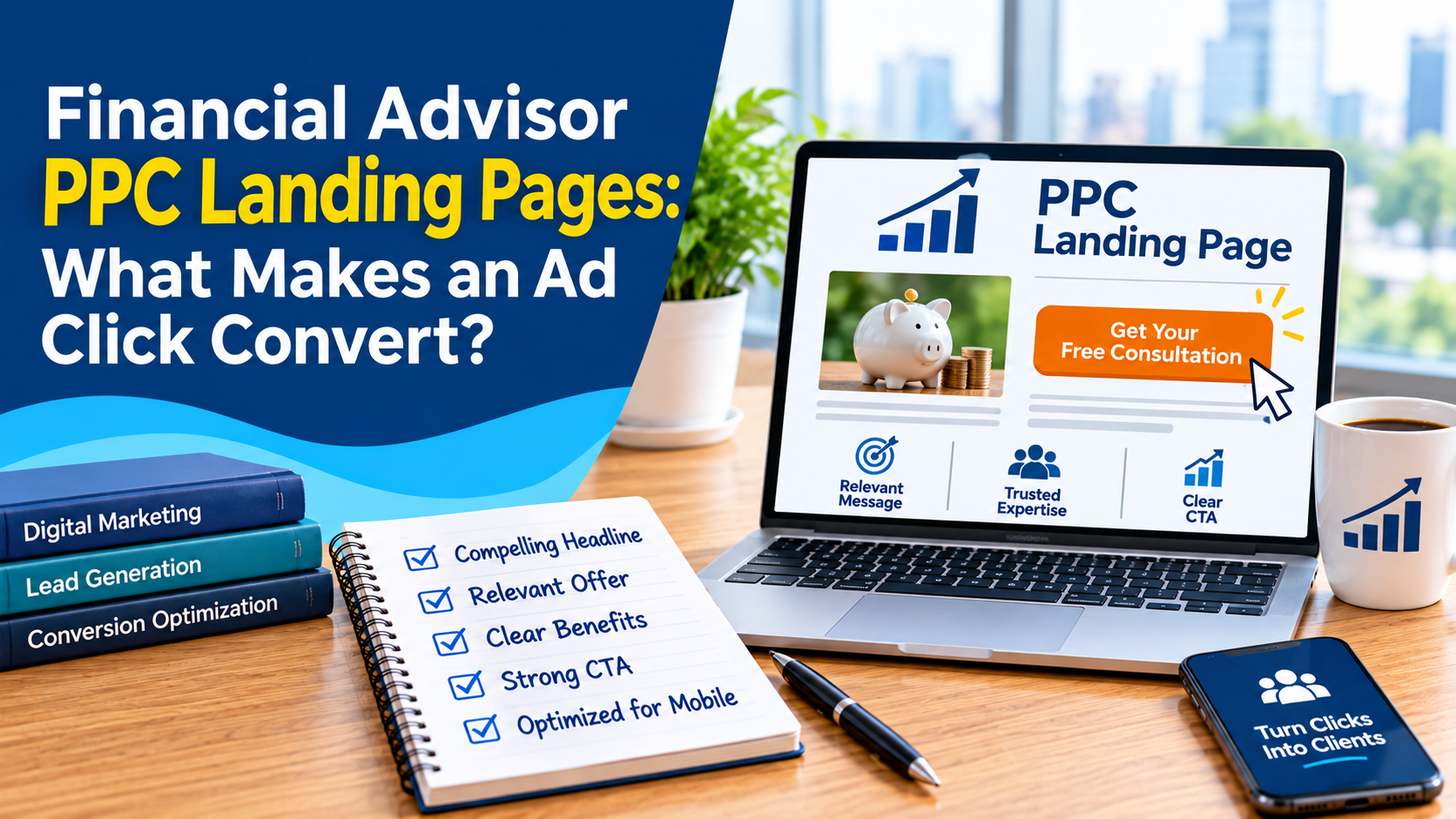
A financial advisor PPC landing page is a dedicated webpage designed to receive visitors from paid advertisements, such as Google Ads. Unlike a general website page, it focuses on one specific campaign objective, such as scheduling a consultation, requesting information, or booking an appointment.
For example, an advisor running Google Ads for retirement planning may create a landing page specifically for people searching for retirement planning assistance. Instead of sending visitors to the homepage, the advertisement directs them to a page that explains the service, identifies who it is intended for, and provides a clear way to get in touch.
How Does a PPC Landing Page Work?
The process is straightforward:
- A potential client searches for a financial service on Google.
- They see a relevant paid advertisement.
- They click the advertisement and arrive at the landing page.
- The page explains the service and establishes credibility.
- The visitor completes a form or schedules an appointment.
- The financial firm follows up with the prospect.
The landing page connects advertising activity with the next step in the client acquisition process.
How Is a PPC Landing Page Different From a Financial Advisor Website?
A regular financial advisor website introduces the firm, explains its services, and provides information about its approach. A PPC landing page has a narrower purpose: encouraging visitors from a particular campaign to take one relevant action.
Comparison Factor | Regular Website | PPC Landing Page |
Main purpose | Introduce the firm and its services | Encourage a specific action |
Content | Covers multiple topics | Focuses on one campaign |
Navigation | Multiple menu options | Minimal distractions |
Messaging | Broad brand messaging | Matches the advertisement |
CTA | Multiple actions | One primary conversion goal |
Lead capture | Across different pages | Prominent and campaign-specific |
Measurement | Overall website performance | Campaign-specific conversions |
Both serve important purposes. However, a dedicated landing page gives paid advertising visitors a more focused experience.
Why Do Financial Advisors Need Dedicated PPC Landing Pages?
Paid advertisements can bring visitors to your website, but traffic alone does not guarantee inquiries. A dedicated PPC landing page helps financial advisors deliver relevant information and guide visitors toward taking action. As businesses explore AI-powered marketing and personalization, domain-specific AI models can also help align AI capabilities with specific business needs, workflows, and industry requirements.
Turn Paid Traffic Into Relevant Inquiries
Different prospects have different financial needs. Dedicated landing pages allow advisors to focus on specific services, such as retirement planning, investment management, or insurance.
Match Landing Page Content With Search Intent
Your landing page should reflect what visitors searched for. Matching the advertisement, headline, and page content creates a more relevant experience and helps visitors find what they need.
Reduce Distractions and Encourage Action
Too many links and competing CTAs can confuse visitors. A focused landing page highlights one primary action, such as requesting a consultation or booking an appointment.
What Makes a Financial Advisor PPC Landing Page Convert?
An effective landing page combines clear messaging, trust, and an easy conversion process. Visitors should quickly understand your services and know what to do next.
A Clear and Relevant Headline
Use a headline that directly reflects the advertised service. For example, “Retirement Planning Guidance to Help You Prepare for Your Next Chapter.”
A Strong Value Proposition
Explain your services, target audience, advisory approach, and what prospects can expect from an initial consultation.
A Compelling Call to Action (CTA)
Use clear CTAs such as:
- Schedule an Initial Consultation
- Book an Appointment
- Speak With a Financial Professional
Simple Lead Capture Forms
Request only essential information, such as name, email, phone number, and area of interest. Avoid unnecessary questions.
Trust Signals and Social Proof
Include relevant credentials, accurate firm information, permitted client testimonials, and professional memberships to establish credibility.
Mobile-Friendly Landing Page Design
Ensure text is readable, buttons are accessible, and forms work smoothly across smartphones and tablets.
Fast Loading Speed and Easy Navigation
Optimize images, reduce unnecessary scripts, and keep navigation simple so visitors can quickly find information and take action.
How Should You Structure a High-Converting Financial Advisor PPC Landing Page?
A well-structured landing page introduces the service, communicates its value, builds trust, and makes it easy for visitors to take action. For businesses using AI-driven tools to improve customer experiences and marketing decisions, maintaining accurate and reliable information is equally important. Learn more about data quality and AI and why high-quality data matters for effective AI implementation.
1. Above-the-Fold Section
Include a clear headline, brief service description, relevant visual, prominent CTA, and an introductory form if appropriate.
2. Services and Value Proposition
Explain the specific service promoted in the advertisement and how it addresses the visitor’s needs. Avoid unrelated service information.
3. Benefits and Supporting Information
Highlight your advisory approach, service benefits, and what prospects can expect from an initial consultation.
4. Trust-Building Elements
Display relevant credentials, professional experience, accurate firm information, and permitted client testimonials.
5. Lead Capture Form and Appointment Booking
Make it easy for visitors to submit their details or schedule an appointment. Clearly explain what happens next.
6. Privacy Information and Required Disclosures
Include an accessible privacy notice and applicable regulatory disclosures. Ensure all advertising claims and testimonials are accurate and compliant.
How Do Google Ads and Landing Pages Work Together for Financial Advisors?
Google Ads attract potential clients, while landing pages provide relevant information and encourage them to take the next step. Both should share consistent messaging to create a smooth visitor experience.
Maintain Consistency Between Ad Copy and Headlines
Ensure your landing page headline, content, and CTA match the promise made in your advertisement.
Align Keywords With Landing Page Content
Create relevant landing page content based on the keywords you target. For example, retirement planning ads should direct visitors to a page focused on retirement planning services.
Match the Offer to Search Intent
Understand what visitors are looking for. Some may want an introductory consultation, while others may prefer educational information before contacting an advisor.
Use Relevant Landing Pages for Different Campaigns
Create separate landing pages for services such as retirement planning, investment management, and insurance. This keeps messaging relevant and makes it easier for visitors to find what they need.
For more campaign insights, explore our guide to Google Ads for financial advisors.
What Are the Best CTA Strategies for Financial Advisor PPC Landing Pages?
A good CTA makes the next step clear and encourages visitors to take action without feeling pressured.
Use Action-Oriented CTA Text
Use specific phrases such as “Schedule an Initial Consultation” or “Book an Appointment” instead of generic buttons like “Submit.”
Make Appointment Booking Simple
Keep the scheduling process short, display available time slots clearly, and avoid unnecessary steps.
Set Clear Expectations
Explain what happens after visitors submit a form, such as receiving a call or email from your team.
Test Different CTA Placements and Messaging
Experiment with button wording, placement, and design. Measure meaningful conversions and lead quality to identify what works best.
How Can Financial Advisors Build Trust on PPC Landing Pages?
Trust encourages potential clients to share their information and consider working with your firm.
Display Relevant Professional Credentials
Show accurate qualifications, licenses, and professional designations without making misleading claims.
Explain Your Advisory Process
Briefly describe what happens after an inquiry, from initial contact to the introductory consultation.
Include Testimonials and Reviews Where Permitted
Use genuine client feedback where allowed, following applicable advertising and regulatory requirements.
Add Clear Contact and Privacy Information
Display business contact details, an accessible privacy notice, and relevant disclosures so visitors understand how their information is handled.
What Common Mistakes Reduce Financial Advisor PPC Landing Page Conversions?
Avoid these common mistakes that can reduce landing page effectiveness:
Sending Paid Traffic to the Homepage
Use dedicated landing pages that match the specific service promoted in your advertisement.
Using Generic Headlines and CTAs
Write specific headlines and action-oriented CTAs that reflect visitor intent.
Asking for Too Much Information
Keep lead forms short and request only essential details.
Ignoring Mobile Users
Ensure the page, forms, and buttons work smoothly across mobile devices.
Making Unsubstantiated Financial Claims
Avoid guaranteed returns, exaggerated promises, and misleading performance statements.
Failing to Track Conversions
Monitor inquiries, qualified leads, and booked appointments instead of measuring clicks alone.
How Should Financial Advisors Measure PPC Landing Page Performance?
Financial advisors should track metrics that show whether their PPC campaigns generate relevant leads and booked appointments.
Landing Page Conversion Rate
Measures the percentage of visitors who complete an action.
Formula: (Conversions ÷ Visitors) × 100
Cost Per Lead (CPL)
Measures the advertising cost of generating one inquiry.
Formula: Advertising Spend ÷ Number of Leads
Cost Per Qualified Lead
Measures the cost of generating leads that match the firm’s target audience.
Cost Per Booked Appointment
Tracks how much advertising spend is required to generate a scheduled appointment. Learn more about cost per booked appointment.
Lead-to-Appointment Conversion Rate
Measures how many inquiries turn into booked appointments.
Formula: (Booked Appointments ÷ Total Leads) × 100
Tracking these metrics helps firms evaluate campaign effectiveness and lead quality.
How Can Financial Advisors Optimize a PPC Landing Page?
Regular optimization helps improve the visitor experience and generate more relevant inquiries.
Conduct A/B Testing
Test different headlines, CTAs, forms, and page layouts to identify what performs better.
Improve Page Speed and Mobile Experience
Optimize images, reduce unnecessary scripts, and ensure the page works smoothly on mobile devices.
Refine Headlines and CTA Messaging
Use clear messaging that matches the advertisement and encourages visitors to take action.
Review Form Abandonment
Remove unnecessary fields and simplify forms to make submissions easier.
Analyze Lead Quality and Follow-Up
Review whether leads respond, meet your qualification criteria, and book appointments. Explore financial advisor appointment scaling for additional insights.
When Should Financial Advisors Consider Professional PPC Landing Page Design?
Professional support may help when existing campaigns struggle to generate meaningful inquiries.
When Ad Clicks Are Not Generating Inquiries
Review landing page messaging, CTAs, forms, and service relevance.
When Leads Are Not Booking Appointments
Evaluate lead quality, follow-up practices, and the appointment booking process.
When Scaling Google Ads Campaigns
Professional support can help create relevant landing pages for different campaigns and services.
When Promoting Multiple Financial Services
Separate landing pages for retirement planning, investment management, and insurance can provide more targeted experiences.
How Do You Choose the Right Financial Advisor PPC Landing Page Strategy?
Choose a strategy that aligns with your services, audience, advertising goals, and compliance requirements.
Consider these factors when selecting a marketing partner:
- Industry knowledge: Understanding of financial services marketing.
- PPC experience: Ability to align advertisements, keywords, and landing pages.
- Conversion-focused design: Clear messaging, CTAs, and simple forms.
- Lead tracking: Measuring qualified leads and booked appointments.
- Compliance awareness: Reviewing advertising claims and disclosures.
- Performance reporting: Providing transparent campaign insights.
The right strategy connects paid advertising, landing page optimization, and lead follow-up to create a more effective client acquisition process.

Final Thoughts: Turning Financial Advisor PPC Clicks Into Qualified Appointments
A successful PPC campaign does not end when someone clicks an advertisement. What happens after that click plays an equally important role in determining whether the visitor becomes a potential client.
A well-planned financial advisor PPC landing page connects the advertisement with a relevant service offering, communicates value clearly, establishes trust, and makes it easier for visitors to take the next step. By focusing on a clear conversion path and reducing friction, financial advisors can turn more qualified prospects into booked appointments and create a more effective lead generation process.
Financial firms should focus on more than attractive designs or higher form submission numbers. The real objective is to create a consistent experience that attracts relevant prospects and encourages qualified conversations.
At Revenx, we understand that financial advisor marketing requires more than simply driving traffic. From campaign strategy and landing page optimization to lead generation and appointment-focused marketing, the focus should remain on building a measurable path from advertising clicks to meaningful business opportunities. We also help financial services organizations strengthen their marketing efforts through specialized marketing solutions for agencies and IMOs designed to support lead generation and business growth.
If your PPC campaigns are generating traffic but not enough qualified inquiries, it may be time to review how your landing pages support the overall marketing process.
FAQs About Financial Advisor PPC Landing Pages
1. What is a PPC landing page for financial advisors?
A PPC landing page is a dedicated webpage designed to receive visitors from paid advertisements. It focuses on a specific financial service or campaign and encourages visitors to take an action, such as requesting information, contacting an advisor, or scheduling an introductory consultation.
2. What should a financial advisor include on a PPC landing page?
A financial advisor PPC landing page should include a clear headline, relevant service information, a strong value proposition, professional credentials, a simple lead capture form, and a prominent call to action. It should also provide accessible privacy information and applicable advertising disclosures.
3. How do financial advisor PPC landing pages generate leads?
These landing pages generate leads by connecting paid advertisements with relevant service information and an easy way to contact the firm. When visitors find the information they expected and understand the next step, they have a clearer path to submitting an inquiry or booking an appointment.
4. Should financial advisors send Google Ads traffic to their homepage?
Not necessarily. A homepage usually covers multiple services and provides several navigation options. A dedicated landing page can better match a specific advertisement, focus on one service, and provide a more direct path to conversion.
5. What is a good conversion rate for a financial advisor landing page?
There is no universal conversion rate that guarantees success for every financial advisor landing page. Results depend on factors such as campaign targeting, search intent, advertising costs, service offerings, and visitor expectations. Firms should compare performance over time and prioritize qualified inquiries rather than relying on a single benchmark.
Disclaimer:
This content is for informational and educational purposes only and should not be considered legal, financial, tax, or regulatory advice. Financial advertising requirements may vary depending on the firm and jurisdiction. Revenx does not guarantee leads, rankings, appointments, or revenue from marketing activities.