- Written & Reviewed by Jeremy
- Published
- Last Updated Oct 19, 2026
A financial advisor landing page is a dedicated web page designed to turn interested visitors into potential clients by encouraging them to take one specific action, such as booking a consultation, requesting a financial review, or registering for a webinar. Unlike a general website homepage, a landing page focuses on one audience, one offer, and one clear next step.
For financial advisors and insurance agents, an effective landing page can connect marketing campaigns with qualified inquiries and booked appointments. However, simply adding a contact form and a prominent button is not enough. The page must communicate value, establish credibility, address visitor concerns, and make it easy to move forward.
Whether you are attracting retirement planning prospects, promoting wealth management services, or generating insurance inquiries, the goal is to create a page that speaks to the right audience and supports the entire lead generation process.
In this guide, we will explore how to build a financial advisor landing page, which elements matter most, common mistakes to avoid, and how to measure whether your page is generating meaningful business opportunities.
What Is a Financial Advisor Landing Page?
A financial advisor landing page is a standalone webpage designed to encourage visitors to take a specific action, such as booking a consultation, registering for a webinar, or downloading a financial planning guide.
It typically includes a clear headline, service benefits, trust indicators, and a call to action (CTA).
Landing pages work alongside SEO, paid ads, email marketing, and webinars to attract relevant prospects and generate qualified leads.
Why Do Financial Advisors Need a High-Converting Landing Page?
A high-converting financial advisor landing page helps build trust, attract relevant prospects, and turn marketing traffic into qualified inquiries.
- Creates a Clear Destination: Connects ads, emails, and campaigns to a relevant offer.
- Attracts Qualified Leads: Explains the target audience and services to encourage suitable prospects to inquire.
- Measures Marketing Results: Tracks visits, form submissions, and bookings to identify improvement opportunities.
For more ideas, explore financial advisor marketing strategies.
What Makes a Financial Advisor Landing Page Convert?
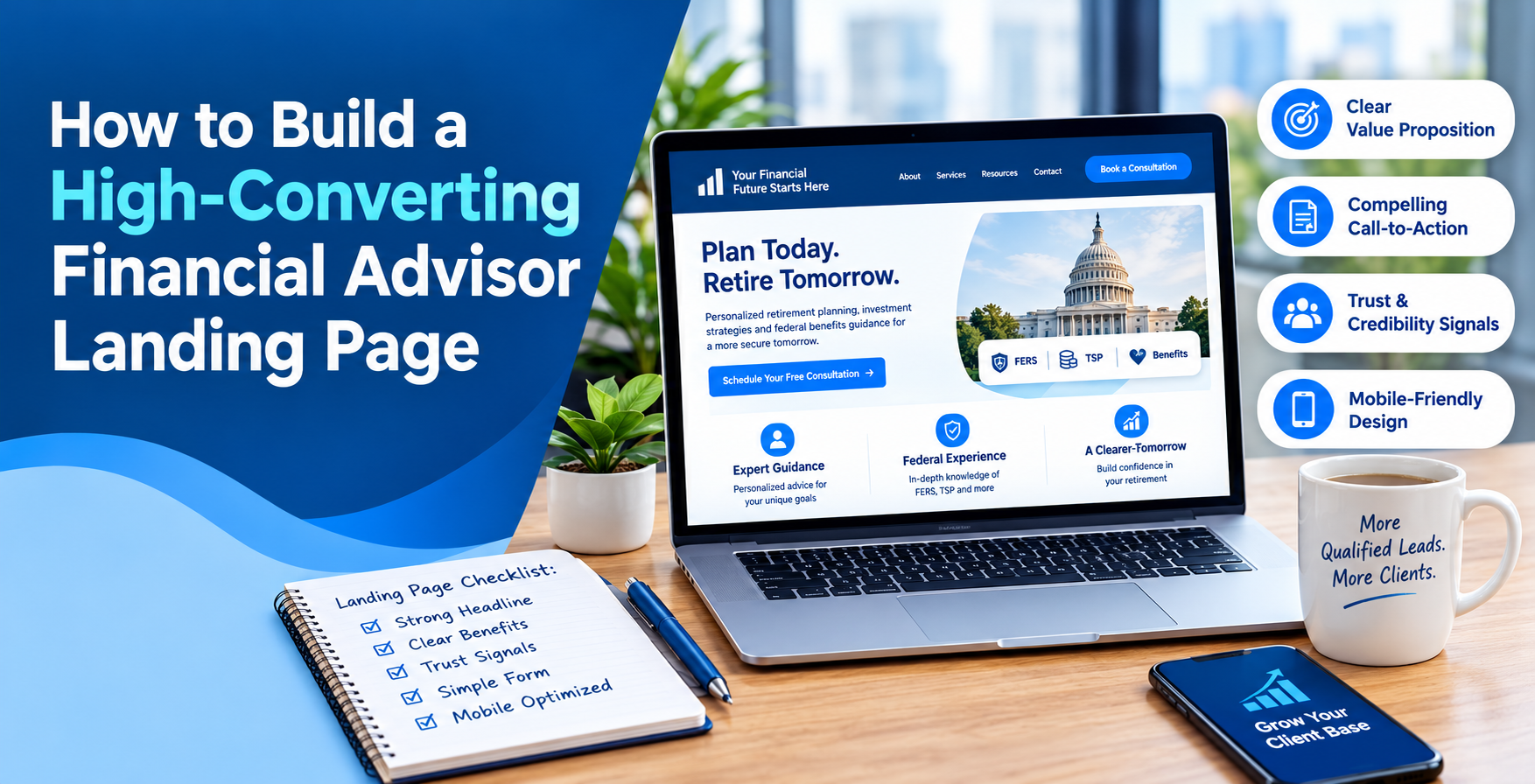
A successful page combines several elements. No single design feature guarantees conversions, but the following components create a clearer and more trustworthy experience.
- Relevant messaging: Visitors immediately understand what the page offers and whom it serves.
- A clear value proposition: The page explains why the service may be useful.
- Credibility indicators: Accurate credentials, transparent business information, and permitted testimonials help establish trust.
- A visible call to action: Visitors know what to do next.
- A simple form: The page requests only the information needed at that stage.
- Mobile-friendly design: Visitors can read the content and complete the form on their devices.
- Prompt follow-up: Inquiries are handled consistently, with clear next steps.
- Performance tracking: The firm measures qualified leads and appointments, not just page visits.
These elements work together. An attractive page may still perform poorly if the offer is unclear, the form is difficult to complete, or the follow-up process is unreliable.
How to Build a High-Converting Financial Advisor Landing Page in 10 Steps
1. Define Your Target Audience and Goal
Identify your ideal prospects, their financial needs, and the action you want them to take, such as booking a consultation or requesting a financial review.
2. Write a Clear, Benefit-Focused Headline
Use a specific headline that explains your offer and connects with your audience’s needs. Avoid vague claims and unnecessary jargon.
3. Explain Your Value Proposition
Clearly communicate who your service helps, what prospects can expect, and how your process works. Avoid guaranteed financial outcomes.
4. Use One Clear Call to Action
Add a prominent CTA, such as “Schedule a Consultation” or “Request a Financial Review,” that guides visitors toward the next step.
5. Create a Simple Lead Capture Form
Request only essential details, such as name, email, and area of interest. Explain how personal information will be used and protect sensitive data.
6. Establish Trust With Credibility Indicators
Show genuine credentials, relevant experience, transparent service information, and permitted testimonials. Include applicable disclosures.
7. Optimize for Mobile Devices and Speed
Use responsive design, readable text, fast-loading images, and easy-to-complete forms. Test the entire booking process on mobile devices.
8. Align the Page With Your Marketing Campaign
Ensure your landing page matches the message of your SEO, paid advertising, email marketing, or webinar campaign. Explore content marketing for financial advisors for additional ideas.
9. Make Appointment Booking Easy
Offer convenient scheduling, confirmation emails, and timely follow-ups. Use a CRM to manage inquiries and track prospects through the booking process. Learn more about financial advisor webinar marketing.
10. Track Performance and Test Improvements
Monitor conversion rates, qualified leads, booked appointments, show rates, and acquisition costs. Test headlines, CTAs, and forms to identify opportunities for improvement.
Metric | Purpose |
Conversion rate | Measures completed actions |
Qualified lead rate | Evaluates lead quality |
Appointment booking rate | Tracks scheduled meetings |
Show rate | Measures attended appointments |
Cost per qualified appointment | Evaluates marketing efficiency |
Conversion rate = (Conversions ÷ Visitors) × 100
Focus on generating relevant inquiries and qualified appointments rather than simply increasing website traffic.
Financial Advisor Landing Page vs. Financial Advisor Homepage
A homepage and a landing page serve different purposes. A homepage introduces the firm and provides access to its broader range of services. A landing page focuses on a specific offer or campaign.
Feature | Landing Page | Homepage |
Primary purpose | Encourage a specific action | Introduce the firm |
Content focus | One audience, service, or offer | Multiple services and topics |
Navigation | Often simplified | Usually includes full website navigation |
Main CTA | One primary conversion action | Several possible actions |
Typical traffic | Targeted campaigns and specific search queries | Branded searches, referrals, and general website visits |
Performance measurement | Page and campaign conversions | Overall website engagement and conversions |
Best use | Generating relevant inquiries and bookings | Helping visitors explore the business |
Neither option replaces the other. The homepage establishes the firm’s overall identity, while a landing page gives a particular audience a more direct path to a relevant offer.
What Common Financial Advisor Landing Page Mistakes Should You Avoid?
Avoid these common mistakes to improve your landing page’s performance:
- Promoting Too Many Services: Focus on one audience and offer.
- Using Vague Headlines: Clearly explain the service and its benefits.
- Requesting Too Much Information: Keep forms short and relevant.
- Making Unsupported Claims: Avoid guaranteed returns or misleading promises.
- Hiding Important Information: Display clear CTAs, firm details, disclosures, and privacy information.
- Ignoring Follow-Up: Respond to inquiries promptly and consistently.
- Tracking Only Traffic: Measure qualified leads and booked appointments.
- Skipping Testing: Check page speed, forms, mobile usability, and booking links.
Fixing these issues can improve user experience and help generate more qualified leads.
How Does a Landing Page Fit Into a Financial Advisor Lead Generation Strategy?
A landing page supports the financial advisor lead generation process by turning marketing traffic into inquiries and potential appointments.
The typical funnel is:
Traffic → Lead → Qualification → Appointment → Consultation → Potential Client
- Traffic: Attract visitors through SEO, ads, email, and webinars.
- Lead: Collect relevant prospect information.
- Qualification: Assess whether prospects fit the firm’s services.
- Appointment: Make scheduling easy.
- Consultation: Discuss needs and explain services.
- Potential Client: Move suitable prospects toward onboarding.
Track each stage to identify issues, improve follow-up, and generate more qualified appointments.
When Should You Hire a Financial Services Marketing Agency?
Managing a landing page involves more than writing copy and choosing a layout. Firms may need support with audience research, content, SEO, advertising, conversion tracking, CRM integration, and lead follow-up.
Working with a specialized financial services marketing agency may be worth considering when:
- Website visitors are not turning into relevant inquiries.
- Marketing campaigns generate leads but few qualified appointments.
- The firm struggles to follow up consistently.
- Internal resources are limited.
- Different marketing channels are operating without a coordinated strategy.
- The business lacks reliable reporting on lead quality and acquisition costs.
Before selecting a partner, ask how the agency defines a qualified lead, what reporting it provides, how it handles data, and how it coordinates with the firm’s compliance process.
Also clarify what is included in the engagement. Landing page design alone may not cover advertising, SEO, CRM setup, or appointment-setting support.
A suitable partner should be able to explain its approach, establish measurable objectives, and report on performance without promising guaranteed results.
How Much Does It Cost to Build a Financial Advisor Landing Page?
The cost depends on the scope of the project, the technology involved, and the level of ongoing support required.
A simple page built with an existing website platform may require less investment than a custom landing page with CRM integration, appointment scheduling, analytics configuration, and multiple audience-specific variations.
Common cost factors include:
- Copywriting and audience research
- Design and development
- Mobile optimization and performance improvements
- Forms, CRM integration, and calendar booking
- Analytics and conversion tracking
- Compliance review and revisions
- Ongoing testing and maintenance
When comparing providers, look beyond the initial build price. Ask what deliverables are included, who owns the page and its data, whether ongoing optimization is covered, and what additional software or campaign costs may apply.
The right investment depends on the firm’s objectives and resources. Evaluate the page in the context of qualified appointments and overall acquisition costs rather than expecting the lowest-priced option to deliver the best results.

Final Thoughts: Build a Financial Advisor Landing Page That Converts
A high-converting financial advisor landing page starts with a clear understanding of the audience and the action the firm wants visitors to take. A relevant headline, a convincing value proposition, a simple form, credible information, and an easy booking process help create a focused experience. Aligning your landing page with a clear financial advisor appointment scaling strategy can also help connect marketing efforts with appointment goals as your firm grows.
However, the page is only one component of the wider marketing strategy. SEO, paid campaigns, email marketing, webinars, and consistent follow-up all contribute to the journey from an initial visit to a qualified consultation.
Financial firms should measure success through relevant inquiries, booked appointments, attendance, and eventual client acquisition not just page views or form submissions.
For advisors and insurance agents looking to improve this process, Revenx’s booked appointment generation services can be a starting point for exploring how content, digital marketing, and appointment generation work together. The priority is to build a measurable system that attracts suitable prospects and gives them a clear, trustworthy path to the next conversation.
FAQs About Financial Advisor Landing Pages
1. What is a financial advisor landing page?
A financial advisor landing page is a dedicated web page designed to encourage a specific action, such as booking a consultation, requesting information, or registering for a webinar. It focuses on a particular audience and offer rather than presenting every service the firm provides.
2. How do you create a high-converting financial advisor landing page?
Start by defining your audience and conversion goal. Write a clear headline, explain the offer, add a visible CTA, use a simple lead form, include genuine credibility indicators, optimize the page for mobile devices, and make appointment booking straightforward. Track qualified leads and test improvements over time.
3. What should a financial advisor landing page include?
Most pages benefit from a relevant headline, a clear value proposition, a description of the service, an appropriate CTA, a simple form or booking option, accurate firm information, privacy information, and applicable disclosures. The exact elements depend on the audience and the conversion goal.
4. How can a financial advisor landing page generate qualified leads?
A focused page explains who the service is intended for, what the offer involves, and what happens next. Relevant traffic, appropriate qualification questions, clear expectations, and consistent follow-up help the firm distinguish suitable prospects from general inquiries.
5. What is a good conversion rate for a financial advisor landing page?
There is no single conversion rate that applies to every financial advisor landing page. Results vary by traffic source, audience, offer, device, and the action being measured. Establish a baseline, track qualified inquiries and appointments, and compare performance over time using consistent definitions.
Disclaimer:
This article is for informational and educational purposes only and does not constitute financial, investment, legal, or compliance advice. Marketing results vary based on audience, offer, traffic source, and implementation. Financial firms should review applicable regulatory, privacy, and advertising requirements before publishing landing pages or launching campaigns.