- Written & Reviewed by Jeremy
- Published
- Last Updated Oct 26, 2026
A potential client visits your website, requests a consultation, or registers for a webinar. They show interest in your services, but after the first interaction, they stop responding. You send a follow-up email, wait a few days, and eventually move on to other prospects.
For financial advisors and insurance agents, this situation is common. However, a prospect who stops responding is not necessarily a prospect who will never become a client.
They may be busy, comparing providers, waiting for the right time, or looking for answers before scheduling a meeting. Without a consistent follow-up process, these opportunities can disappear from your pipeline.
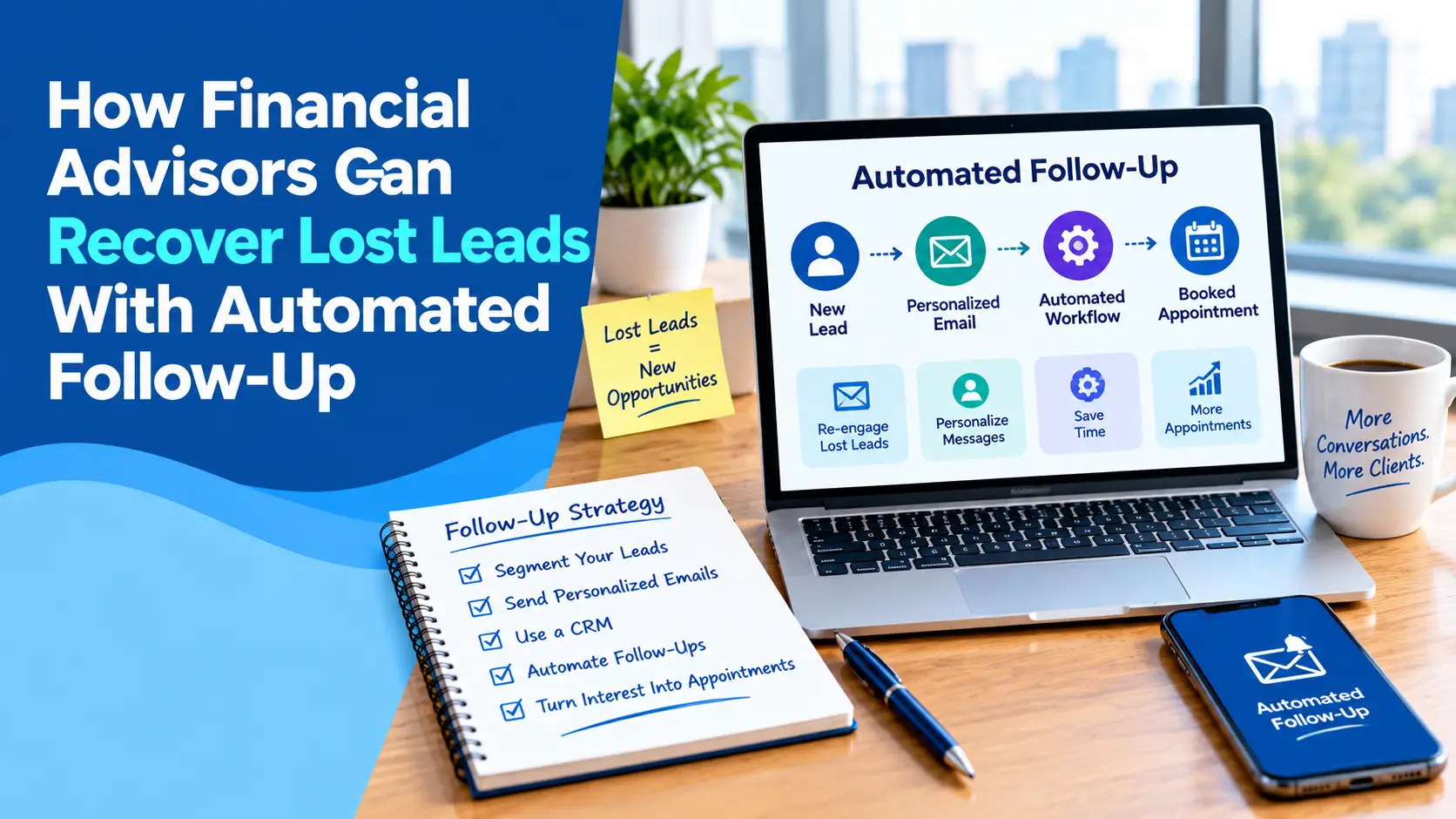
Automated follow-up helps financial advisors reconnect with inactive prospects through timely messages, relevant resources, and appointment reminders. When combined with a customer relationship management (CRM) system and personal communication, it can help advisors manage leads more consistently and identify prospects who are ready for a conversation.
In this guide, we will explain why financial advisors lose leads, how automated follow-up works, how to build a practical follow-up sequence, and how to measure whether your efforts are generating qualified appointments.
What Does It Mean to Recover Lost Leads?
Recovering lost leads means reconnecting with prospects who previously expressed interest in your services but did not move forward.
These prospects may have completed a contact form, attended a webinar, requested information about insurance, or scheduled a consultation they later postponed.
Not every inactive prospect has the same needs, so it helps to understand the difference between several types of leads.
- Cold leads: People who have shown little recent interest or have not engaged with your outreach.
- Unresponsive leads: Prospects who expressed interest but have stopped replying.
- Incomplete leads: People who started a booking or inquiry process but did not finish it.
- Nurture-ready leads: Prospects who may need more information or time before making a decision.
- Disqualified leads: People who do not meet your firm’s criteria or have clearly indicated that they are not interested.
The goal is not to contact every person indefinitely. It is to identify prospects who may still benefit from a conversation and give them a relevant, convenient way to reconnect.
Why Some Leads Are Not Really Lost
Financial decisions often require research and careful consideration. Someone exploring retirement planning, investment management, or insurance coverage may not be ready to schedule a meeting immediately.
A useful educational email or a simple invitation to revisit an earlier conversation may be enough to restart communication.
When Should Financial Advisors Revisit Old Leads?
Consider reviewing inactive leads from:
- Previous consultation requests.
- Webinar registrations and attendees.
- Prospects who postponed appointments.
- Website inquiries that received an initial response.
- People who requested educational resources but did not take another step.
Before contacting anyone, check their communication preferences, consent status, previous interactions, and any opt-out requests.
Why Financial Advisors Lose Potential Clients
Financial advisors often lose potential clients because of inconsistent communication, delayed responses, and poor lead management.
1. Slow Responses to New Inquiries
Delayed responses can cause prospects to lose interest or contact another advisor. Automated acknowledgments help ensure timely communication.
2. Inconsistent Follow-Up
Busy schedules can lead to missed follow-ups. CRM reminders and automated workflows help advisors stay organized.
3. Generic Messages
Irrelevant emails often fail to engage prospects. Personalized messages based on their interests can encourage responses.
4. No Clear Next Step
Vague messages make it difficult for prospects to act. Offer a clear next step, such as booking a consultation or reviewing a helpful resource.
5. Poor Lead Tracking
Without proper tracking, advisors may miss opportunities or contact prospects unnecessarily. A CRM helps manage lead status and communication history.
How Automated Follow-Up Helps Recover Lost Leads
Automated follow-up helps financial advisors reconnect with inactive prospects through scheduled messages, CRM workflows, and appointment reminders. It reduces manual work while keeping communication consistent and relevant.
Respond to Inquiries More Consistently
Automated confirmations acknowledge new inquiries and provide clear next steps, such as booking a consultation.
Send Personalized Follow-Up Messages
Use CRM information to share relevant resources and follow up based on a prospect’s interests and previous interactions.
Re-Engage Prospects at the Right Time
Schedule helpful messages based on lead activity and communication preferences instead of sending repeated sales pitches.
Reduce Missed Appointments
Send appointment confirmations, reminders, and rescheduling links to help prospects manage their meetings.
Identify Leads Ready for a Conversation
Notify advisors when prospects reply, ask questions, or show interest in booking an appointment so the team can respond personally.
How to Build an Automated Follow-Up System for Financial Advisors
A simple, well-organized follow-up system helps financial advisors manage leads, save time, and improve appointment opportunities.
Step 1: Organize and Segment Existing Leads
Group leads by status, such as new inquiries, unresponsive prospects, webinar attendees, and postponed appointments. This helps you send relevant messages.
Step 2: Choose the Right CRM and Automation Tools
Select tools that support email automation, appointment reminders, lead tracking, reply notifications, and secure data management.
Step 3: Create a Follow-Up Sequence
Plan when to send confirmations, helpful resources, and appointment invitations. Keep messages relevant and avoid excessive outreach.
Step 4: Personalize Every Touchpoint
Use the prospect’s original inquiry and interests to make messages more useful than generic sales emails.
Step 5: Set Clear Conversion Goals
Track responses, booked consultations, attended appointments, and qualified leads to measure performance.
Step 6: Define When a Human Should Step In
Notify an advisor when prospects reply, ask detailed questions, or show interest in a consultation. Automation should support—not replace—personal communication.
What Should an Automated Follow-Up Sequence Look Like?
A follow-up sequence should provide enough opportunities for a prospect to reconnect without overwhelming them.
The following is an example that financial advisors can adapt to their own process.
Timing | Follow-up action | Purpose |
Immediately after inquiry | Send a confirmation and relevant next step | Acknowledge the inquiry |
Day 1 | Share a helpful educational resource | Address an initial question |
Day 3 | Send a personalized check-in | Invite a response |
Day 7 | Offer a consultation or scheduling link | Make booking convenient |
Day 14 | Send a final check-in or relevant resource | Provide another opportunity to reconnect |
Later, if appropriate | Add to a relevant nurture sequence | Maintain contact over time |
This is an illustrative schedule, not a universal rule. The appropriate timing depends on the prospect’s original request, preferences, engagement, and applicable communication requirements.
Stop marketing outreach when someone opts out or asks not to be contacted. Avoid sending additional messages simply because a workflow has more steps remaining.
Example: Recovering a Prospect Who Stopped Responding
Imagine that a prospect requests a retirement planning consultation but does not book an appointment after receiving the initial response.
Instead of repeatedly sending sales messages, your system could acknowledge the original inquiry, share a useful retirement planning checklist, and later offer a convenient way to schedule a meeting.
If the prospect responds with a question, the automated sequence should pause and notify the appropriate team member.
This approach gives the prospect a useful reason to reconnect while keeping the advisor involved when personal attention matters.
Automated Follow-Up vs. Manual Follow-Up: Which Works Better?
Both methods can support lead recovery. The best approach depends on the task, the prospect’s needs, and the firm’s workflow.
Factor | Manual follow-up | Automated follow-up |
Consistency | Depends on staff availability and reminders | Follows predefined workflows |
Personalization | Allows direct, individual communication | Can use CRM information and tailored templates |
Scalability | Requires more staff time as lead volume grows | Supports repetitive tasks across larger lead lists |
Relationship building | Strong for individual conversations | Works best alongside human interaction |
Tracking | May require manual recordkeeping | Can log activity and workflow outcomes |
Best use | Complex questions and personal conversations | Routine reminders, acknowledgments, and nurturing |
For most firms, a hybrid approach is practical. Automation handles repetitive administrative tasks, while advisors and appointment-setting teams focus on qualification, questions, and relationship building.
The objective is not to eliminate human contact. It is to make sure valuable conversations are less likely to be missed.
How Email Marketing and CRM Automation Work Together
Email marketing and CRM automation serve different but complementary purposes.
Email provides a way to deliver relevant educational content, while the CRM helps determine who should receive it, when it should be sent, and what action should follow.
Use Email to Deliver Relevant Educational Content
Financial advisors can share helpful articles, webinar invitations, planning checklists, and explanations of common financial questions.
Useful content gives prospects a reason to remain engaged without turning every message into a sales pitch.
For more guidance, read Financial Email Marketing Compliance: What Advisors Must Know.
Use CRM Workflows to Trigger the Next Step
A booking, reply, registration, or change in lead status can trigger an appropriate workflow.
For example, a webinar attendee might receive a follow-up resource, while someone who books a consultation should receive confirmation and appointment details rather than more messages asking them to book. These workflows can also help agencies and IMOs coordinate lead follow-up and manage prospect engagement more consistently.
These workflows should be tested regularly to prevent duplicate messages, incorrect segmentation, and unnecessary outreach.
Keep Follow-Up Relevant and Compliant
Financial services marketing requires careful attention to privacy, communication preferences, and applicable regulations.
Depending on the channel and circumstances, firms may need to comply with the CAN-SPAM Act, the Telephone Consumer Protection Act (TCPA), applicable state privacy laws, and industry-specific rules.
Use accurate sender information, provide required unsubscribe mechanisms, maintain appropriate consent records, and review marketing messages under your firm’s compliance procedures. Requirements vary by communication method and situation, so design automation with compliance oversight rather than treating it as a substitute. A well-structured booked appointments strategy can help financial advisors connect lead follow-up processes with their client acquisition goals while maintaining appropriate compliance oversight.
How to Measure Whether Your Lead Recovery Strategy Is Working
Track these key metrics to understand whether your automated follow-up is generating meaningful results.
1. Lead Re-Engagement Rate
Measure how many inactive prospects respond or interact with your follow-up messages.
2. Appointment Booking and Attendance Rates
Track how many re-engaged leads book consultations and attend scheduled meetings.
3. Qualified Appointment Rate
Measure how many booked appointments meet your firm’s criteria for potential clients.
4. Follow-Up Performance by Channel
Compare responses, bookings, attendance, and opt-outs across your communication channels.
Tip: Review these metrics regularly and adjust your messaging, timing, and lead segmentation to improve results.
Common Mistakes to Avoid When Automating Lead Follow-Up
Avoid these common mistakes to keep your follow-up process effective and professional.
- Sending too many messages: Follow a reasonable schedule and respect communication preferences.
- Using generic messages: Personalize follow-ups based on each prospect’s interests.
- Ignoring replies: Notify team members when prospects respond.
- Ignoring opt-outs: Stop marketing messages when prospects unsubscribe or request no further contact.
- Maintaining inaccurate CRM records: Update lead statuses and remove duplicate records.
- Making unsupported claims: Avoid guaranteed financial outcomes or unsubstantiated marketing promises.
- Tracking the wrong metrics: Focus on qualified appointments and meaningful engagement, not just email activity.
Tip: Keep your automation simple, relevant, and regularly monitored to build better prospect relationships.
When Should Financial Advisors Consider Professional Lead Follow-Up Support?
Some firms have enough internal resources to manage their follow-up process. Others may need outside help to connect marketing campaigns, CRM automation, and appointment setting.
Professional support may be worth considering when:
- Your firm receives inquiries but struggles to respond consistently.
- Advisors spend too much time on repetitive administrative outreach.
- Leads arrive through multiple channels without centralized tracking.
- Prospects regularly fail to complete appointment bookings.
- Your team cannot clearly identify which leads need attention.
- Your existing marketing campaigns generate interest but few qualified conversations.
Before hiring a marketing partner, review its experience with financial services, CRM workflows, lead qualification, and compliance-sensitive messaging.
Ask how it measures performance, protects prospect data, handles opt-outs, and coordinates automated communication with human follow-up.
It is also worth reviewing what actually brings financial advisors clients and what doesn’t to understand how follow-up fits into a broader client acquisition strategy.
How Revenx Can Help Financial Advisors Re-Engage Leads
Recovering inactive leads requires more than sending a few additional emails. Financial firms need a coordinated process that connects initial inquiries, relevant follow-up, lead qualification, and appointment scheduling.
Revenx helps financial services businesses approach client acquisition through marketing and appointment-focused strategies. Depending on your firm’s needs, a structured approach can help organize lead nurturing, improve follow-up consistency, and create a clearer path from initial interest to a qualified conversation.
For firms that use webinars to attract prospects, financial advisor webinar marketing offers another way to connect educational engagement with the next step in the client journey.
You can also explore content marketing for financial advisors to see how relevant resources can support ongoing lead nurturing.
The right approach depends on your existing lead volume, tools, team capacity, and business objectives. Focus on building a process that supports real conversations rather than relying on automation alone.

Final Thoughts: Recover Lost Leads With Automated Follow-Up
Improving lead nurturing does not necessarily require more marketing software or a larger advertising budget.
Automated follow-up gives financial advisors a practical way to manage these opportunities through organized lead records, relevant messages, scheduled reminders, and timely human intervention.
Start by reviewing your inactive leads, identifying why they stopped progressing, and grouping them according to their needs. Then create a simple follow-up sequence, measure qualified appointments, and refine the process based on actual results.
Most importantly, make every interaction useful and respectful. Automation should help your team communicate more consistently, not overwhelm prospects with unnecessary messages.
If your firm is generating leads but struggling to turn them into meaningful conversations, consider reviewing your follow-up and appointment-setting process with Revenx. A more organized approach can help your team make better use of existing opportunities while keeping the prospect experience at the center of your strategy.
FAQs About Recovering Lost Leads With Automated Follow-Up
1. How can financial advisors recover lost leads with automated follow-up?
Financial advisors can recover inactive leads by organizing prospects in a CRM, identifying their interests, and sending relevant follow-up messages at appropriate intervals. Educational resources, personalized emails, and convenient scheduling links can encourage prospects to reconnect. Timely human follow-up helps turn renewed interest into meaningful conversations.
2. What is the best follow-up system for financial advisors?
The best follow-up system combines a customer relationship management (CRM) platform, email automation, appointment scheduling, and lead qualification. It should track communication history, organize prospects, and notify team members when leads respond. The right system depends on the firm’s needs, budget, existing tools, and compliance requirements.
3. How often should financial advisors follow up with leads?
Financial advisors should follow up according to the prospect’s original inquiry, engagement, and communication preferences. A practical sequence may include an initial acknowledgment, a helpful resource, and a later appointment invitation. Avoid excessive messages, respect opt-out requests, and adjust the timing based on responses.
4. Can automated emails help financial advisors convert cold leads?
Yes, automated emails can help financial advisors re-engage cold leads by sharing relevant educational content, addressing common questions, and offering a clear next step. Results depend on message relevance, timing, and the prospect’s interest. Automation supports the process but cannot guarantee responses, appointments, or new clients.
5. Is automated follow-up compliant with financial services marketing regulations?
Automated follow-up can support compliant marketing when workflows account for applicable consent requirements, unsubscribe requests, privacy protections, recordkeeping, and industry regulations. Financial firms should review their messages and automation processes with their compliance professionals. Using automation does not remove responsibility for marketing communications.