- Written & Reviewed by Jeremy
- Published
- Last Updated Oct 12, 2026
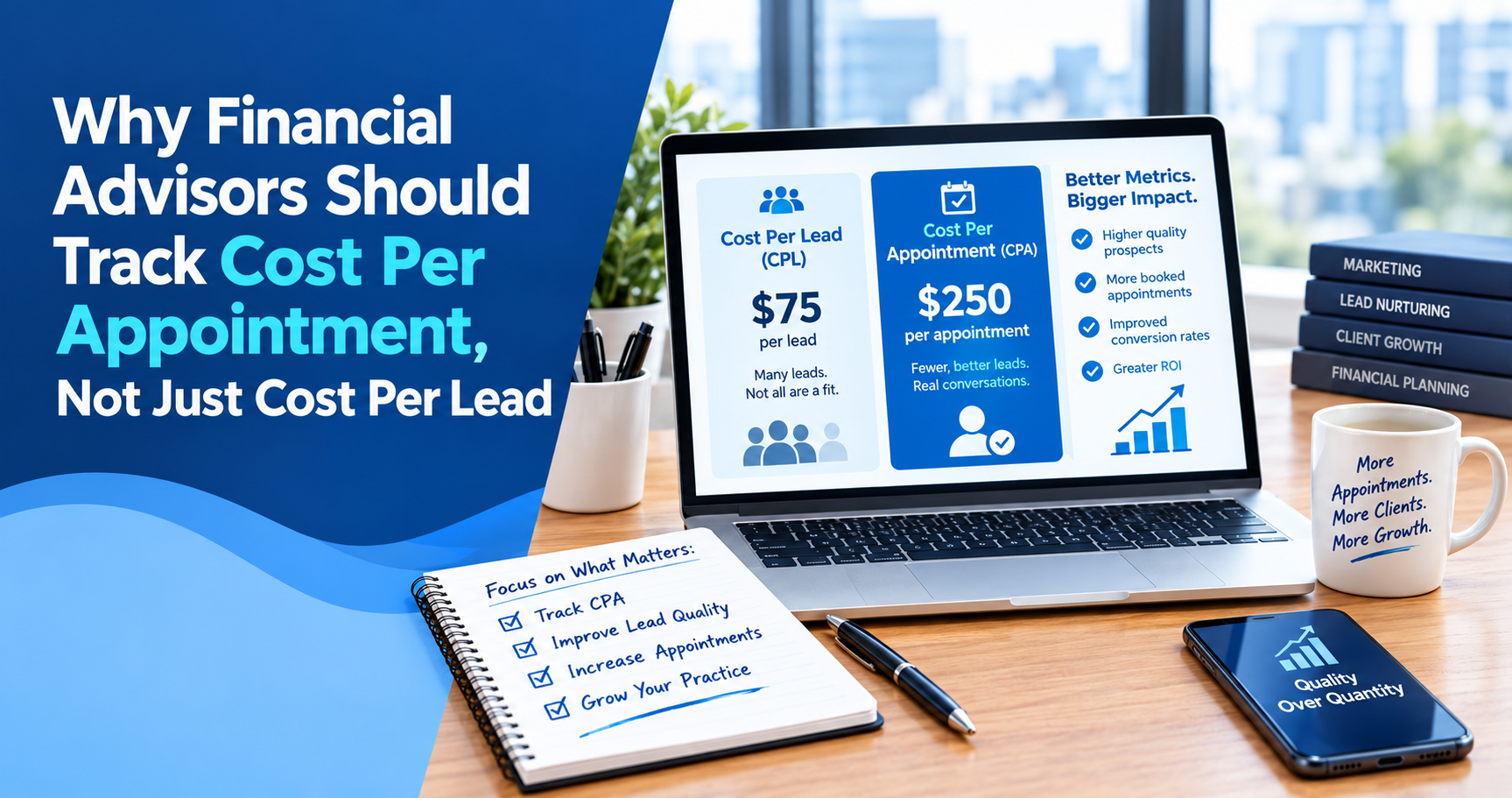
Financial advisors often measure marketing success by how many leads a campaign generates and how much each lead costs. But a low cost per lead does not necessarily mean a campaign is bringing in more prospective clients. If those leads never respond, schedule a meeting, or show up for an appointment, the campaign may not be delivering the results the firm needs.
That is why tracking cost per booked appointment matters. This metric helps financial advisors understand how much they spend to turn marketing interest into a scheduled conversation. Strategies such as SEO for financial advisors can help attract potential clients through organic search. When combined with cost per lead, appointment attendance, and client acquisition data, it provides a clearer picture of marketing performance.
For financial advisors and insurance agents investing in lead generation, the goal is not simply to collect contact details. The goal is to connect with relevant prospects who want to discuss their financial needs.
In this guide, we explain how to calculate cost per booked appointment, how it differs from cost per lead, which factors influence it, and how financial firms can use it to make better marketing decisions.
What Is Cost Per Booked Appointment?
Cost per booked appointment measures how much a business spends to generate one scheduled appointment through its marketing and lead-generation activities.
For financial advisors, this could mean a prospect booking a retirement planning consultation, an insurance review, or an introductory meeting with an advisor. Using AI marketing for financial advisors can help firms explore ways to streamline marketing workflows and improve prospect engagement.
Unlike cost per lead, which measures the expense of acquiring a lead, cost per booked appointment focuses on the next stage of the marketing process: getting someone to schedule a conversation.
How to Calculate Cost Per Booked Appointment
The formula is straightforward:
Cost Per Booked Appointment = Total Marketing Costs ÷ Number of Appointments Booked
For example, suppose a financial advisory firm spends $3,000 on a marketing campaign and generates 30 booked appointments.
The calculation would be:
$3,000 ÷ 30 = $100 per booked appointment
This means the firm spent an average of $100 to generate each scheduled meeting.
However, the calculation depends on which expenses are included. A media-only calculation might include advertising spend alone, while a fully loaded calculation could also include agency fees, marketing software, creative production, and campaign management.
Both approaches can be useful, but firms should apply the same cost definition when comparing campaigns.
Booked Appointments vs. Attended Appointments
A booked appointment is not necessarily a completed conversation. Some prospects cancel, reschedule, or fail to attend.
This is why financial advisors should also track cost per attended appointment.
Suppose the campaign above generates 30 bookings, but only 20 prospects attend. If the campaign costs $3,000, the cost per attended appointment is:
$3,000 ÷ 20 = $150 per attended appointment
The original campaign cost per booking remains $100, but the cost of generating an actual conversation is $150.
Tracking both metrics helps firms identify whether the main problem is generating bookings or getting prospects to attend.
What Is Cost Per Lead, and Why Is It Not Enough?
Cost per lead (CPL) measures how much a business spends to acquire one lead through a marketing campaign.
The formula is:
Cost Per Lead = Total Marketing Costs ÷ Number of Leads Generated
For example, if a firm spends $2,000 and generates 100 leads, its cost per lead is $20.
CPL is useful because it helps marketers compare acquisition costs across campaigns and channels. Financial firms can use it to evaluate paid search, social media advertising, organic search, webinar registrations, and other lead-generation activities.
The problem begins when CPL becomes the only metric used to judge success.
The Problem With Focusing Only on Cheap Leads
A campaign can generate inexpensive leads without producing many meaningful sales conversations.
For example, one campaign might generate 100 leads at $20 each, while another generates 40 leads at $50 each. At first glance, the first campaign appears more efficient.
But consider what happens after those leads enter the sales process.
- Campaign A generates 100 leads, of which 10 book appointments.
- Campaign B generates 40 leads, of which 12 book appointments.
Campaign A produces more leads at a lower cost per lead. However, Campaign B generates more appointments despite having fewer leads.
If both campaigns cost $2,000, Campaign A’s cost per booked appointment is $200, while Campaign B’s is approximately $167. Tracking this metric can help financial advisors evaluate their marketing performance and understand how booked appointments fit into their lead generation strategy.
The second campaign produces appointments at a lower cost, even though its leads are more expensive.
This example shows why financial advisor lead generation should be evaluated beyond the initial form submission.
When Cost Per Lead Is Still Useful
CPL remains an important metric. It helps firms understand acquisition costs, monitor advertising efficiency, and identify changes in lead volume.
It is particularly useful when testing new audiences, landing pages, and advertising messages.
However, CPL should be considered an early-stage indicator rather than a complete measure of marketing effectiveness. It becomes more meaningful when reviewed alongside booking rates, attendance rates, and qualified appointment costs.
Cost Per Booked Appointment vs. Cost Per Lead: Key Differences
Both metrics measure marketing performance, but they answer different questions.
Metric | What It Measures | What It Helps You Understand | Main Limitation |
Cost per lead | Cost to acquire a lead | Lead acquisition efficiency | Does not show whether leads book |
Cost per booked appointment | Cost to generate a scheduled meeting | Efficiency of turning leads into bookings | Does not guarantee attendance |
Cost per attended appointment | Cost to generate a completed meeting | Efficiency of generating actual conversations | Does not guarantee client conversion |
Cost per acquired client | Cost to acquire a new client | Overall client acquisition efficiency | Requires longer-term tracking |
These metrics represent different stages of the marketing and sales process.
Cost per lead shows how efficiently a firm attracts potential prospects. Cost per booked appointment shows whether those prospects take the next step. Cost per attended appointment reveals how many scheduled meetings become actual conversations. Cost per acquired client connects marketing activity to new business.
The best approach is to track these metrics together rather than choosing one and ignoring the others.
Why Financial Advisors Should Track Cost Per Booked Appointment
Tracking cost per booked appointment helps financial advisors understand how effectively their marketing turns leads into scheduled meetings. It provides a clearer picture of campaign performance than cost per lead alone. Strategies to turn website visitors into booked appointments can help advisors improve conversion rates and get more value from their marketing efforts.
The marketing system can then:
1. It Connects Marketing Spend to Sales Activity
Clicks and leads don’t guarantee conversations. Tracking booked appointments helps advisors measure whether marketing generates actual opportunities.
2. It Helps Evaluate Lead Quality
Booked appointments indicate prospect interest, but advisors should also assess whether prospects fit their services and target audience.
3. It Makes Marketing Channels Easier to Compare
Compare paid ads, SEO, email campaigns, and webinars to identify which channels generate appointments efficiently.
For more insights, read Financial Advisor Marketing: What Actually Brings You Clients (and What Doesn’t).
4. It Helps Identify Funnel Bottlenecks
If many leads generate few bookings, review follow-up speed, messaging, lead qualification, and scheduling before increasing marketing spend.
How to Calculate and Interpret Cost Per Booked Appointment
Accurate tracking requires consistent cost calculations and appointment records.
Step 1: Calculate Total Marketing Costs
Include relevant expenses such as advertising, agency fees, software, campaign management, and content production. Keep media-only and fully loaded costs separate when comparing campaigns.
Step 2: Count Booked Appointments
Count confirmed bookings and use a CRM system to track cancellations, rescheduled meetings, and duplicate appointments.
Step 3: Calculate the Cost
Formula: Cost Per Booked Appointment = Total Marketing Costs ÷ Booked Appointments
For example, spending $4,000 to generate 40 appointments results in a cost of $100 per booked appointment.
Step 4: Measure Attendance and Qualification
If 30 appointments are attended and 18 are qualified:
- Cost per booked appointment: $100
- Cost per attended appointment: $133
- Cost per qualified attended appointment: $222
These metrics help identify where improvements are needed.
Step 5: Compare Performance Over Time
Review monthly or quarterly results by channel and campaign. Use consistent reporting methods and enough data to make informed marketing decisions.
What Factors Affect Cost Per Booked Appointment?
Several factors influence how much financial firms spend to generate booked appointments.
Target Audience and Lead Intent
Targeting relevant prospects who are actively seeking financial services can improve booking rates compared with broad, less-focused campaigns.
Landing Page and Offer Quality
Clear messaging, relevant information, and a simple booking process help prospects understand the service and take action.
Follow-Up Speed and Consistency
Timely calls, compliant emails, and scheduling links help firms respond to inquiries and encourage interested prospects to book.
Appointment Scheduling Experience
Limited availability, complicated forms, and unclear confirmations can discourage bookings. Keep scheduling simple across desktop and mobile devices.
Campaign Costs and Competition
Advertising costs vary by channel, audience, location, and competition. Evaluate appointment quality, attendance, and conversion outcomes rather than focusing on cost alone.
How Financial Advisors Can Improve Cost Per Booked Appointment
Financial advisors can reduce appointment costs by improving lead quality, follow-up, and the booking process.
Improve Lead Qualification
Define your ideal prospect and use relevant questions to identify leads whose needs match your services. Review lead quality regularly to refine targeting.
Strengthen Landing Pages and Calls to Action
Explain the appointment’s purpose clearly and simplify scheduling. Test page content and calls to action to identify what improves booking rates.
Create a Consistent Follow-Up Process
Respond promptly to inquiries and use appropriate follow-up messages, scheduling links, and reminders. Track response times and booking rates.
Use Email Marketing and Webinars Strategically
Educational emails and webinars can build trust and encourage interested prospects to book consultations. Follow financial email marketing compliance guidelines and explore webinar strategies for generating qualified appointments.
Optimize Based on Performance Data
Identify channels with low booking or attendance rates and investigate targeting, messaging, and follow-up. Focus on generating relevant appointments rather than simply choosing the lowest-cost leads.
How CRM and Marketing Automation Help Track Appointment Costs
Reliable tracking becomes difficult when lead sources, marketing expenses, and appointment records are spread across separate systems.
A CRM and appropriate marketing automation tools can help connect these activities.
Connect Leads to Their Marketing Sources
Record where each lead originated, such as paid search, organic search, a webinar, an email campaign, or a referral.
Campaign tags and consistent source tracking help firms understand which channels contribute to bookings.
Where practical, compare first-touch and last-touch attribution. The first-touch model records the initial known source, while the last-touch model records the most recent source before a conversion. Neither necessarily captures the full customer journey.
Track the Full Appointment Funnel
Financial advisors should consider monitoring these stages:
- Lead generated
- Lead contacted
- Appointment booked
- Appointment attended
- Prospect qualified
- Client acquired, where applicable
Tracking these stages helps teams identify conversion gaps and understand how marketing activity relates to business outcomes.
Build a Simple Marketing Performance Dashboard
A useful dashboard may include:
- Total marketing spend
- Number of leads
- Cost per lead
- Lead-to-appointment booking rate
- Number of booked appointments
- Cost per booked appointment
- Appointment attendance rate
- Cost per attended appointment
- Qualified appointments
- Client acquisition cost, where measurable
Review the dashboard regularly and check for duplicate records, missing campaign sources, and inconsistent appointment statuses.
Common Mistakes Financial Advisors Make When Measuring Appointment Costs
Even when firms track appointment costs, inconsistent reporting can lead to poor decisions.
Using different cost definitions: Comparing one campaign’s media-only cost with another campaign’s fully loaded cost can distort the results.
Counting every booking as qualified: A scheduled meeting may not match the firm’s target audience or service offering.
Ignoring cancellations and no-shows: Bookings alone do not reveal how many actual conversations take place.
Making decisions with too little data: A small number of appointments may not provide a reliable basis for changing the marketing strategy.
Relying on one attribution model: Prospects may interact with several channels before booking. Crediting the entire outcome to one interaction can oversimplify the process.
Focusing on volume instead of outcomes: More leads do not necessarily produce more attended appointments or clients.
Ignoring operational costs: Advertising spend alone may understate the total cost of generating appointments.
Treating appointments as guaranteed revenue: A booked meeting is a step in the sales process, not proof that a prospect will become a client.
Avoiding these mistakes makes marketing reports more useful and helps financial firms allocate resources more carefully.
How to Decide Whether Your Cost Per Booked Appointment Is Good
There is no universal cost per booked appointment that works for every financial advisory firm.
The appropriate target depends on the firm’s services, target audience, marketing channel, appointment quality, attendance rate, and client conversion economics.
Rather than relying on a generic industry benchmark, firms can work backward from their own results.
Work Backward From Client Acquisition Economics
Consider an illustrative example:
- 100 booked appointments
- 50% attendance rate
- 20% conversion rate from attended appointments to new clients
- $10,000 in marketing costs
If 50 of the 100 booked appointments are attended and 20% of those attended meetings result in new clients, the firm acquires approximately 10 clients.
The marketing cost per acquired client would be:
$10,000 ÷ 10 = $1,000 per acquired client
This is an illustrative marketing cost, not a complete measure of profitability. It excludes other business expenses and assumes the stated conversion rates hold.
The example shows why appointment cost should be considered alongside attendance and client conversion.
Balance Cost With Quality
A campaign generating appointments at $80 each may appear more attractive than one generating them at $120 each. However, the more expensive campaign could still be preferable if it consistently generates more relevant, attended appointments and stronger client conversion.
Evaluate cost alongside:
- Prospect relevance
- Appointment attendance
- Qualification rate
- Client conversion rate
- Client acquisition costs
- Longer-term business outcomes, where measurable
This provides a more balanced basis for making marketing decisions.
When Should a Financial Advisor Reassess Their Marketing Strategy?
Financial advisors should review their marketing process when campaign results no longer support their growth objectives.
Common warning signs include:
- Lead costs are increasing without better booking outcomes.
- Lead volume is high, but appointment bookings remain low.
- Many prospects cancel or fail to attend.
- One channel generates leads that rarely match the firm’s services.
- The team cannot connect marketing spending with appointment outcomes.
- Follow-up is inconsistent or difficult to measure.
- The firm’s audience, services, or growth goals have changed.
Sometimes the answer is to improve the existing campaign. In other cases, the firm may need better tracking, a more consistent follow-up process, or support from a specialized financial services marketing agency.
Before increasing the budget, identify which part of the process needs improvement.

Final Thoughts: Measure the Appointments That Move Your Business Forward
Cost per lead remains a useful marketing metric, but it does not tell the whole story. Financial advisors also need to understand whether leads turn into booked appointments, whether those appointments take place, and whether the conversations involve relevant prospects. A well-structured financial advisor marketing strategy can help advisors evaluate these metrics and focus on lead quality and appointment outcomes.
Tracking cost per booked appointment helps firms evaluate this middle stage of the marketing funnel. Adding attendance, qualification, and client acquisition data provides a more complete picture.
Start by reviewing the last 30–90 days of campaign data, where available. Compare the costs of generating leads, booked appointments, and attended appointments across channels. Then identify the largest drop-off and test improvements in targeting, follow-up, or scheduling. Financial advisor retargeting can also help you reconnect with prospects who have previously interacted with your campaigns but haven’t booked an appointment.
The objective is not simply to generate cheaper leads. It is to build a measurable process for generating relevant conversations and making better use of marketing spend.
Revenx can help financial firms assess their appointment-generation process, identify gaps in campaign tracking, and develop a more measurable marketing strategy.
FAQs About Cost Per Booked Appointment
1. What Is Cost Per Booked Appointment?
Cost per booked appointment measures the average marketing cost to generate one scheduled meeting. Calculate it by dividing total marketing costs by the number of appointments booked during the same period.
2. How Is Cost Per Booked Appointment Different From Cost Per Lead?
Cost per lead measures the cost of acquiring a lead, while cost per booked appointment measures the cost of turning leads into scheduled meetings. Tracking both helps financial advisors evaluate marketing performance more effectively.
3. What Is a Good Cost Per Booked Appointment for Financial Advisors?
There is no universal benchmark. The ideal cost depends on the target audience, marketing channel, appointment quality, attendance rate, and client conversion rate.
4. How Can Financial Advisors Reduce Cost Per Booked Appointment?
Advisors can improve targeting, simplify booking forms, strengthen landing pages, respond promptly to inquiries, and use consistent follow-up processes to increase booking efficiency.
5. Should Financial Advisors Track Cost Per Attended Appointment Too?
Yes. Cost per attended appointment measures the cost of generating meetings that actually take place. Tracking it alongside booked appointments helps identify cancellations, no-shows, and opportunities to improve follow-up.
Disclaimer:
This article is for informational and educational purposes only and should not be considered financial, investment, legal, or compliance advice. Marketing costs, appointment conversion rates, and client acquisition results vary based on each firm’s services, target audience, marketing strategy, and business circumstances. The examples and calculations provided are illustrative and do not guarantee specific results. Financial advisors and insurance professionals should evaluate their own data and consult qualified professionals when necessary. Revenx does not guarantee specific marketing performance or business outcomes.