- Written & Reviewed by Jeremy
- Published
- Last Updated Jul 14, 2026
Artificial intelligence is changing how financial advisors attract, engage, and convert prospects. Firms that embrace AI strategically are improving efficiency, generating better-qualified leads, and delivering more personalized client experiences.
Whether you’re an independent financial advisor, wealth manager, or insurance professional, understanding how AI fits into your marketing strategy can help you stay competitive in 2026 and beyond.
What Is AI Marketing for Financial Advisors?
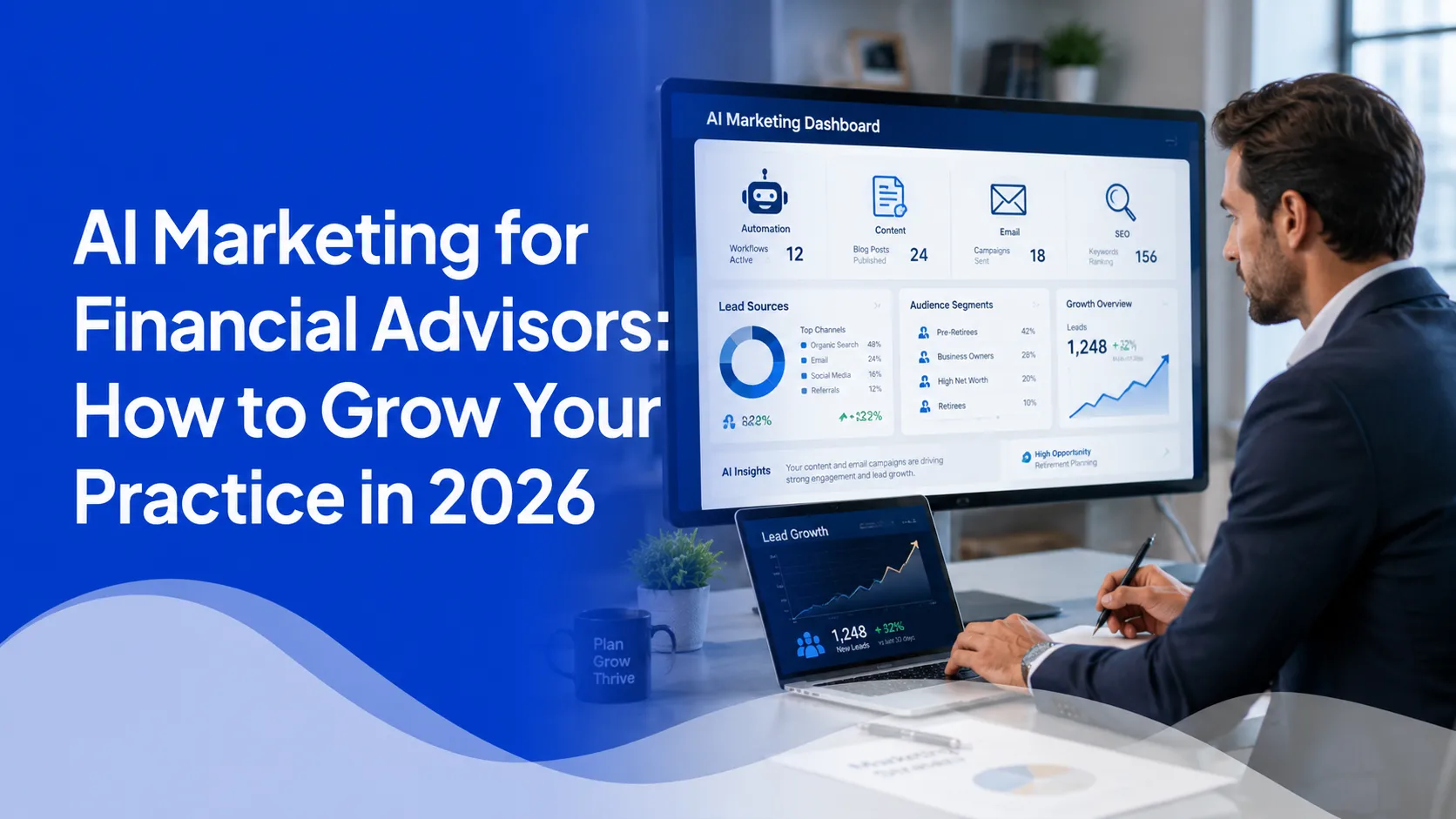
AI Marketing for Financial Advisors is the use of artificial intelligence to improve marketing performance across channels such as search engines, email, websites, social media, paid advertising, and customer relationship management (CRM). Rather than replacing human expertise, AI enhances your ability to reach the right audience with the right message at the right time.
Modern AI tools can analyze large amounts of marketing data, identify patterns, automate repetitive tasks, and provide insights that help advisors make smarter decisions. The result is a more efficient marketing process that saves time while improving lead quality.
For financial advisors, AI can assist with:
- Creating educational blog content
- Optimizing website pages for search engines
- Personalizing email campaigns
- Automating follow-up sequences
- Identifying high-intent prospects
- Improving appointment booking rates
- Analyzing campaign performance
- Generating social media content ideas
- Predicting customer behavior based on engagement data
The goal isn’t simply to automate marketing. It’s to create a more personalized experience for prospects while allowing advisors to focus on what they do best building relationships and providing financial guidance.
Why AI Is Transforming Financial Advisor Marketing in 2026
Consumer expectations have evolved dramatically over the last few years. Prospective clients now expect personalized communication, quick responses, valuable educational content, and seamless digital experiences before they ever schedule an appointment.
AI helps advisors meet these expectations without dramatically increasing their workload.
Some of the biggest shifts include:
Smarter Personalization
AI analyzes user behavior to recommend content based on a visitor’s interests. Someone researching retirement planning may receive different educational resources than someone searching for investment strategies or insurance planning.
This creates a more relevant experience that increases engagement and trust.
Better Lead Qualification
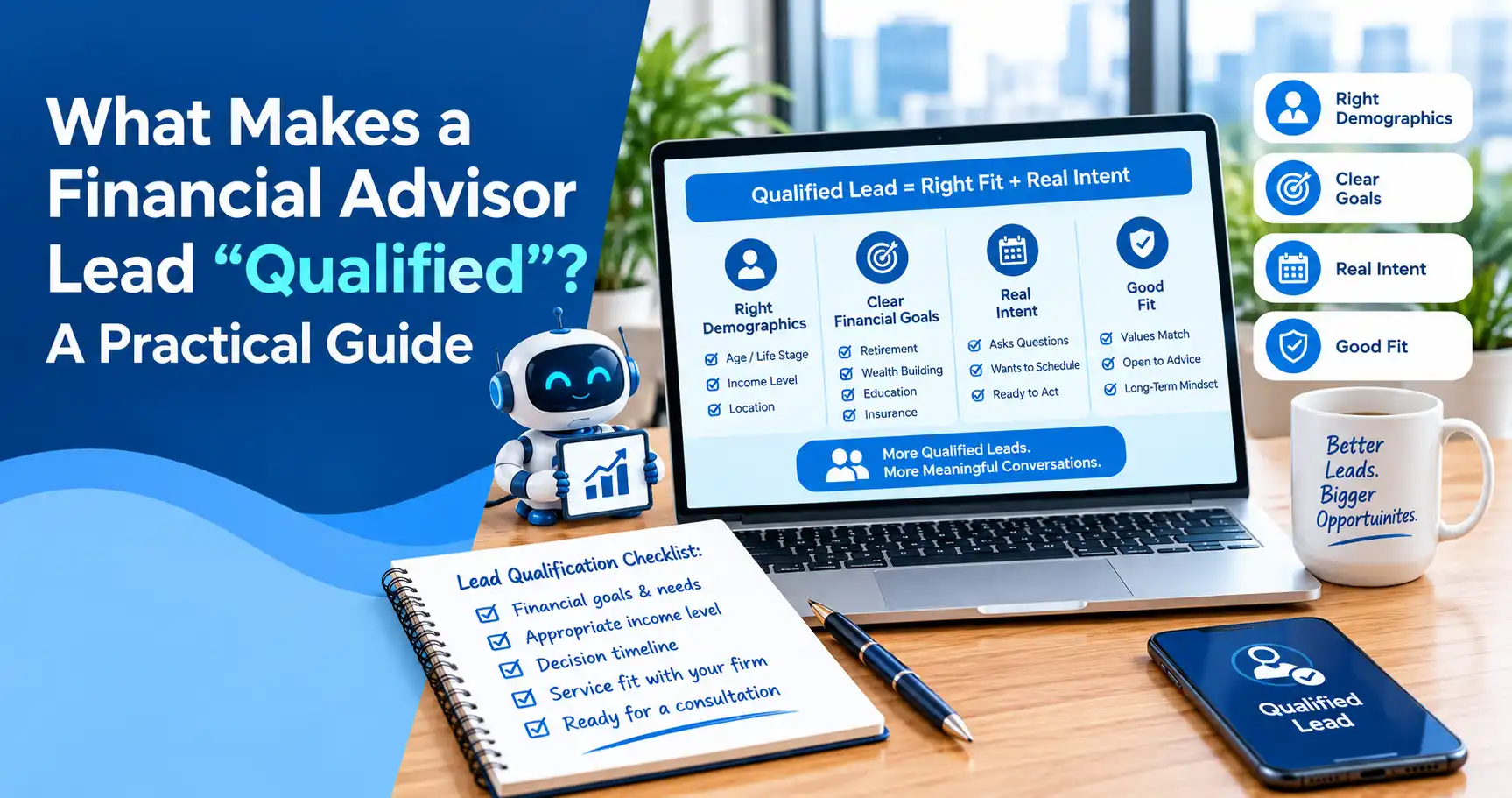
Not every website visitor is ready to become a client. AI tools can score leads based on factors such as:
- Pages visited
- Time spent on the website
- Email engagement
- Webinar attendance
- Form submissions
- Downloaded resources.
This helps advisors prioritize conversations with prospects who show stronger buying intent, making financial advisor lead generation more efficient.
Faster Content Creation
Creating consistent, high-quality content is often one of the biggest challenges for advisors. AI can help generate:
- Blog outlines
- Email drafts
- Video scripts
- Social media captions
- Webinar summaries
- FAQ content
However, human expertise remains essential. Financial advisors should always review and refine AI-generated content to ensure accuracy, compliance, and alignment with their brand voice.
Improved Decision-Making
Instead of relying on assumptions, AI provides insights based on real marketing data. Advisors can better understand:
- Which blog posts generate the most traffic
- Which emails produce the highest open rates
- Which landing pages convert visitors into appointments
- Which keywords attract qualified prospects
These insights help improve marketing ROI over time.
The Biggest Benefits of AI Marketing for Financial Advisors
Adopting AI doesn’t mean replacing your existing marketing strategy. Instead, it enhances the channels you’re already using by making them more efficient and data-driven.
Here are some of the most significant benefits.
1. More Qualified Leads
AI identifies patterns among your best-performing prospects and helps target similar audiences through search, paid advertising, and content recommendations.
Instead of chasing large volumes of unqualified traffic, advisors can focus on attracting people who are actively researching financial solutions.
2. Better Content Performance
Educational content remains one of the strongest ways to build trust with prospective clients. AI helps identify trending questions, organize topic clusters, and optimize content for readability and search intent.
When combined with financial services content marketing, AI enables advisors to publish valuable resources more consistently while maintaining quality.
3. Higher Marketing Efficiency
Many marketing tasks are repetitive:
- Scheduling emails
- Reporting campaign metrics
- Updating CRM records
- Managing social media calendars
- Segmenting audiences
AI automates much of this administrative work, allowing advisors to spend more time serving clients and less time managing marketing operations.
4. Stronger Client Engagement
AI-powered personalization ensures prospects receive relevant content throughout their decision-making journey.
For example:
- Retirement-focused emails for retirement prospects
- Tax-planning resources for business owners
- Investment guides for high-net-worth individuals
Relevant communication increases engagement and strengthens trust over time.
5. Improved Marketing ROI
AI helps identify what’s working and what isn’t.
Instead of continuing ineffective campaigns, advisors can adjust their strategy based on data, improving return on marketing investment.
How AI Supports SEO for Financial Advisors
Search engine optimization continues to be one of the most reliable long-term marketing channels for financial advisors. While AI doesn’t replace SEO strategy, it significantly improves how efficiently advisors can research, create, and optimize content.
Successful SEO for financial advisors still depends on creating helpful, trustworthy content that answers the questions prospective clients are actively searching for. AI enhances this process by identifying content gaps, suggesting relevant keywords, analyzing competitor pages, and improving on-page optimization.
For example, AI can help advisors:
- Discover frequently searched financial planning questions
- Build topical authority through content clusters
- Improve internal linking opportunities
- Optimize headings and meta descriptions
- Identify opportunities for local SEO
- Monitor ranking performance over time
Combined with expert oversight, AI allows advisors to publish consistent, high-quality educational content that supports long-term organic growth.
If you’re looking to strengthen your content strategy further, explore our guide on Content Marketing for Financial Advisors:
AI Is Enhancing Not Replacing Human Expertise
One of the biggest misconceptions about AI is that it can replace financial advisors or their marketing teams. In reality, the most successful firms use AI to support human expertise, not substitute it.
Clients still choose advisors based on trust, credibility, and personal relationships. AI can streamline processes, improve personalization, and uncover valuable insights, but it cannot replicate the empathy, judgment, and experience that advisors bring to financial planning.
The firms seeing the best results in 2026 are those that combine intelligent automation with authentic, client-focused communication.
How AI Improves Financial Advisor Lead Generation
Attracting website traffic is only the first step. The real challenge is turning that traffic into qualified appointments with prospects who genuinely need your services. This is where AI is reshaping financial advisor lead generation.
Instead of relying on guesswork, AI analyzes user behavior across your website, emails, ads, and CRM to identify prospects who are most likely to become clients. It helps advisors understand not just who is visiting their website, but also why they’re visiting and how close they are to making a decision.
For example, AI can identify visitors who:
- Read multiple retirement planning articles
- Download a retirement income guide
- Attend a webinar
- Return to your website several times
- Click through multiple emails
- Spend significant time on your service pages
These behavioral signals indicate higher buying intent. Rather than treating every inquiry equally, advisors can prioritize follow-ups with prospects who are showing genuine interest.
AI Helps Personalize Every Stage of the Buyer Journey
Every prospective client is at a different stage of their financial planning journey. Someone researching “How much do I need to retire?” requires different information than someone searching for “Best financial advisor near me.”
AI helps tailor content based on where a prospect is in the decision-making process.
Buyer Stage | Traditional Marketing | AI-Powered Marketing |
Awareness | Same message for everyone | Personalized educational content |
Consideration | Generic email campaigns | Content recommendations based on interests |
Decision | Manual follow-up | Automated nurturing with relevant resources |
Conversion | Advisor contacts every lead equally | Prioritized outreach based on lead scoring |
This personalization creates a better experience for potential clients while improving marketing efficiency.
AI-Powered Content Marketing for Financial Advisors
Educational content remains one of the most effective ways to build trust with prospective clients. People rarely hire a financial advisor after seeing one advertisement they usually consume several pieces of content before scheduling a consultation.
AI makes this process more efficient without sacrificing quality.
Content Research
Before writing a blog, AI tools can identify:
- Frequently asked client questions
- Trending financial topics
- Search intent behind keywords
- Competitor content gaps
- Seasonal opportunities
Instead of guessing what prospects want to learn, advisors can create content that directly answers real search queries.
Faster Content Production
AI can assist with:
- Blog outlines
- Article drafts
- Video scripts
- Webinar summaries
- Email newsletters
- Social media captions
- FAQ sections
- Meta titles and descriptions
However, financial content should never be published without human review. Advisors must ensure every article is accurate, compliant, and reflects their professional expertise.
The most successful firms use AI as a productivity tool not a replacement for subject matter expertise.
AI and Financial Services Content Marketing
Modern financial services content marketing is no longer about publishing random blog posts. Instead, it’s about creating a connected ecosystem of valuable educational resources that guide prospects through their buying journey.
An AI-assisted content strategy might include:
- Weekly educational blog articles
- Monthly webinars
- Downloadable retirement guides
- Market updates
- Client newsletters
- Short educational videos
- FAQ libraries
- Case studies
- Social media insights
Each piece of content supports the others through internal linking, helping search engines better understand your expertise while making it easier for visitors to find relevant information.
For example, someone reading an article about retirement planning may naturally move on to a guide about Social Security strategies or an upcoming webinar on income planning. This interconnected approach keeps prospects engaged and builds trust over time.
For a deeper look at creating a content strategy that attracts and converts qualified prospects, read our guide on Content Marketing for Financial Advisors:
AI Email Marketing for Financial Advisors
Email remains one of the highest-performing digital marketing channels for financial advisors because it allows you to build long-term relationships with prospects and existing clients.
AI enhances email marketing for financial advisors by making campaigns more relevant and timely.
Instead of sending the same newsletter to every subscriber, AI can segment audiences based on factors such as:
- Age group
- Financial goals
- Website activity
- Previous email engagement
- Service interests
- Webinar attendance
- Downloaded resources
This allows advisors to deliver personalized content that resonates with each audience segment.
A prospect who downloads a retirement planning guide could automatically receive:
Examples of AI-Powered Email Automation
A prospect who downloads a retirement planning guide could automatically receive:
Week 1
- Retirement checklist
- Income planning article
Week 2
- Invitation to a retirement webinar
Week 3
- Tax-efficient withdrawal strategies
Week 4
- Free consultation invitation
Because the content is tailored to the prospect’s interests, engagement rates are often higher than with generic email campaigns.
Compliance Still Matters
While AI can generate email drafts and automate campaigns, financial advisors must ensure all communications comply with applicable regulations and internal compliance policies.
Before sending any AI-assisted email:
- Verify factual accuracy.
- Avoid misleading or exaggerated claims.
- Include required disclosures where applicable.
- Obtain compliance approval if your firm requires it.
- Review personalization for appropriateness and privacy considerations.
Using AI responsibly helps advisors maintain credibility while benefiting from automation.
For more guidance, read our detailed article on Financial Email Marketing Compliance: What Advisors Must Know:
Should You Build an AI Marketing System Yourself or Hire an Agency?
Many advisors wonder whether they should manage AI marketing internally or partner with a specialized agency.
The answer depends on your available time, budget, and marketing expertise.
Managing AI Marketing In-House
An in-house approach can work if you have:
- A dedicated marketing team
- Time to learn AI tools
- Resources for ongoing SEO and content creation
- Experience with paid advertising and analytics
However, maintaining multiple AI platforms, optimizing campaigns, and staying current with algorithm updates can become time-consuming.
Working With a Specialized Agency
A financial services digital marketing agency brings industry-specific expertise and established processes.
Instead of starting from scratch, advisors gain access to professionals who understand:
- Financial services regulations
- Advisor marketing strategies
- SEO best practices
- Lead generation funnels
- Content planning
- AI-assisted campaign optimization
- Performance tracking
This allows advisors to focus on serving clients while marketing activities continue consistently in the background.
Similarly, a financial services marketing agency can help integrate AI across your website, content, email campaigns, and advertising to create a more cohesive growth strategy.
How AI Supports Smarter Client Acquisition
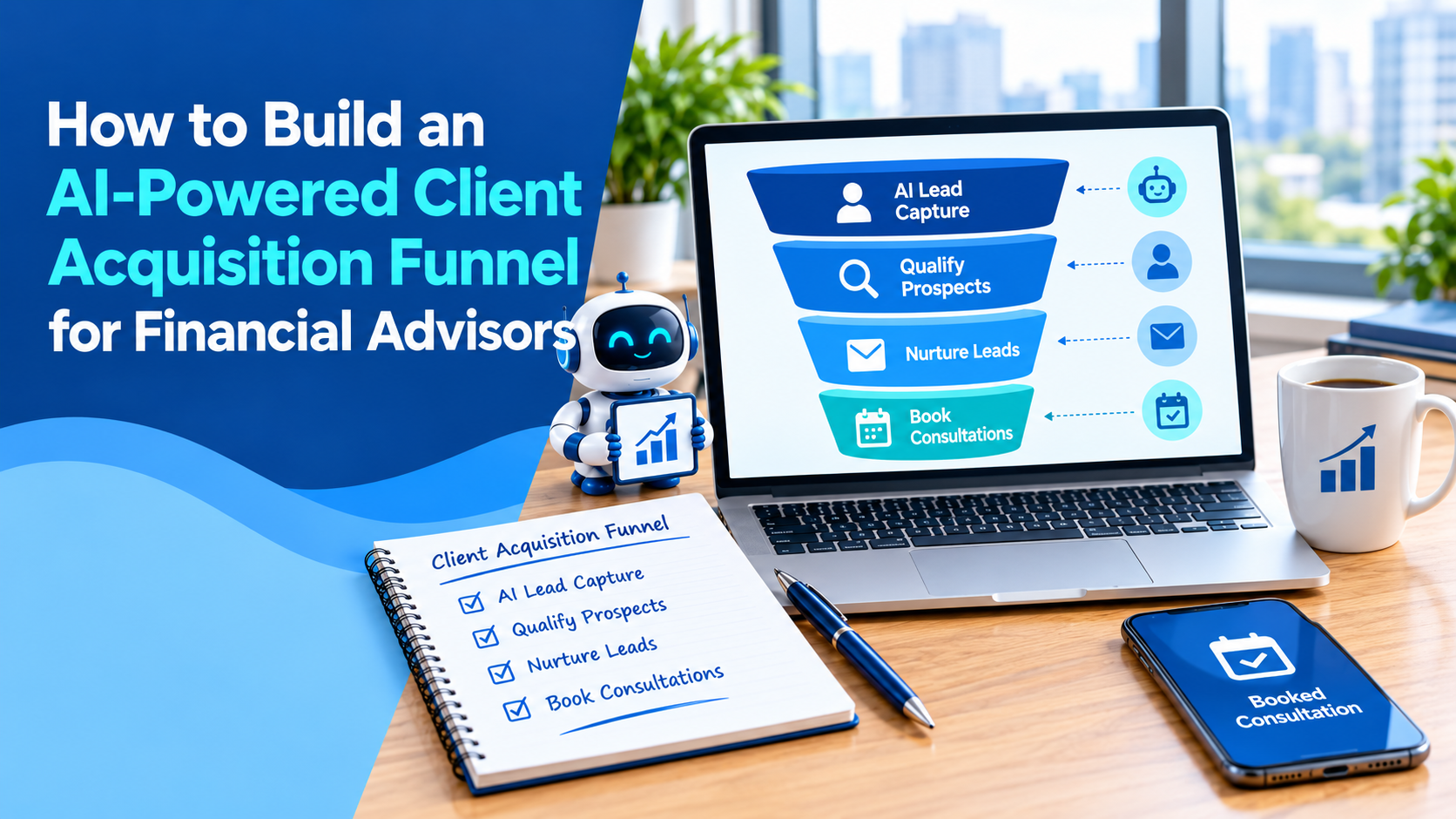
AI is most effective when integrated into a broader marketing strategy rather than used as a standalone solution. Think of it as an intelligent assistant that enhances every stage of your marketing funnel:
- Attract: Optimize blog content and improve search visibility.
- Engage: Personalize website experiences and email campaigns.
- Nurture: Deliver relevant educational content automatically.
- Convert: Identify high-intent leads and streamline appointment booking.
- Retain: Maintain ongoing communication with clients through timely, personalized updates.
When these elements work together, advisors create a marketing system that consistently attracts qualified prospects and builds lasting client relationships.
Best AI Marketing Agencies for Financial Advisors
As AI becomes a standard part of digital marketing, many agencies now offer AI-powered services. However, not every agency understands the unique challenges of marketing financial services.
Financial advisors operate in a highly regulated industry where trust, compliance, and credibility are just as important as generating leads. An agency that has experience working with financial professionals is better equipped to create campaigns that balance growth with regulatory considerations.
When evaluating the best AI marketing agencies for financial advisors, consider whether they offer:
- AI-assisted SEO and content strategy
- Industry-specific keyword research
- Website optimization and conversion rate improvements
- AI-powered email automation
- Paid advertising management
- CRM integration and lead nurturing
- Analytics dashboards with actionable insights
- Compliance-aware content workflows
- Webinar marketing support
- Local SEO and Google Business Profile optimization
Rather than choosing an agency simply because it uses AI, focus on one that understands the financial services industry and can demonstrate measurable results.
Questions to Ask Before Hiring an AI Marketing Agency
Before signing a contract, ask questions such as:
- Have you worked with financial advisors or insurance agencies before?
- How do you use AI without sacrificing content quality?
- What SEO strategy do you recommend for long-term growth?
- How do you measure marketing success?
- Can you help with compliance-friendly marketing?
- What reporting will I receive?
- How do you qualify leads?
- Which AI tools are part of your process?
The answers will help you determine whether the agency is using AI strategically or simply following a trend.
Best AI for Financial Market Analysis in 2026
While marketing AI focuses on attracting and nurturing clients, advisors are also exploring AI platforms that assist with research and market analysis.
The best AI for financial market analysis in 2026 can help professionals:
- Monitor market trends
- Analyze large financial datasets
- Summarize earnings reports
- Identify economic patterns
- Track sector performance
- Generate research summaries
- Support investment analysis
It’s important to remember that AI should complement professional judgment not replace it. Financial recommendations should always reflect an advisor’s expertise, fiduciary responsibilities, client objectives, and applicable regulations.
For marketing purposes, advisors can also use AI to transform complex market insights into client-friendly newsletters, blog posts, webinar topics, and educational videos, making technical information easier for clients to understand.
AI Marketing vs Traditional Marketing
AI doesn’t replace proven marketing fundamentals it enhances them. The strongest growth strategies combine technology with authentic relationship-building and expert guidance.
Marketing Area | Traditional Approach | AI-Powered Approach |
Keyword Research | Manual research | AI-assisted trend and intent analysis |
Blog Planning | Individual topic selection | Topic clusters based on search behavior |
Content Creation | Entirely manual | AI-assisted drafting with expert review |
SEO Optimization | Manual audits | Automated recommendations and ongoing monitoring |
Email Campaigns | One-size-fits-all newsletters | Personalized, behavior-based automation |
Lead Qualification | Manual review | AI lead scoring and prioritization |
Analytics | Periodic reporting | Real-time insights and predictive analysis |
Appointment Booking | Manual follow-up | Automated reminders and intelligent workflows |
The table highlights an important point: AI improves efficiency, but human oversight remains essential for strategy, relationship building, and compliance.
Common AI Marketing Mistakes Financial Advisors Should Avoid
AI can deliver significant benefits, but only when used thoughtfully. The following mistakes can limit results or even damage your firm’s credibility.
Publishing AI Content Without Human Review
AI-generated content may sound polished, but it can include inaccuracies, outdated information, or language that doesn’t reflect your firm’s expertise. Every article, email, or social media post should be reviewed by a qualified professional before publication.
Ignoring Search Intent
Creating large amounts of content won’t improve rankings unless it addresses what prospective clients are actually searching for. Focus on answering real questions and solving real problems.
Over-Automating Client Communication
Automation can improve efficiency, but clients still value genuine human interaction. Use AI to support conversations not replace them.
Neglecting SEO Foundations
Even with AI, strong SEO for financial advisors still depends on:
- Helpful educational content
- Fast website performance
- Mobile-friendly design
- Logical site structure
- Internal linking
- Quality backlinks
- Consistent publishing
AI accelerates these efforts but doesn’t eliminate the need for a solid SEO strategy.
Focusing Only on Traffic
More visitors don’t automatically mean more clients. Success should be measured by meaningful outcomes such as:
- Qualified leads
- Consultation requests
- Webinar registrations
- Email subscribers
- Client acquisition cost
- Conversion rate
- Return on marketing investment
How AI Supports Webinar Marketing
Educational webinars continue to be one of the most effective ways for financial advisors to build trust with prospective clients. AI can make webinar marketing more efficient by assisting with:
- Topic ideation based on trending searches
- Registration page optimization
- Personalized email invitations
- Reminder sequences
- Post-event follow-up emails
- Audience segmentation
- Engagement analysis
- Repurposing webinar recordings into blogs, videos, and social posts
This allows advisors to extend the value of a single webinar across multiple marketing channels.
AI Can Help You Grow Your Accounting Practice Too
Although this guide focuses on financial advisors, many of the same AI marketing principles apply to accounting firms and tax professionals.
If you’re wondering how to grow your accounting practice, AI can help by:
- Improving local SEO visibility
- Creating educational tax and accounting content
- Automating appointment reminders
- Personalizing email newsletters
- Identifying high-value service opportunities
- Enhancing client onboarding experiences
- Measuring campaign performance more accurately
Whether you provide financial planning, tax preparation, wealth management, or insurance services, AI enables a more data-driven approach to client acquisition and retention.
How to Choose the Right AI Marketing Partner
Choosing the right marketing partner involves more than comparing pricing. Look for a team that understands your business goals, target audience, and industry requirements.
A reliable partner should:
- Develop a customized marketing strategy
- Combine AI with human expertise
- Understand financial services compliance
- Focus on long-term SEO growth
- Provide transparent reporting
- Align marketing efforts with business objectives
- Continuously refine campaigns using performance data
If your goal is sustainable growth rather than short-term traffic spikes, partnering with specialists who understand both AI and financial services can provide a significant competitive advantage.
Before making a decision, it’s also worth reviewing broader marketing strategies that consistently generate qualified prospects. Our guide on Financial Advisor Marketing: What Actually Brings You Clients (and What Doesn’t) explores proven tactics that work alongside AI-driven initiatives

Final Thoughts: AI Marketing Is Reshaping Financial Advisor Growth
Artificial intelligence is no longer a future trend it’s becoming a practical tool that helps financial advisors market their services more efficiently and effectively. From improving financial advisor lead generation to creating personalized email campaigns and supporting SEO for financial advisors, AI enables firms to reach the right audience with greater precision.
However, successful AI marketing isn’t about replacing human expertise. Trust remains the foundation of every successful advisory relationship. Prospective clients want educational content that answers their questions, transparent communication that builds confidence, and personalized guidance that reflects their unique financial goals.
The firms seeing the greatest success in 2026 are those that combine AI-powered efficiency with authentic human relationships. They use technology to automate repetitive tasks, uncover valuable insights, and improve marketing performance while ensuring every interaction reflects their experience and professionalism.
Whether you’re an independent financial advisor, wealth management firm, insurance agency, or accounting practice, AI should be viewed as an enhancement to your existing strategy not a replacement for it.
A comprehensive marketing approach typically includes:
- AI-assisted content creation
- High-quality financial services content marketing
- Strategic email marketing for financial advisors
- Search engine optimization
- Local SEO
- Educational webinars
- Conversion-focused website design
- Data-driven lead nurturing
- Ongoing campaign optimization
When these elements work together, they create a scalable marketing system capable of attracting qualified prospects, nurturing long-term relationships, and supporting sustainable business growth.
If you’re ready to integrate AI into your marketing strategy, start with clear objectives, invest in high-quality content, monitor your performance consistently, and partner with professionals who understand both artificial intelligence and the financial services industry.
FAQs About Google Ads for Financial Advisors
1. What is AI marketing for financial advisors?
AI marketing for financial advisors involves using artificial intelligence to improve digital marketing activities such as SEO, content creation, email marketing, lead generation, and campaign analysis. It helps advisors work more efficiently while delivering personalized experiences to prospective clients.
2. Can AI help financial advisors generate more qualified leads?
Yes. AI analyzes user behavior, website interactions, email engagement, and other signals to identify prospects with higher purchase intent. This enables advisors to focus on the leads most likely to schedule consultations and become long-term clients.
3. Is AI replacing financial advisors?
No. AI is designed to support advisors by automating repetitive tasks and providing marketing insights. Building trust, understanding client goals, and delivering personalized financial advice remain responsibilities that require human expertise.
4. How does AI improve SEO for financial advisors?
AI assists with keyword research, content planning, competitor analysis, on-page optimization, and performance monitoring. Combined with expert strategy, it helps advisors create valuable content that improves search visibility and attracts qualified organic traffic.
5. What should I look for in an AI marketing agency for financial advisors?
Look for an agency with experience in financial services, expertise in SEO and content marketing, AI-assisted campaign management, compliance-aware workflows, transparent reporting, and a proven process for generating qualified appointments.
6. What is the best AI for financial market analysis in 2026?
The best AI tools for financial market analysis help professionals analyze market data, summarize reports, identify trends, and support research. They should be used to enhance professional decision-making rather than replace an advisor’s expertise or fiduciary responsibilities.
7. Can AI improve email marketing for financial advisors?
Yes. AI can segment audiences, personalize email content, automate follow-up sequences, optimize send times, and analyze engagement metrics. These capabilities help advisors build stronger relationships with prospects and clients.
8. How long does AI marketing take to produce results?
Some AI-driven improvements, such as email automation and campaign optimization, can show results within weeks. Long-term strategies like SEO and content marketing generally take several months to build authority and generate consistent organic leads.
Disclaimer
This article is for informational and educational purposes only and should not be considered financial, investment, legal, or tax advice. AI-generated insights should always be reviewed alongside professional judgment and applicable regulatory requirements before being implemented.