- Written & Reviewed by Jeremy
- Published
- Last Updated Sep 16, 2026
Generating leads is only one part of growing a financial advisory practice. The bigger challenge is often what happens after someone fills out a form, downloads a guide, attends a webinar, or asks for more information.
If a prospect does not receive a timely response, the opportunity can quickly go cold. This is where AI appointment setting for financial advisors can become part of a broader lead-generation and client acquisition strategy.
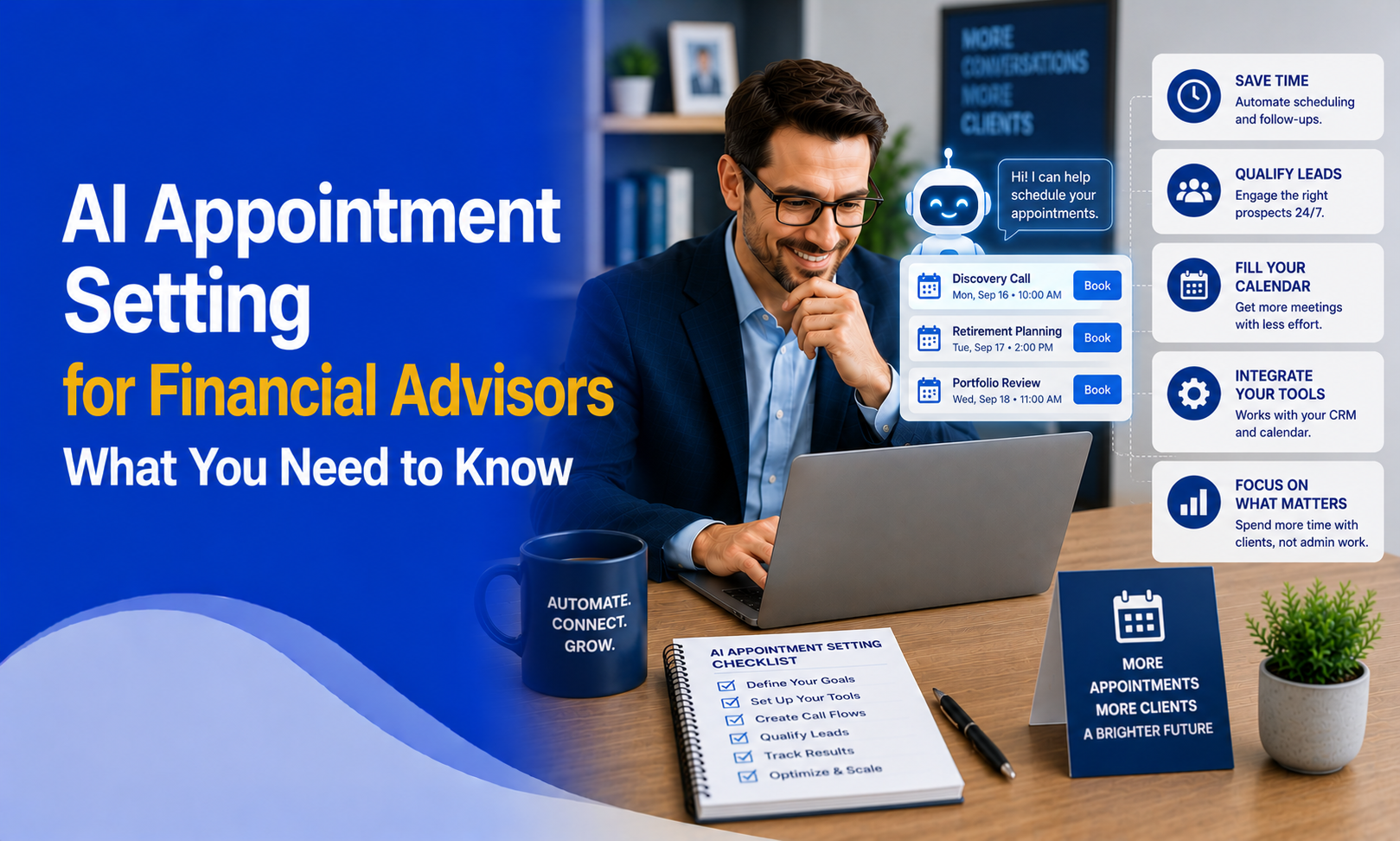
AI appointment-setting systems can help respond to inquiries, ask predefined qualification questions, follow up with prospects, and schedule meetings. They can also reduce some of the repetitive administrative work involved in managing leads.
However, AI should not replace professional financial advice or human relationship-building. Financial firms need clear boundaries around what AI can communicate, what information it can collect, and when a prospect should be transferred to a human.
This guide explains how AI appointment setting works, where it fits into financial advisor marketing, what firms should consider before adopting it, and how to measure its performance.
What Is AI Appointment Setting for Financial Advisors?
AI appointment setting for financial advisors refers to using artificial intelligence to assist with the process of engaging prospects, qualifying inquiries, following up, and scheduling appointments with financial professionals.
Instead of requiring a team member to manually respond to every initial inquiry, an AI system can handle predefined parts of the conversation.
For example, a prospect might submit a website form asking about retirement planning. An AI-powered workflow could:
- Respond to the inquiry.
- Ask approved qualification questions.
- Identify the prospect’s general area of interest.
- Determine whether the prospect wants to speak with an advisor.
- Offer available appointment times.
- Confirm the meeting.
- Send the information to the firm’s CRM.
- Hand the conversation to a human when necessary.
The exact capabilities depend on the technology, integrations, and workflows used by the firm.
How Does AI Appointment Setting Work for Financial Advisors?
AI appointment setting helps financial advisors manage leads and move qualified prospects toward a consultation.
1. Capture the Lead
Leads can come from SEO, ads, website forms, webinars, email, social media, referrals, and downloadable guides.
2. Respond Quickly
AI can instantly acknowledge inquiries and guide prospects toward the next step using approved information.
3. Qualify the Lead
AI can ask basic questions about the prospect’s needs, requested service, location, and preferred appointment time.
4. Schedule the Appointment
The system can show available calendar slots, send confirmations, and handle reminders or rescheduling.
5. Handoff to an Advisor
Complex questions and personalized financial guidance should be handled by a qualified human advisor. AI supports the process while the advisor manages the client relationship.
Why Are Financial Advisors Using AI for Appointment Setting?
Financial firms can spend significant time following up with leads that may or may not be ready to schedule a conversation.
AI can help address several operational challenges.
Faster Lead Follow-Up
A prospect’s interest may be highest shortly after submitting an inquiry. Automated workflows can help reduce delays in the initial response.
Fewer Manual Tasks
Scheduling, appointment confirmations, basic qualification questions, and reminders can take time when handled manually.
Automating repetitive steps can allow staff to focus on conversations that require human involvement.
More Consistent Follow-Up
A lead that does not schedule immediately does not necessarily mean the prospect is uninterested.
AI-assisted workflows can support structured follow-up rather than relying entirely on staff remembering to contact every lead.
Support Outside Normal Office Hours
Depending on the system and communication channel, AI can respond to basic inquiries outside normal working hours and direct prospects toward an appropriate next step.
How Does AI Appointment Setting Support Financial Advisor Lead Generation?
Lead generation and appointment setting are connected, but they are not the same thing.
Financial advisor lead generation focuses on attracting potential clients. Appointment setting focuses on turning relevant inquiries into scheduled conversations.You can share educational resources, participate in community events, collaborate on educational sessions, and learn more about the professionals you work with.
For example:
SEO → Website Content → Lead Form → AI Follow-Up → Qualification → Appointment → Advisor Consultation
A firm may invest heavily in SEO or paid advertising but still lose opportunities if leads are not followed up effectively.
That is why AI appointment setting can be viewed as a conversion layer within the broader marketing funnel.
For firms investing in SEO for financial advisors, educational content can attract people researching financial topics. Once those visitors become leads, an appointment-setting workflow can help move appropriate prospects toward a consultation.
What Role Does AI Play in Financial Advisor Marketing?
AI appointment setting works best when it is connected to a larger marketing strategy.
A financial firm may use:
- SEO for financial advisors
- Financial services content marketing
- Email marketing for financial advisors
- Webinar marketing
- Paid advertising
- Landing pages
- CRM automation
- Referral marketing
Each channel serves a different purpose.
Content and SEO can attract prospects. Email can nurture them. Webinars can educate them. AI can help with follow-up and scheduling. The advisor then handles the professional relationship.
For example, firms exploring email automation should also consider communication and compliance requirements. See this guide on financial email marketing compliance for additional context.
How Do SEO, Content Marketing, and AI Appointment Setting Work Together?
A strong financial advisor marketing funnel does not depend on one technology.
Consider a prospect searching for information about retirement planning. They may discover an educational article through search. After reading the article, they may download a guide or request more information. That creates an opportunity for the firm to begin a structured follow-up process.
This is where content marketing and AI appointment setting can work together.
The content builds awareness and trust. The lead form captures interest. AI can help with initial engagement and scheduling. The advisor handles the consultation.
What Can AI Appointment Setting Automate?
Not every part of the client acquisition process should be automated.
Activity | AI Can Assist With | Human Involvement |
Initial lead response | Yes | As needed |
Basic qualification | Yes | Review may be appropriate |
Appointment scheduling | Yes | Oversight |
Appointment reminders | Yes | Optional |
Rescheduling | Yes | As needed |
Basic approved FAQs | Yes | Recommended oversight |
Complex financial questions | Limited | Advisor |
Personalized financial advice | No | Qualified professional |
Investment recommendations | No | Qualified professional |
Compliance decisions | No | Compliance professionals |
The goal should be to automate appropriate administrative and communication tasks while keeping professional judgment with qualified people.
What Are the Compliance Considerations?
Compliance should be considered before using AI for financial advisor communications. For SEC-registered investment advisers, the Marketing Rule sets requirements for advertising, disclosures, testimonials, endorsements, and recordkeeping.
Protect Prospect Information
Know what prospect data the AI collects, where it is stored, and who can access it.
Use Approved Messaging
Keep AI responses within the firm’s approved communication and marketing guidelines.
Include Human Oversight
Questions involving personalized financial advice, complaints, or complex situations should be escalated to a qualified professional.
Maintain Records
Firms should maintain required records of applicable marketing communications and related materials.
Before deployment, firms should have their compliance professionals review the AI workflow and controls.
What Should AI Appointment Setting Never Do?
AI appointment-setting systems should have clear limits. They should not:
- Provide personalized investment recommendations or financial advice
- Promise or imply investment returns
- Make unsupported claims about the firm
- Share performance or hypothetical information without proper controls
- Handle complex compliance questions without human review
- Misrepresent themselves as human
- Continue sensitive conversations when a qualified professional should take over
The SEC Marketing Rule places requirements on investment adviser advertising, including rules around misleading statements, performance information, testimonials, and endorsements.
The key is to define clear boundaries for what AI can and cannot do.
How Can AI Appointment Setting Improve the Client Experience?
Automation should not be used simply because it is available.
The better question is whether it makes the prospect’s experience easier.
A well-designed system can help prospects:
- Get a faster initial response
- Find relevant information
- Schedule without exchanging multiple emails
- Receive appointment reminders
- Reschedule more easily
- Reach a human when needed
However, too much automation can have the opposite effect.
If a prospect cannot reach a person when they have a complex question, the technology can become a source of frustration.
The best workflows therefore combine automation with an easy human handoff.
What Should Financial Advisors Look for in an AI Appointment-Setting System?
Before choosing a platform, evaluate more than its AI capabilities.
CRM Integration
The system should work with the firm’s existing CRM or provide a reliable method for transferring lead information.
Calendar Integration
Scheduling should connect with the firm’s actual availability to reduce double bookings and unnecessary back-and-forth.
Custom Qualification
Different financial firms have different target audiences. The system should allow qualification criteria to be configured around the firm’s approved process.
Human Handoff
There should be a clear way to transfer a prospect to a human.
Reporting
Useful metrics can include:
- Leads contacted
- Response rate
- Qualified leads
- Appointments booked
- Appointment show rate
- Qualified appointment rate
- Lead-to-client conversion
- Cost per qualified appointment
Compliance Controls
Look for appropriate controls around messaging, access, data, approvals, and recordkeeping.
What Common Mistakes Do Financial Advisors Make?
Automating Before Fixing the Funnel
AI cannot fix a poorly defined target audience or weak offer.
Treating Every Lead the Same
A retirement-planning prospect may require a different journey from someone looking for business financial planning.
Using Generic AI Scripts
Generic conversations can feel impersonal. Approved messaging should reflect the firm’s services and audience.
Measuring Only Appointments
More appointments do not automatically mean better results.
If your ideal clients are local, your website and online profiles should clearly communicate where you serve.
A firm should also examine appointment quality, show rates, and eventual client conversion.
Removing Human Interaction
Financial services are relationship-driven. AI should support human interaction rather than make it unnecessarily difficult.
Ignoring Compliance
Compliance should be part of the implementation process, not something considered after the system goes live.
When Should a Financial Advisor Consider AI Appointment Setting?
AI appointment setting may be worth evaluating when a firm:
- Receives a consistent flow of leads
- Has difficulty responding quickly
- Spends substantial staff time on scheduling
- Has a defined qualification process
- Wants more consistent lead follow-up
- Already uses a CRM and calendar system
- Has appropriate compliance processes
It may require more planning when a firm has very few leads, unclear messaging, or no established follow-up process.
The technology works best when the underlying marketing and sales process is already reasonably well defined.
How to Implement AI Appointment Setting Step by Step
Step 1: Define Your Ideal Prospect
Identify who the firm wants to speak with and which services are relevant to those prospects.
Step 2: Map the Existing Lead Journey
Document what happens from the moment someone submits an inquiry to the moment they meet an advisor.
Step 3: Define AI’s Role
Clearly establish what AI can say, ask, schedule, record, and escalate.
Step 4: Create Approved Conversation Flows
Develop responses for common questions and situations before launching the system.
Step 5: Connect Your CRM and Calendar
Make sure lead information and appointment details move correctly between systems.
Step 6: Test the Workflow
Test common questions, unusual questions, scheduling changes, escalation scenarios, and compliance-sensitive conversations.
Step 7: Monitor Results
Review conversations and appointment quality regularly. Use the data to improve the workflow rather than simply increasing automation.
AI Appointment Setting vs. Traditional Lead Follow-Up
Factor | Traditional Follow-Up | AI-Assisted Follow-Up |
Initial response | Usually manual | Can be automated |
Availability | Primarily staff-dependent | Can support broader availability |
Qualification | Staff-driven | AI-assisted |
Scheduling | Often manual | Can be automated |
Follow-up consistency | Depends on staff | Workflow-driven |
Scalability | Limited by staff capacity | Can handle larger volumes |
Human interaction | High | Human handoff remains important |
Oversight | Staff management | AI plus human oversight |
Neither approach eliminates the need for a well-designed process. The right choice depends on the firm’s lead volume, resources, systems, compliance requirements, and client experience goals.
How Can Financial Advisors Measure AI Appointment-Setting Performance?
Start with measurable outcomes rather than simply counting conversations.
Important KPIs include:
- Lead response time
- Lead engagement rate
- Qualification rate
- Appointment-booking rate
- Appointment show rate
- Qualified appointment rate
- Lead-to-client conversion rate
- Cost per qualified appointment
- Client acquisition cost
One particularly important distinction is between appointments booked and qualified appointments booked.
A system that books many meetings with people who do not fit the firm’s target audience may create more work rather than better results.

Final Thoughts: AI Appointment Setting for Financial Advisors
AI appointment setting can help financial advisors automate parts of lead engagement, qualification, follow-up, and scheduling.
But it should not be viewed as a replacement for financial professionals.
The strongest approach is usually a connected system: marketing attracts relevant prospects, content builds trust, AI supports timely follow-up, and human advisors handle the conversations that require professional judgment.
Firms considering this technology should focus on three areas: client experience, measurable outcomes, and appropriate compliance controls.
For firms also investing in webinars, AI can support follow-up after an event by helping organize attendee conversations and scheduling opportunities. See this guide on financial advisor webinar marketing for more information.
Ultimately, the purpose of AI appointment setting is not simply to automate more conversations. It is to help the right prospects move more efficiently from initial interest to a meaningful conversation with a financial professional.
FAQs About AI Appointment Setting for Financial Advisors
1. What is AI appointment setting for financial advisors?
AI appointment setting uses AI-powered systems to engage leads, ask basic qualification questions, follow up with prospects, and help schedule appointments with financial advisors.
2. How does AI appointment setting work for financial advisors?
A typical process captures a lead, responds to the inquiry, asks approved qualification questions, identifies appointment intent, offers available meeting times, and sends the appointment details to the firm’s CRM or calendar system.
Local SEO helps your firm appear when people search for retirement planning and financial advice in your area. Location pages, relevant content, Google Business Profile optimization, and consistent business information can improve local visibility.
3. How does AI appointment setting help financial advisor lead generation?
AI can help financial advisors respond to leads faster, maintain consistent follow-up, qualify prospects, and reduce scheduling friction. This can help move relevant inquiries from initial interest toward a conversation with an advisor.
4. Is AI appointment setting compliant for financial advisors?
Compliance depends on the firm’s regulatory status, location, communication channels, data practices, and applicable requirements. Financial firms should establish approved messaging, data controls, human escalation procedures, and appropriate review processes before using AI for prospect communications.
5. What should financial advisors look for in an AI appointment-setting platform?
Financial advisors should evaluate CRM and calendar integration, customizable qualification workflows, reporting, human handoff capabilities, data security, communication controls, and support for the firm’s compliance processes.
Disclaimer
This article is for informational and educational purposes only and does not constitute financial, investment, legal, or compliance advice. AI appointment-setting capabilities and regulatory requirements may vary by firm, jurisdiction, and use case. Financial advisors and firms should consult their qualified compliance, legal, or financial professionals before implementing AI-driven communication or appointment-setting workflows.