- Written & Reviewed by Jeremy
- Published
- Last Updated Jun 04, 2026
Public employees are not the same as general retirement planning leads. Teachers, firefighters, police officers, municipal workers, university staff, and government employees often have benefit structures that are more complex than a standard private-sector retirement plan. Many have pensions, 403(b) plans, 457(b) plans, deferred compensation options, survivor benefits, and specific retirement timing rules that shape how they think about financial planning.
That means a generic ad, basic landing page, or simple email sequence is usually not enough.
A strong marketing funnel for financial advisors selling to public employees should do more than collect names and phone numbers. It should educate prospects, build trust, answer benefit-related questions, nurture leads over time, and guide qualified prospects toward booked appointments.
A strong financial advisor marketing funnel connects every part of the journey. It starts with awareness, moves into education, captures interest, follows up consistently, and guides the right prospects toward a consultation. For advisors targeting public employees, the funnel must also show that the firm understands their retirement system, concerns, and decision-making process.
What Makes Public Employees Different From Other Financial Planning Leads?
Public employees often approach financial planning with different questions than private-sector professionals. They may not simply ask, “How much should I invest?” Instead, they may wonder how their pension works, when they should retire, how their 403(b) or 457(b) fits into their income plan, or whether they are making the right survivor benefit decision.
This makes public employee financial advisor marketing more education-driven.
A police officer nearing retirement may care about pension income, deferred compensation, and healthcare costs. A teacher may want to understand how a 403(b) fits alongside a pension. A municipal employee may need help deciding whether to retire now or work a few more years. These are not impulse decisions. They require trust.
That is why public employees may not respond well to broad wealth management ads. A headline like “Plan Your Retirement Today” may be too generic. A more specific message, such as “Understand How Your Pension and 457(b) Work Together Before Retirement,” speaks more directly to their situation.
Public employees need a marketing funnel that educates them around retirement benefits, builds trust over time, and guides them toward a qualified appointment when they are ready.
What Is a Strong Marketing Funnel for Financial Advisors?
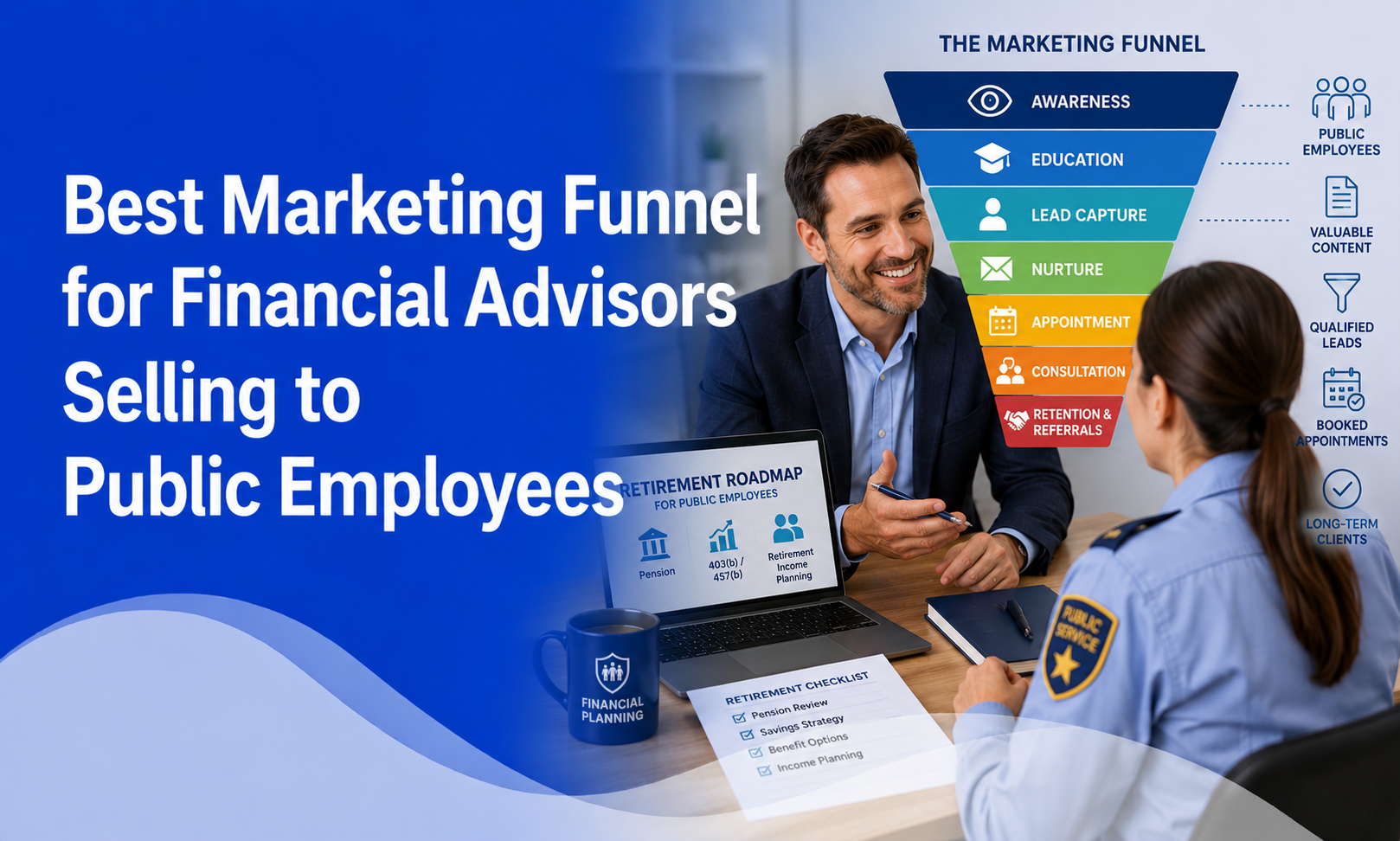
A strong marketing funnel for financial advisors is a structured system that moves prospects from first awareness to a booked consultation. It does not stop at lead generation. It includes every step needed to turn attention into trust and trust into action.
A complete marketing funnel for financial advisors usually includes seven stages:
- Awareness
- Education
- Lead capture
- Lead nurturing
- Appointment booking
- Consultation
- Retention and referrals
Each stage has a specific role. Awareness helps public employees find the advisor. Education helps them understand their problem. Lead capture gives them a reason to share their information. Lead nurturing builds trust over time. The appointment setting turns interest into scheduled conversations. The consultation helps qualify the prospect and explain the next step. Retention keeps clients engaged and may lead to future appointments or referrals.
A basic funnel may only focus on ads and landing pages. A stronger financial advisor marketing system connects content, ads, email, CRM, follow-up, appointment setting, reporting, and retention.
That is the difference between “getting leads” and building a system designed to support more qualified booked appointments.
Stage 1: Attract Public Employees With Specific Educational Content
The first stage of the funnel is awareness. This is where public employees first discover your firm through search, paid ads, social media, webinars, videos, referral content, or downloadable guides.
The key is specificity.
Instead of creating generic retirement planning content, advisors should build content around public employee concerns. For example:
- How 457(b) Plans Work for State Employees
- Retirement Planning Mistakes Teachers Should Avoid
- Pension and 403(b) Planning for Public School Employees
- When Should Public Employees Meet With a Financial Advisor?
- How Firefighters Can Prepare for Retirement Income Decisions
- What Municipal Employees Should Know Before Retiring
This type of content works because it speaks to real questions. It also positions the advisor as someone who understands public employee retirement planning, not just general investing.
SEO can help attract prospects who are already searching for answers. Paid ads can support awareness among targeted employee groups. Webinars can work well for prospects who need a deeper explanation before they are ready to speak with an advisor.
For firms comparing outreach options, understanding how financial advisor lead generation companies structure campaigns can help clarify what should happen at the top of the funnel.
The goal at this stage is not to sell immediately. The goal is to attract the right audience with the right message.
Stage 2: Use Lead Magnets That Match Public Employee Concerns
Once a public employee lands on your website or sees your content, the next step is lead capture. This is where many advisor funnels fail.
A basic form that says “Contact Us” may not be enough. Public employees often need a reason to exchange their information. That reason should be useful, specific, and connected to their financial concerns.
Strong lead magnet ideas include:
- Public Employee Retirement Readiness Checklist
- Pension Planning Guide for Teachers
- 403(b) and 457(b) Comparison Guide
- Public Employee Retirement Timeline
- Benefits Review Worksheet
- Pre-Retirement Appointment Checklist
- Deferred Compensation Planning Guide
- Survivor Benefit Decision Checklist
The lead magnet should solve one focused problem. It should not try to explain every financial topic at once. A simple checklist or short guide can work better than a long technical report.
The form should also be short. At the first stage, asking for name, email, phone number, role, and retirement timeline may be enough. If the form asks too many questions too soon, prospects may leave without converting.
The goal of lead capture is not just to collect an email address. The goal is to start a relevant conversation. That is why the lead magnet should connect naturally to the next step, such as a retirement review, benefits planning call, or educational webinar.
Stage 3: Build Trust With Financial Advisor Lead Nurturing
Most public employees will not book an appointment after one ad, one blog post, or one guide download. They may need time to understand the issue, compare options, talk with a spouse, or decide whether they trust the advisor.
This is where financial advisor lead nurturing becomes important.
Lead nurturing is the process of following up with prospects through helpful, relevant communication. It may include emails, retargeting ads, SMS reminders where appropriate, webinar invitations, phone follow-up, and educational content.
A simple nurture sequence could look like this:
Email 1: Deliver the guide and explain the next step
Email 2: Explain a common pension planning mistake
Email 3: Discuss how a 403(b) or 457(b) may fit into retirement income
Email 4: Share a general educational planning scenario, reviewed for compliance, that explains how a public employee might think through common retirement questions
Email 5: Invite the prospect to book a consultation
The tone should be helpful, not pushy. Public employees often need reassurance that the advisor understands their benefits and is not simply trying to sell a product.
Good nurturing should also be segmented. A teacher five years from retirement should not receive the exact same message as a firefighter retiring in six months. A younger public employee may need help understanding contributions and savings habits, while a near-retiree may care more about income timing, pension elections, and rollover decisions.
The more relevant the follow-up, the more likely the prospect is to stay engaged.
Stage 4: Turn Educated Leads Into Appointment Opportunities
A financial advisor marketing funnel only becomes valuable when it supports real conversations with qualified prospects. Leads are important, but booked appointments are closer to business outcomes.
Appointment setting for financial advisors should be built into the funnel from the beginning. Every lead magnet, email sequence, landing page, webinar, and follow-up message should guide qualified prospects toward a clear next step.
Examples of effective calls to action include:
- Schedule a public employee retirement review
- Book a benefits planning call
- Request a retirement income consultation
- Talk with an advisor about your pension and deferred compensation plan
- Review your retirement timeline before making a decision
The appointment process should be simple. Use calendar links, confirmation emails, reminder messages, and pre-call questions. These steps reduce friction and help prospects understand what will happen on the call.
It is also important to qualify appointments. A large number of unqualified calls can waste time. A smaller number of well-matched consultations is usually more valuable.
A strong appointment-setting process for financial advisors should focus on lead quality, fit, and readiness, not just volume. The goal is to speak with public employees who have a real need, fit the firm’s services, and are ready to discuss next steps.
For firms that want to strengthen this part of the funnel, a dedicated booked appointments for financial advisors strategy can help connect lead generation, follow-up, and scheduling into one clearer process.
Stage 5: Use Automation Without Losing the Human Touch
Marketing automation for financial advisors can make the funnel more consistent. It can help advisors send timely emails, update CRM records, confirm appointments, trigger reminders, and keep leads engaged without relying on manual follow-up every time.
However, automation should not feel robotic.
Public employees are dealing with personal financial decisions. They need clear, relevant, and human communication. If every message feels generic, the funnel may lose trust.
The right advisor marketing software can support the process by helping firms:
- Segment leads by employee type or retirement timeline
- Send follow-up emails automatically
- Track which leads opened or clicked messages
- Trigger appointment reminders
- Manage calendar bookings
- Record lead source and funnel stage
- Support retargeting campaigns
- Measure lead-to-appointment performance
A financial advisor marketing platform should make follow-up easier, but the message still needs to sound personal. For example, an email to a teacher should not sound exactly like an email to a police officer or city employee. The core process can be automated, but the content should still feel relevant.
Marketing tools for financial advisors are most useful when they support a complete strategy. A CRM, calendar tool, email platform, and landing page builder can all help. But tools alone do not create a strong funnel. The strategy behind the tools matters more.
Stage 6: Connect Retention to Future Appointments and Referrals
Many firms think of the funnel as something that ends when a lead becomes a client. That is a mistake.
Retention is part of the funnel because existing clients still need communication, review meetings, education, and ongoing support. For public employees, financial planning needs can change over time. A client may need help reviewing retirement dates, beneficiary decisions, rollover options, income strategy, tax planning, or survivor benefits.
Retention campaigns can support repeat appointments, stronger client engagement, and more predictable relationship growth. They can also improve the client experience.
For example, an advisor could create annual review campaigns, retirement milestone reminders, benefits update emails, or educational events for existing public employee clients. These campaigns keep the relationship active and help clients feel supported beyond the first consultation.
Retention also supports trust. A client who receives clear and timely communication is more likely to stay engaged and refer colleagues.
This is why firms should understand how retention drives consistent pre-booked appointments instead of treating retention as a separate activity from marketing.
Basic Lead Funnel vs Complete Financial Advisor Marketing Funnel
Funnel Area | Basic Lead Funnel | Complete Advisor Marketing Funnel |
Main goal | Capture contact details | Support more qualified booked appointment opportunities |
Audience targeting | Broad retirement audience | Specific public employee segments |
Content | Generic financial tips | Pension, 403(b), 457(b), retirement timing, and benefits education |
Follow-up | Manual or inconsistent | Automated lead nurturing with advisor oversight |
Tools | Landing page and form | CRM, email automation, calendar booking, retargeting, reporting |
Lead quality | Mixed | More qualified and better educated |
Appointment process | Often unclear | Built-in appointment setting and reminders |
Retention | Usually ignored | Used for repeat appointments and referrals |
A basic lead funnel can still generate names, emails, and phone numbers. But it may not create enough trust or context to move public employees into consultations.
A complete financial advisor lead generation funnel is different. It uses education to attract the right people, lead magnets to capture interest, nurturing to build trust, automation to maintain consistency, and appointment setting to support real conversations.
Should Advisors Build the Funnel Themselves or Hire a Marketing Partner?
Some advisors can build a funnel internally. This may work for firms that already have marketing knowledge, content resources, compliance review, and time to manage campaigns.
A do-it-yourself approach gives the firm more control, but it also requires ongoing work. The team must create content, build landing pages, write email sequences, manage ads, track performance, update CRM workflows, and improve conversion rates.
Advisor marketing software can make the process easier. It helps organize leads, automate follow-up, schedule appointments, and measure results. But software still needs strategy, messaging, and management.
A marketing partner or agency may be useful when the firm wants support with positioning, content, paid ads, landing pages, appointment generation, and funnel optimization. For advisors comparing outside support, reviewing the best marketing agencies for financial services can help clarify what to look for before choosing a partner.
The right option depends on the firm’s budget, growth goals, internal capacity, and compliance process. Many advisory firms use a mix of software and agency support.
Common Mistakes Financial Advisors Make With Public Employee Funnels
One of the most common mistakes is using generic retirement messaging. Public employees are more likely to respond when the message reflects their world. A teacher, police officer, or state employee wants to know that the advisor understands their benefits, not just general retirement concepts.
Another mistake is focusing only on lead volume. More leads do not always mean better growth. If the leads are unqualified, unresponsive, or poorly nurtured, the firm may spend more time chasing people than advising them.
Other common mistakes include:
- Sending every lead the same email sequence
- Not segmenting by profession or retirement timeline
- Using landing pages that are too broad
- Ignoring follow-up after the first email
- Not tracking appointment show rates
- Making unrealistic claims in marketing copy
- Asking for too much information on the first form
- Not connecting retention with future growth
- Failing to review campaigns for compliance
Advisory firms should review all ads, landing pages, testimonials, case-style examples, performance references, and follow-up campaigns through their compliance process before publishing. Marketing should avoid misleading claims, guaranteed outcomes, or unsupported statements about results.
A strong funnel should remove friction. It should make the next step clear, help prospects feel understood, and give advisors better visibility into which campaigns are supporting qualified appointment opportunities.
What Metrics Should Financial Advisors Track?
A marketing funnel should be measured by more than website traffic or raw lead count. Advisors should track the numbers that show whether the funnel is supporting real business opportunities.
Important metrics include:
- Landing page conversion rate
- Cost per lead
- Lead-to-appointment rate
- Appointment show rate
- Qualified appointment rate
- Consultation-to-client rate
- Email open and click rates
- Cost per booked appointment
- Client retention rate
- Referral volume
The most important numbers are usually lead-to-appointment rate, qualified appointment rate, show rate, and cost per booked appointment. These metrics show whether the funnel is attracting the right people and moving them toward real conversations.
For example, a campaign that produces 200 low-quality leads but only two appointments may be weaker than a campaign that produces 40 leads and 12 qualified calls. Raw lead volume can look good in a report, but qualified booked appointments are usually more meaningful.
How to Build a Strong Marketing Funnel for Financial Advisors Selling to Public Employees
Building a strong marketing funnel for financial advisors selling to public employees starts with clarity. The firm must know who it wants to reach and what financial questions that audience is trying to answer.
A practical process looks like this:
First, define the public employee segment. Decide whether the firm wants to focus on teachers, state workers, firefighters, police officers, municipal employees, or another group.
Second, identify their retirement and benefits questions. These may include pension timing, survivor benefits, 403(b) planning, 457(b) planning, retirement income, healthcare costs, or rollover decisions.
Third, create educational content around those questions. Use blogs, videos, guides, webinars, and landing pages to explain the topics in plain language.
Fourth, build a focused landing page. The page should match the audience and offer. A landing page for teachers should not sound like a page for all retirees.
Fifth, offer a relevant lead magnet. Give prospects a useful checklist, guide, or worksheet that helps them take the next step.
Sixth, add automated follow-up. Use email sequences and reminders to keep the conversation active.
Seventh, include appointment-setting calls to action. Make it easy for qualified prospects to schedule a consultation.
Eighth, qualify leads before the call. Use simple pre-call questions to understand their role, timeline, and main concern.
Ninth, track funnel performance. Measure leads, bookings, show rates, and consultation outcomes.
Tenth, improve the funnel based on real appointment quality. If leads are not qualified, adjust the message. If people book but do not show, improve reminders. If people attend calls but do not move forward, review the offer and consultation process.
A strong funnel is not a one-time setup. It should improve as the firm learns more about its audience.
Final Thoughts: A Strong Funnel Turns Education Into Better Appointment Opportunities
Public employees need more than generic financial marketing. They often have specific retirement benefits, unique planning questions, and a longer trust-building process. That is why a strong marketing funnel for financial advisors selling to public employees should focus on education, relevance, lead nurturing, and booked appointment opportunities.
A complete financial advisor marketing system connects every step. It attracts the right audience, explains the issues they care about, captures leads with useful offers, follows up consistently, and makes it easy to schedule a qualified consultation.
The goal is not just to fill a CRM with names. The goal is to create a repeatable system designed to support better conversations with public employees who need guidance.
For advisors who want to grow in this market, a stronger funnel is usually simple, specific, and consistent. It helps public employees understand their options and gives the advisory firm a clear path from first touch to appointment opportunity.
FAQs
1.What is the best marketing funnel for financial advisors?
The best marketing funnel for financial advisors is a structured process that attracts a specific audience, educates them, captures leads, nurtures them with relevant follow-up, and guides qualified prospects toward booked appointments.
2. Why do financial advisors need a different funnel for public employees?
Public employees often have pensions, 403(b), 457(b), deferred compensation plans, and retirement timing questions. A generic funnel may miss these concerns, while a focused funnel speaks directly to their needs.
3. How can financial advisors generate leads from public employees?
Financial advisors can generate leads from public employees by creating educational content, using targeted ads, offering retirement guides or checklists, and building landing pages focused on public employee financial planning needs.
4. What role does lead nurturing play in a financial advisor marketing funnel?
Lead nurturing helps advisors stay in touch with prospects who are not ready to book immediately. It builds trust through helpful emails, reminders, education, and relevant calls to action.
5. Can marketing automation help financial advisors get more appointments?
Yes. Marketing automation can help financial advisors follow up faster, send timely emails, confirm appointments, segment leads, and reduce missed opportunities. It should still be supported by clear messaging, compliance review, and human oversight.
6. What is the appointment setting for financial advisors?
Appointment setting for financial advisors is the process of turning interested leads into scheduled consultations through calendar booking, follow-up, reminders, and qualification steps.
7. Should financial advisors use marketing software or hire an agency?
Marketing software helps organize and automate the funnel, while an agency can help with strategy, content, ads, landing pages, and appointment generation. Many firms use both.
8. What should advisors track in a marketing funnel?
Advisors should track cost per lead, lead-to-appointment rate, appointment show rate, qualified appointment rate, consultation-to-client rate, and cost per booked appointment.
Disclaimer
This content is for educational and marketing purposes only and should not be considered financial, investment, legal, tax, or compliance advice. Advisory firms should review all ads, landing pages, testimonials, examples, performance references, and follow-up campaigns through their compliance process before publishing. Marketing should avoid misleading claims, guaranteed outcomes, or unsupported statements about results.