- Written & Reviewed by Jeremy
- Published
Many advisory firms believe they have a lead generation problem.
But in many cases, the real issue starts after the lead comes in.
A firm may be getting form fills, downloads, phone inquiries, webinar sign-ups, or ad responses. Still, those financial advisor leads may not turn into booked appointments if the follow-up process is weak, the offer is unclear, or the prospect is not properly nurtured.
That is why lead volume alone is not enough.
When financial advisor leads don’t convert, the issue is often not one single problem. It is usually a weak handoff between marketing, follow-up, and appointment setting.
A strong financial advisor marketing system should connect lead generation, qualification, follow-up, financial advisor lead nurturing, appointment setting, reminders, and performance tracking. Without that system, even good leads can go cold before they ever speak with an advisor.
This guide explains why financial advisor leads don’t convert into booked appointments and what advisory firms can do to fix the gap between interest and scheduled conversations.
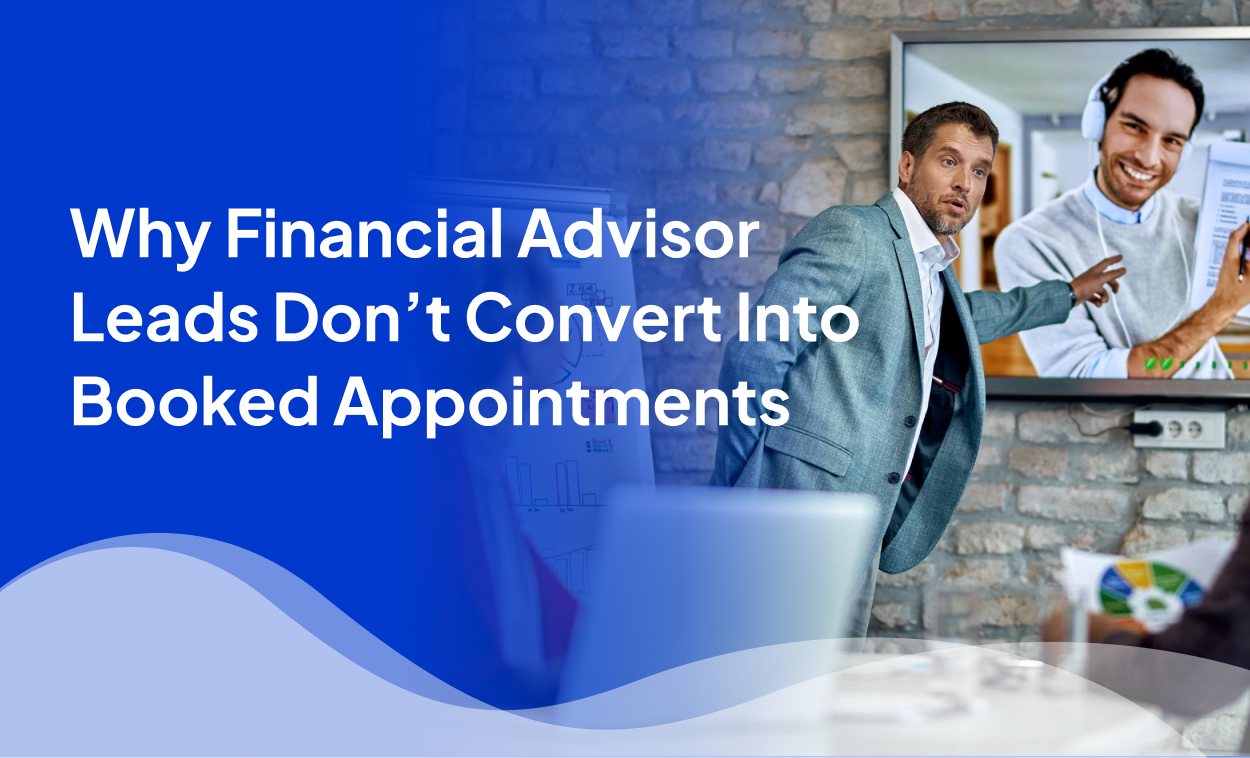
Why Financial Advisor Leads Don’t Convert Into Booked Appointments
Financial advisor leads usually fail to convert because there is a disconnect between the lead source, the message, the follow-up, and the appointment-setting process.
Some leads are not ready to book. Some are not qualified. Some had interest but were contacted too late. Others may not understand why a meeting is worth their time.
This is why firms should not judge marketing only by the number of leads generated.
A lead is only the start of the process. The real goal is to move the right prospects toward qualified booked appointments.
Many firms invest in ads, landing pages, or lead generation companies but do not have a strong system for what happens after someone raises their hand. When that happens, leads can slip through the cracks.
Common reasons leads fail to convert include:
- Poor lead quality
- Slow follow-up
- Generic messaging
- Weak appointment offers
- No nurturing sequence
- Poor qualification
- No reminder system
- Disconnected marketing tools
- No clear tracking from lead to appointment
The solution is not always “more leads.” Often, the better fix is improving the process between the first inquiry and the booked call.
The Lead Quality Problem
Not every lead is worth the same amount of time, attention, or budget.
Some financial advisor leads come from people who are actively looking for help. Others come from people who are only researching a topic. Some may have clicked an ad out of curiosity but have no real intent to speak with an advisor.
That difference matters.
For example, someone searching for “retirement income advisor near me” may have much stronger intent than someone downloading a broad retirement checklist. Both may become good prospects, but they are at different stages.
A common mistake is treating every lead the same.
Low-quality leads often come from:
- Broad ad targeting
- Weak landing page messaging
- Free offers that attract the wrong audience
- Lead forms with no qualification questions
- Campaigns focused on volume instead of intent
- Misaligned promises in ads or landing pages
A prospect who downloads a guide may still need education before booking. They may want to understand their options, compare firms, or decide whether they are ready to speak with someone.
That does not mean the lead is bad.
It means the firm needs a better follow-up and nurturing process.
Your Offer May Not Give Prospects a Clear Reason to Book
Many financial advisor websites use generic calls to action like “Schedule a consultation” or “Contact us today.”
Those phrases are common, but they do not always explain why the prospect should take action.
A strong appointment offer should make the value of the meeting clear.
The prospect should know what they will get, what problem the call helps solve, and why it is worth their time.
For financial advisors, the appointment should feel useful, not sales-heavy.
Weak Appointment Offer | Stronger Appointment Offer |
Schedule a consultation | Book a retirement income review |
Talk to an advisor | See if your current strategy supports your retirement timeline |
Get in touch | Review your portfolio, tax exposure, and income plan |
Contact us | Find out whether your financial plan is ready for retirement |
Book a call | Identify gaps in your retirement, tax, and investment strategy |
A stronger offer gives the prospect a clear reason to book.
It also helps filter out people who are not a good fit.
If the appointment is framed around a real financial concern, such as retirement income, tax exposure, investment risk, estate planning, or portfolio review, the prospect is more likely to understand the value of speaking with the firm.
Slow Follow-Up Can Reduce Financial Advisor Lead Conversion
Response speed can affect whether a prospect stays engaged.
When a prospect fills out a form, downloads a resource, or requests information, their interest is often highest at that moment. If the firm waits too long to respond, the lead may lose interest, forget why they reached out, or speak with another advisor.
Slow follow-up is one of the most common reasons financial advisor leads don’t convert into booked appointments.
This is especially true when prospects are comparing several firms.
A delayed response can make the firm appear less organized or less attentive. In a relationship-driven industry, that first impression matters.
Strong follow-up should include:
- Immediate confirmation after form submission
- Fast outreach from the firm
- Clear next steps
- Helpful educational content
- A simple way to book an appointment
- Reminder messages before scheduled calls
This is where marketing automation for financial advisors can help.
Automation does not need to replace personal communication. It should support the team by making sure no lead is ignored.
For example, an investment advisor automated marketing can send a quick thank-you message, deliver the promised resource, invite the prospect to book a call, and notify the team to follow up personally.
The human touch still matters.
Automation simply keeps the process consistent.
Poor Financial Advisor Lead Nurturing Creates Drop-Off
Many prospects are not ready to book after the first interaction.
That is normal.
Financial planning, retirement planning, investment management, tax planning, and wealth management are high-trust services. People usually do not make those decisions after one ad click or one landing page visit.
They need time.
They may need to understand the firm’s process, compare options, talk with a spouse, review their finances, or decide whether the issue is urgent enough to act.
That is why financial advisor lead nurturing is important.
Lead nurturing keeps the conversation going after the first touchpoint. It gives prospects helpful information while building trust over time.
A good nurturing sequence may include:
- Educational emails
- Case-style examples
- Retirement planning checklists
- Tax planning reminders
- Portfolio review prompts
- Appointment invitations
- Follow-up messages based on the prospect’s interest
- Retention and reactivation campaigns
The goal is not to pressure every lead into booking immediately.
The goal is to move the right prospects forward when they are ready.
A useful nurturing system can also support long-term retention and reactivation. This is important because consistent growth often comes from staying visible with prospects and existing contacts, not only from chasing new leads. Revenx explains this connection in its guide on how retention drives consistent pre-booked appointments.
The Appointment-Setting Process Is Too Weak
Appointment setting for financial advisors requires more than sending a calendar link.
A calendar link is only one step.
The prospect still needs to understand why the meeting matters, what will happen on the call, and what they should expect next.
If the appointment-setting process is weak, prospects may hesitate to book or fail to show up after booking.
Common appointment-setting problems include:
- The call offer is unclear
- The booking page has little context
- The firm does not confirm the appointment properly
- There are no reminders
- The prospect is not qualified before the call
- The meeting feels too sales-focused
- The follow-up after booking is weak
A stronger process should make the appointment feel valuable before it happens.
For example, the confirmation message can explain what the call will cover, what the prospect should bring, and how the advisor will help them evaluate their next step.
This can improve both booking rates and show-up rates.
For firms focused on booked appointments, the process should include lead qualification, scheduling, confirmation, reminders, and follow-up after missed calls.
The goal is not just to fill the calendar.
The goal is to fill it with qualified prospects who understand why they are meeting with the firm.
Your Messaging May Be Too Generic
Generic messaging is another reason financial advisor leads fail to convert.
Many firms say things like:
- “We help you reach your goals.”
- “We provide personalized financial advice.”
- “We help you plan for the future.”
- “We offer comprehensive wealth management.”
Those statements may be true, but they are not specific enough to move many prospects to action.
People usually respond to clear problems, not broad promises.
Better messaging speaks to the prospect’s real situation.
For example:
- Are you within five years of retirement?
- Worried about taxes reducing your retirement income?
- Not sure if your portfolio can support your income needs?
- Need help turning savings into a retirement paycheck?
- Concerned about market risk before retirement?
- Unsure whether your current advisor has a clear income plan?
Specific messaging helps prospects recognize themselves in the offer.
It also helps the firm attract better-fit leads.
A retiree, a business owner, a federal employee, a high-income executive, and a young family may all need financial advice. But they do not respond to the same message.
The more specific the message, the easier it is for the right prospect to take the next step.
There Is No Clear System Between Lead Generation and Sales
This is one of the biggest issues.
Many firms have marketing activity, but they do not have a complete financial advisor marketing system.
They may have ads, landing pages, email tools, a CRM, and a calendar link. But those pieces may not work together.
That creates gaps.
A lead may fill out a form, but no one follows up quickly. A prospect may receive one email but no further nurturing. Someone may book an appointment but never get a proper reminder. Another lead may be interested but not ready, so they disappear because there is no long-term follow-up.
A strong system connects every step.
It should cover:
- Lead capture
- Lead source tracking
- Qualification
- Fast response
- Email and SMS follow-up
- Advisor notifications
- Appointment booking
- Calendar reminders
- No-show recovery
- Long-term nurturing
- Reporting and performance review
Without this connection, firms often focus on the wrong problem.
They may think they need better ads when the real issue is poor follow-up. They may think the leads are bad when the real issue is weak qualification. They may think the offer is not working when the booking page is unclear.
A connected financial advisor marketing system helps the firm see where leads are dropping off.
That makes it easier to fix the right part of the process.
Comparison Table: Why Leads Don’t Convert and How to Fix It
Conversion Problem | What Usually Causes It | What to Fix |
Leads do not reply | Slow or generic follow-up | Use faster, more personalized follow-up |
Leads are not qualified | Poor targeting or weak lead forms | Improve audience, messaging, and qualification questions |
Prospects do not book | Appointment offer is unclear | Make the value of the call specific |
Booked calls do not show | No reminder or confirmation system | Add email/SMS reminders and clear expectations |
Leads go cold | No nurturing sequence | Use educational follow-up content |
High lead volume but low conversion | Focus on quantity over intent | Track qualified appointments, not just form fills |
Manual process breaks down | Too many disconnected tools | Use a connected financial advisor marketing platform |
Prospects hesitate | Low trust or vague messaging | Add proof, examples, and clearer positioning |
Team cannot diagnose issues | Poor tracking | Measure source, response time, booking rate, and show-up rate |
How Advisor Marketing Software Can Improve Lead Conversion
Advisor marketing software can help firms manage the steps between lead generation and booked appointments.
The right system should not only collect leads. It should help the firm respond, nurture, qualify, and schedule prospects more consistently.
A strong financial advisor marketing platform can help with:
- Faster lead response
- Automated follow-up
- Prospect segmentation
- Appointment reminders
- CRM tracking
- Lead source reporting
- Email and SMS communication
- Re-engagement campaigns
- Appointment-setting workflows
- Performance measurement
This matters because manual follow-up is difficult to manage at scale.
When leads come from several sources, such as paid ads, referrals, webinars, website forms, lead magnets, and organic search, it becomes easy to miss opportunities.
Marketing tools for financial advisors should reduce that risk.
They should help the firm know where each lead came from, what action they took, whether they booked, whether they showed up, and what happened next.
This gives the firm a clearer view of what is actually working.
Should You Use a Marketing Agency or a Financial Advisor Marketing Platform?
Some firms need a marketing agency. Others need a better platform. Many need both.
A marketing agency can help with strategy, campaign planning, creative, paid media, SEO, content, landing pages, and positioning. A financial advisor marketing platform can help manage the lead journey after the prospect enters the system.
The difference matters.
An agency may help generate demand. A platform may help organize, automate, and track what happens after demand is created.
Option | Best Use Case | Limitation |
Marketing agency | Strategy, campaigns, creative, SEO, paid media, and positioning | May not manage every follow-up or appointment-setting step |
Advisor marketing platform | Automation, lead tracking, nurturing, reminders, and booking workflows | Still needs strong messaging and campaign strategy |
Combined approach | Firms that want traffic, follow-up, and booked appointments working together | Requires clear goals, tracking, and accountability |
For advisory firms comparing marketing agencies for financial services, the key question is not only who can generate leads.
The better question is:
Can the partner help turn the right leads into qualified booked appointments?
That is where strategy, software, automation, and follow-up need to work together.
What Metrics Should Financial Advisors Track?
Many firms track cost per lead but ignore the metrics that matter after the lead comes in.
A low-cost lead is not valuable if it never becomes a qualified appointment.
Financial advisors should track the full path from lead source to client opportunity.
Important metrics include:
- Lead source
- Cost per lead
- Cost per qualified lead
- Lead-to-appointment rate
- Appointment show-up rate
- Appointment-to-client rate
- Time to first response
- Follow-up completion rate
- No-show rate
- Source quality
- Pipeline value
- Revenue by campaign
- Retention and reactivation performance
These metrics help reveal where the process is breaking.
For example, if many leads are coming in but few are booking, the issue may offer clarity or follow-up. If many people book but do not show up, the issue may be confirmation, reminders, or qualification. If appointments happen but few become clients, the problem may be lead quality or sales fit.
Better tracking leads to better decisions.
Without tracking, firms often guess.
How to Improve Financial Advisor Lead Conversion
Improving lead conversion does not always require a complete rebuild.
Often, small improvements across the system can create better results.
1. Tighten targeting before increasing ad spend
Do not scale campaigns until you know the current leads are qualified.
Better targeting can reduce wasted budget and improve appointment quality.
2. Make the appointment offer specific
Avoid vague calls to action.
Explain what the meeting helps the prospect understand or solve.
3. Respond quickly to every new lead
Fast response can create a more professional first impression and keep the conversation active while interest is high.
4. Build a financial advisor lead nurturing sequence
Not every lead will book immediately.
Use educational follow-up to stay visible and answer common questions.
5. Use reminders to reduce no-shows
Send confirmation messages and reminders before the meeting.
Make sure the prospect knows what to expect.
6. Track booked appointments, not just leads
Lead volume is not the final goal.
Qualified appointments are a stronger measure of marketing performance.
7. Review lead sources monthly
Some sources may produce many leads but few real opportunities.
Others may produce fewer leads but better appointments.
8. Align sales follow-up with marketing messages
The message that brought the prospect in should match the follow-up conversation.
This creates a smoother experience.
9. Use automation without removing the human touch
Marketing automation for financial advisors should support personal follow-up, not replace it.
10. Build a connected financial advisor marketing system
Many effective firms connect lead capture, follow-up, nurturing, booking, reminders, and reporting into one clear process.
When Should a Firm Upgrade Its Marketing System?
An advisory firm may need a stronger financial advisor marketing platform when the current process becomes difficult to manage or measure.
This often happens when the firm is getting leads but not enough qualified appointments.
Signs it may be time to upgrade include:
- Leads are coming in but not booking
- Follow-up is inconsistent
- The team manually tracks too much
- Prospects fall through the cracks
- No-shows are common
- The firm cannot see which campaigns produce appointments
- There is no clear nurturing sequence
- The sales team complains about lead quality
- Growth depends too heavily on referrals
- The firm wants more predictable pre-booked appointments
At that point, more traffic may not solve the issue.
The firm may need a better system for converting interest into scheduled conversations.
A leading advisor marketing platform should help the firm manage that process from first touch to appointment.

Final Thoughts: Leads Are Only Valuable When the System Converts Them
Financial advisor leads don’t convert into booked appointments for many reasons.
Some leads are not qualified. Some are contacted too late. Some need more nurturing. Some do not understand the value of booking a call. Others are lost because the firm has no clear system between lead generation and appointment setting.
The fix is not always more leads.
In many cases, the better solution is a stronger financial advisor marketing system that connects targeting, messaging, follow-up, nurturing, qualification, reminders, and tracking.
When those pieces work together, advisory firms can turn more interest into qualified booked appointments and build a more consistent growth process.
A stronger system gives the firm a clear process for every lead: where it came from, how quickly it was contacted, what follow-up it received, whether it booked, and whether it showed up. That visibility makes it easier to improve the parts of the process that are limiting appointment growth.
If your firm is generating leads but not enough booked appointments, the issue may not be lead volume. It may be the system behind the lead. Revenx works with financial advisors on lead generation, follow-up, nurturing, and appointment-setting workflows so more qualified prospects can move from interest to scheduled conversations.
FAQs About Why Financial Advisor Leads Don’t Convert
1.Why don’t financial advisor leads convert?
Financial advisor leads often fail to convert because they are unqualified, contacted too late, poorly nurtured, or not given a clear reason to book an appointment. Many firms focus on lead generation but do not have a strong follow-up and appointment-setting process.
2. How can financial advisors turn more leads into booked appointments?
Financial advisors can improve conversion by using faster follow-up, clearer appointment offers, better lead nurturing, automated reminders, and a structured appointment-setting process. The goal is to guide qualified prospects from interest to a scheduled conversation.
3. What is financial advisor lead nurturing?
Financial advisor lead nurturing is the process of following up with prospects over time through helpful messages, educational content, appointment invitations, and reminders. It helps build trust with leads who may not be ready to book immediately.
4. Why do booked appointments fail to show up?
Booked appointments often fail to show up because the prospect was not properly qualified, did not receive reminders, or did not fully understand the value of the meeting. A strong confirmation and reminder process can help reduce no-shows.
5. Is lead generation enough for financial advisors?
No. Lead generation creates opportunities, but it does not guarantee appointments or clients. Financial advisors also need follow-up, nurturing, qualification, appointment setting, and tracking to turn leads into real business opportunities.
6. Can advisor marketing software help with appointment setting?
Yes. Advisor marketing software can help automate follow-up, segment leads, send reminders, track engagement, and improve the process from lead capture to booked appointment. It can also help firms see which campaigns are producing qualified appointments.
7. What is the difference between a lead and a booked appointment?
A lead is someone who has shown interest in the firm, such as by filling out a form or downloading a resource. A booked appointment is a scheduled meeting with a prospect who has taken the next step toward speaking with the advisory firm.
8. What should financial advisors track besides cost per lead?
Financial advisors should track lead quality, lead-to-appointment rate, appointment show-up rate, appointment-to-client rate, response time, source quality, follow-up completion rate, and pipeline value. These metrics show whether the marketing system is producing real opportunities.
Disclaimer
This content is for informational and educational purposes only. It does not constitute financial, investment, legal, compliance, or marketing advice. Financial advisors and advisory firms should review all marketing materials, claims, testimonials, endorsements, disclosures, lead handling practices, and client communications with their compliance team or qualified legal counsel before publication or use. Results from any marketing platform, agency, or appointment-setting system may vary based on market conditions, offer, audience, follow-up process, compliance requirements, and firm-specific execution.