- Written & Reviewed by Jeremy
- Published
- Last Updated Oct 07, 2026
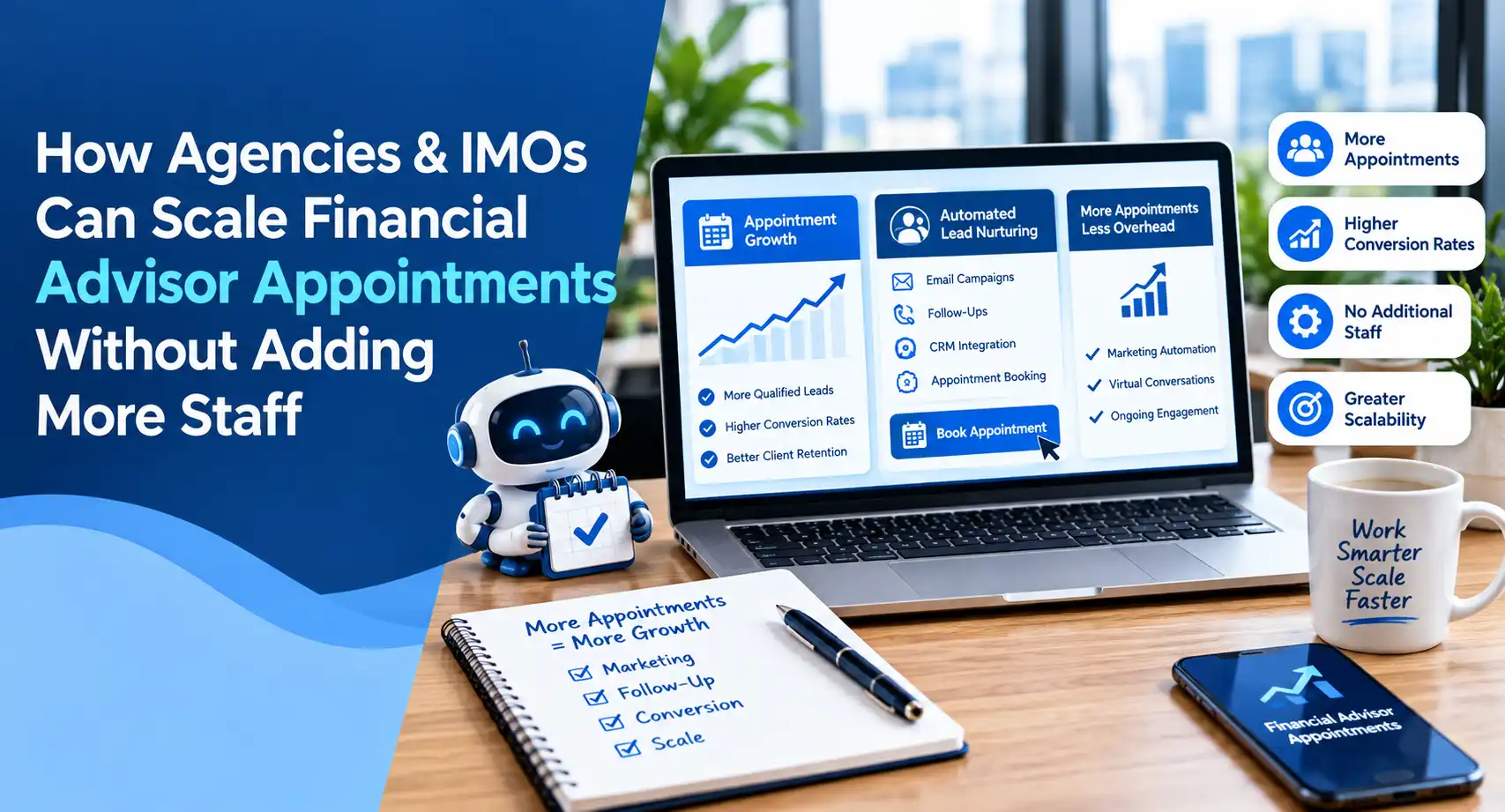
For agencies and Independent Marketing Organizations (IMOs), generating financial advisor leads is only one part of the growth equation. The bigger challenge is turning those leads into qualified, booked appointments without adding pressure to an already busy team.
As lead volume grows, manual follow-ups, scheduling, qualification, reminders, and lead routing can quickly become difficult to manage. A strong SEO strategy for financial advisors can help create a more consistent flow of potential clients before they enter the follow-up process. Adding more staff may seem like the obvious solution, but it is not always the most efficient one.
A better approach is to improve the appointment-generation system.
With the right combination of lead qualification, automation, follow-up, scheduling, content, and performance tracking, agencies and IMOs can increase appointment volume while allowing their existing teams to work more efficiently.
This guide explains how financial advisor appointment scaling works and what agencies and IMOs can do to build a more efficient appointment-generation process.
What Is Financial Advisor Appointment Scaling?
Financial advisor appointment scaling means increasing the number of qualified appointments an agency or IMO can generate without increasing staff and workload at the same rate, ultimately helping turn website visitors into booked appointments.
It is not simply about generating more leads.
For example, an agency may increase its marketing budget and generate 500 additional leads. But if its team cannot respond to those leads quickly, qualify them properly, or help them schedule an appointment, the additional leads may not produce meaningful results.
A scalable appointment process focuses on the entire journey:
Lead → Initial Response → Qualification → Follow-Up → Appointment Booking → Reminder → Advisor Meeting
Each stage should have a clear process.
The goal is to remove unnecessary manual work while keeping the experience personal enough for prospects to feel that they are communicating with a real business that understands their needs.
Why Agencies & IMOs Struggle to Scale Advisor Appointments
Many agencies and IMOs already have a steady flow of leads. Their problem is often what happens after someone submits a form, requests information, or shows interest.
Several common bottlenecks can slow down appointment growth.
Slow Lead Response Times
When a prospect submits an inquiry, interest is usually highest at that moment.
If the response comes several hours or days later, the prospect may have already moved on, contacted another company, or simply lost interest.
A faster response process can make it easier to start the conversation while the prospect is still engaged.
Too Much Manual Follow-Up
A team may spend a large part of its day sending follow-up emails, making calls, checking calendars, confirming appointments, and contacting people who did not respond.
As lead volume increases, this workload increases too.
Eventually, some leads receive inconsistent follow-up or are missed completely.
Poor Lead Qualification
Not every lead is ready for an advisor conversation.
If advisors are receiving appointments from people who are outside their target audience or are not currently looking for help, valuable calendar time can be wasted.
A qualification process helps separate higher-intent prospects from leads that may need more education or nurturing first.
Disconnected Marketing and Sales Systems
Agencies often use several platforms for advertising, websites, email, CRM management, scheduling, and reporting.
If these systems do not work together properly, information can become fragmented.
A lead might submit a form but never enter the correct follow-up sequence. Another prospect might book an appointment without the advisor receiving enough context beforehand.
No Consistent Appointment Process
When every advisor or appointment setter handles leads differently, it becomes difficult to identify what is working.
A standardized process makes performance easier to measure and improve.
The Difference Between Generating More Leads and Scaling Appointments
Generating leads and scaling appointments are related, but they are not the same thing.
Lead Generation | Appointment Scaling |
Focuses on acquiring prospects | Focuses on converting prospects into appointments |
Measures lead volume | Measures appointments and conversion rates |
Often increases workload | Aims to improve operational efficiency |
Primarily focuses on the top of the funnel | Covers the lead-to-appointment journey |
May require additional resources as volume grows | Uses processes and automation to handle more volume |
Does not guarantee qualified appointments | Focuses more heavily on appointment quality |
An agency can generate thousands of leads and still struggle to produce enough qualified appointments.
The real opportunity comes from improving what happens between the first lead interaction and the advisor meeting.
How Agencies & IMOs Can Scale Financial Advisor Appointments
Agencies and IMOs can scale appointments by improving the entire lead-to-appointment process rather than relying on a single tool.
Key steps include:
- Standardize the process: Lead capture → qualification → follow-up → nurture → booking → reminders → advisor meeting.
- Automate follow-up: Use timely acknowledgments, scheduling links, confirmations, and reminders.
- Qualify leads: Collect basic information to determine whether a prospect is ready and appropriate for an advisor conversation.
- Simplify scheduling: Offer real-time availability, online booking, confirmations, and easy rescheduling.
The goal is to reduce manual work while creating a smoother path from lead to booked appointment.
How AI and Automation Can Support Appointment Scaling
AI and automation for appointment setting are becoming useful tools for agencies that need to handle larger lead volumes without increasing administrative work at the same pace.
Potential applications include:
- Lead routing
- Initial lead responses
- Appointment scheduling
- Follow-up reminders
- Lead prioritization
- Data organization
- Reporting
- Identifying inactive leads
However, automation should be implemented carefully in financial services.
Important client communications and recommendations may require human oversight and appropriate compliance review. Technology should support the process rather than make unsupported financial claims or replace professional judgment.
The best use of automation is often simple: let technology handle repetitive administrative tasks so people can spend more time on meaningful conversations.
Create a Follow-Up System for Leads That Do Not Book Immediately
One of the biggest mistakes agencies make is assuming that every lead will book an appointment immediately.-
Many prospects need time.
They may be researching their options, comparing advisors, discussing their situation with a spouse, or simply learning more about a financial topic.
A structured follow-up system can keep the conversation open without requiring staff to manually remember every lead.
First Follow-Up
The initial follow-up should acknowledge the inquiry and make the next step clear.
Continued Follow-Up
Additional communication can provide useful educational information related to the prospect’s interests.
For example, a prospect interested in retirement planning may benefit from educational content about retirement income, planning considerations, or common questions people ask before speaking with an advisor.
Re-Engagement
Older leads can sometimes become relevant again.
A structured re-engagement process can identify prospects who previously showed interest but did not schedule an appointment.
All financial marketing and follow-up communications should be reviewed against applicable regulatory and compliance requirements.
Use Content Marketing to Support Appointment Scaling
Content marketing can support appointment generation by answering questions before a prospect speaks with an advisor.
A person searching for financial advice may have many questions before they are comfortable scheduling a conversation.
Useful content can help address those questions.
Examples include:
- Financial planning guides
- Retirement education
- Insurance explanations
- FAQs
- Blog articles
- Webinars
- Email education
- Downloadable resources
The purpose should not simply be to publish content for search engines.
Good content should help prospects understand a topic and decide whether speaking with a professional is the right next step.
For agencies and IMOs, content can also reduce repetitive questions that advisors frequently receive.
How Webinars Can Help Agencies Scale Advisor Appointments
Webinars can create a useful bridge between marketing and appointment generation.
A typical webinar funnel looks like:
Promotion → Registration → Attendance → Engagement → Follow-Up → Appointment
Instead of asking someone to immediately schedule a consultation, a webinar gives the prospect an opportunity to learn first.
After the webinar, follow-up can be used to provide additional resources and invite qualified attendees to speak with an advisor.
Webinars can also help agencies identify higher-intent prospects.
For example, someone who registers, attends the webinar, stays engaged, and interacts with follow-up content may show stronger intent than someone who simply downloaded a general resource.
The key is to have a clear post-webinar process rather than ending the marketing journey when the webinar finishes.
Build a Multi-Channel Appointment Generation System
A scalable appointment strategy should combine multiple channels rather than rely on one.
- SEO: Attract prospects actively searching for financial information.
- Paid Advertising: Generate targeted traffic and leads.
- Email Marketing: Nurture prospects who are not ready to book.
- Webinars: Educate prospects and encourage meaningful conversations.
- Social Media: Build awareness and drive prospects toward resources or appointments.
The goal is to make these channels work together to generate qualified appointments, not simply more traffic or clicks.
Track the Metrics That Actually Matter
Lead volume alone does not tell you whether an appointment-generation system is working.
Agencies and IMOs should consider tracking metrics such as:
- Number of leads
- Lead response rate
- Lead-to-contact rate
- Contact-to-appointment rate
- Qualified appointment rate
- Appointment show rate
- No-show rate
- Cost per appointment
- Cost per qualified appointment
- Advisor conversion rate
Why Appointment Quality Matters More Than Lead Volume
Imagine two campaigns.
Campaign A produces 500 leads and 20 appointments.
Campaign B produces 250 leads and 35 appointments.
Campaign B generates fewer leads but more appointments.
That is why agencies should not automatically judge a campaign by the number of leads it generates.
The more useful question is:
How many qualified conversations is the marketing system actually creating?
How to Scale Without Overloading Financial Advisors
Scaling appointments works best when advisors can manage the additional conversations.
- Route leads intelligently: Match prospects based on service needs, location, specialization, or availability.
- Prioritize high-intent leads: Focus attention on prospects more likely to be ready for a conversation.
- Automate repetitive tasks: Streamline scheduling, reminders, confirmations, and basic follow-up.
- Protect advisor capacity: Focus on qualified appointments rather than simply increasing volume.
The goal is to balance appointment quantity with appointment quality while keeping advisor calendars manageable.
Common Mistakes Agencies & IMOs Make When Trying to Scale
- Focusing only on lead volume: More leads do not guarantee more clients.
- Hiring before fixing the process: Extra staff cannot solve an inefficient system.
- Responding too slowly: Delayed follow-up can reduce conversion opportunities.
- Not qualifying leads: Poor-fit prospects can waste advisor time.
- Relying on manual follow-up: Manual processes become harder to manage at scale.
- Using the same message for everyone: Different prospects require different approaches.
- Ignoring no-shows: Missed appointments reduce the value of lead generation.
- Tracking only marketing metrics: Focus on qualified appointments and business outcomes.
- Using disconnected systems: Gaps between marketing, follow-up, and scheduling can hurt efficiency.
- Scaling before testing: Fix the process first, then increase volume.
When Should an Agency or IMO Invest in Appointment Scaling?
There are several signs that an organization may be ready to improve its appointment-generation system.
You may need a more scalable process if:
- Lead volume is increasing
- Staff are struggling to follow up quickly
- Leads are falling through the cracks
- Advisors receive inconsistent appointment quality
- Appointment setters are overloaded
- No-show rates are high
- Marketing spend is increasing without a similar increase in appointments
- Staff spend too much time on repetitive administrative tasks
- Management cannot clearly see where leads are being lost
If several of these problems exist, adding more leads may not be the best first step.
Improving the existing funnel may produce a better return.
A Step-by-Step Financial Advisor Appointment Scaling Framework
A practical financial advisor appointment scaling strategy can follow seven steps:
- Audit the funnel: Identify where prospects drop off.
- Define qualified appointments: Set clear criteria for advisor-ready leads.
- Standardize follow-up: Create consistent processes for leads, no-shows, and booked meetings.
- Automate repetitive tasks: Streamline scheduling, reminders, and administration.
- Improve lead routing: Connect qualified prospects with the right advisor.
- Track key metrics: Monitor conversion, show rates, appointment quality, and cost.
- Test and optimize: Improve the weakest stage, measure results, and repeat.

Final Thoughts: Scaling Advisor Appointments Without Scaling Headcount
Agencies and IMOs do not necessarily need to add more staff every time they want to increase financial advisor appointments
In many cases, the bigger opportunity is improving the system that already exists.
A scalable appointment process combines effective lead generation with fast follow-up, qualification, scheduling, reminders, content, automation, and clear performance tracking.
The goal is not simply to generate more leads.
It is to create more qualified advisor conversations while making better use of the team’s existing time and resources.
When agencies and IMOs build a repeatable process, they can make appointment generation more predictable and create a stronger foundation for long-term growth.
FAQs About Financial Advisor Appointment Scaling
1. What is financial advisor appointment scaling?
Financial advisor appointment scaling is the process of increasing the number of qualified appointments without increasing staff and workload at the same rate. It typically involves improving lead qualification, follow-up, scheduling, automation, and appointment management.
2. How can agencies scale financial advisor appointments without hiring more staff?
Agencies can scale appointments by automating repetitive tasks, improving lead qualification, using online scheduling, creating consistent follow-up processes, and routing qualified leads to the right advisors. This allows existing teams to manage more opportunities efficiently.
3. How does automation help financial advisor appointment setting?
Automation can handle repetitive tasks such as lead acknowledgments, appointment scheduling, confirmations, reminders, and follow-up workflows. This reduces administrative work and allows appointment setters and advisors to focus more on qualified prospects and important conversations.
4. What metrics should agencies track when scaling financial advisor appointments?
Agencies should track metrics such as lead-to-appointment conversion rate, qualified appointment rate, appointment show rate, no-show rate, cost per appointment, cost per qualified appointment, and advisor conversion rate. These metrics provide a clearer picture of whether the appointment process is actually improving.
5. Can AI help financial advisors book more appointments?
AI can support appointment scaling through lead routing, scheduling, follow-up, lead prioritization, and reporting. However, financial firms should maintain appropriate human oversight and ensure AI-assisted communications and workflows follow applicable compliance requirements.
Disclaimer:
This content is provided for general informational and educational purposes only. It is not intended to provide financial, investment, legal, tax, or regulatory advice. The strategies and examples discussed are general marketing and appointment-generation considerations and may not be appropriate for every agency, IMO, or financial professional. Financial firms should review marketing communications, AI-assisted workflows, lead-generation practices, and follow-up processes with appropriate compliance and legal professionals before implementation. Results are not guaranteed and may vary based on factors such as audience, market conditions, budget, systems, and execution.