- Written & Reviewed by Jeremy
- Published
- Last Updated Aug 06, 2026
Marketing is one of the most effective ways for financial advisors to grow their business, but it’s also a significant investment. Whether you’re using SEO, paid ads, email campaigns, or webinars, it’s important to know if your marketing is generating profitable clients.
Understanding how to calculate marketing ROI helps you measure the return on every marketing dollar. Instead of focusing only on website traffic or social media engagement, ROI shows how your efforts contribute to qualified leads, new clients, and recurring revenue.
In this guide, you’ll learn how to calculate marketing ROI, which metrics to track, the marketing costs to include, and practical strategies to improve results. Whether you manage marketing in-house or work with a financial services marketing agency, these insights will help you make smarter, data-driven decisions
What Is Marketing ROI?
Marketing ROI (Return on Investment) measures how much revenue your marketing efforts generate compared to the amount you spend.
The standard formula is:
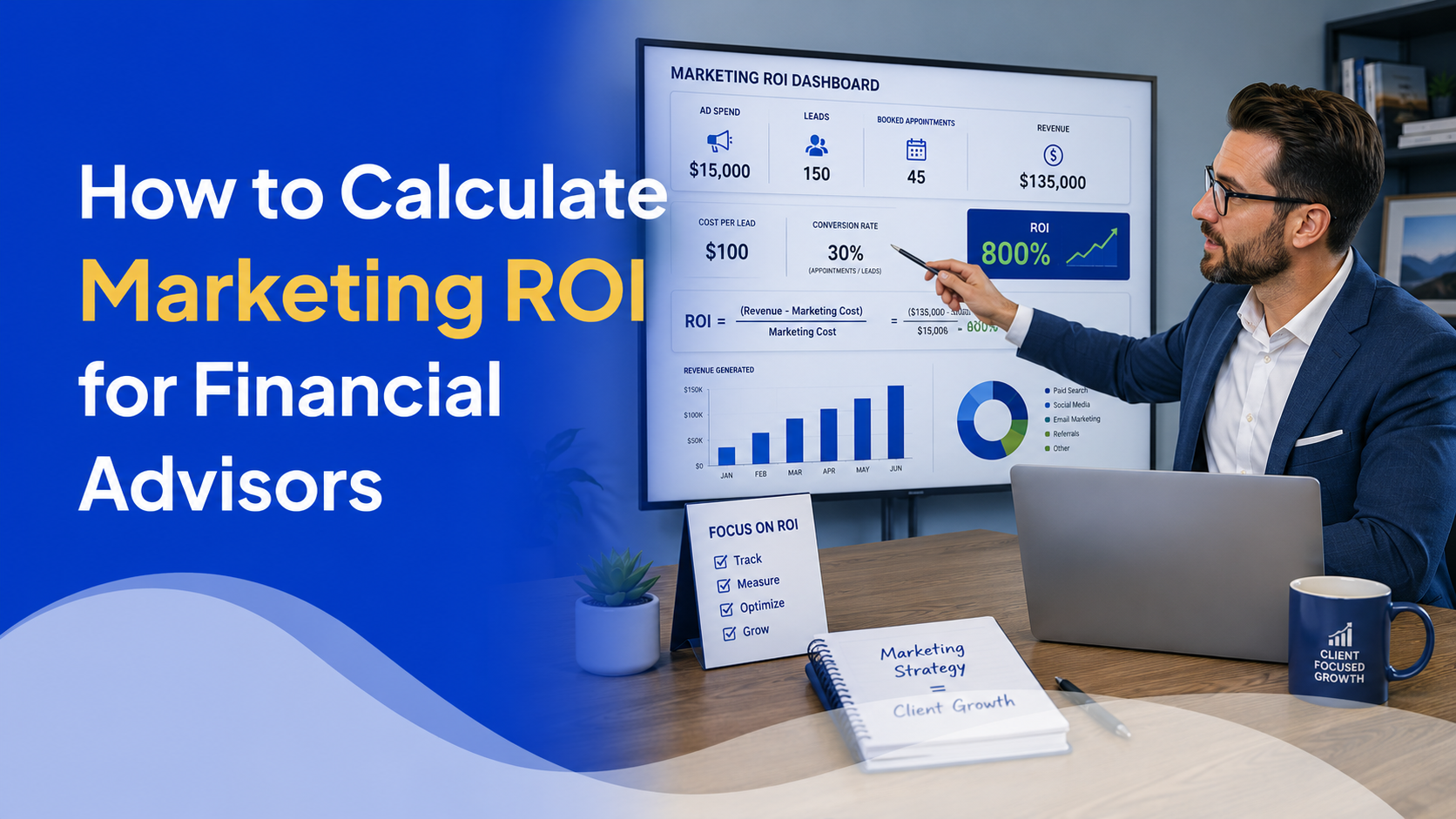
Marketing ROI = ((Revenue Generated − Marketing Cost) ÷ Marketing Cost) × 100
This percentage tells you whether your marketing is profitable and which campaigns deserve continued investment.
For financial advisors, ROI is more meaningful than vanity metrics because it focuses on actual business growth rather than activity.
Instead of asking:
“Did our website get more visitors?”
Ask:
“How many qualified clients did our marketing generate?”
Marketing ROI should measure outcomes such as:
- Qualified leads
- Discovery calls
- Client appointments
- New households acquired
- Assets under management (AUM)
- Annual recurring revenue
- Client lifetime value
Because advisory relationships often last many years, one new client can generate significant long-term revenue. That’s why measuring ROI accurately is critical.
Why Marketing ROI Matters for Financial Advisors
Many firms still judge marketing success using metrics like impressions, clicks, or follower counts. While these indicators can show engagement, they don’t necessarily reflect business growth.
Understanding financial advisor marketing ROI helps firms make smarter decisions.
Better Budget Allocation
Every marketing channel performs differently.
SEO may generate long-term organic leads.
PPC can create immediate opportunities.
Email marketing nurtures prospects over time.
Tracking ROI helps identify where your marketing budget delivers the strongest results.
Higher Lead Quality
Generating 200 inquiries sounds impressive but if only two become clients, the campaign may not be profitable.
ROI encourages firms to prioritize qualified prospects over raw lead volume.
Lower Client Acquisition Costs
When advisors understand exactly how much they spend to acquire each client, they can identify inefficiencies and improve profitability.
Reducing acquisition costs often has a greater impact than simply increasing marketing spend.
Smarter Business Decisions
Reliable marketing data helps firms decide whether to:
- Expand SEO efforts
- Increase webinar marketing
- Improve email campaigns
- Reduce underperforming advertising
- Invest in additional content creation
Instead of making assumptions, every decision becomes data driven.
How to Calculate Marketing ROI
Calculating marketing ROI is simple. Use this formula:
Marketing ROI = ((Revenue Generated − Marketing Cost) ÷ Marketing Cost) × 100
For example, if your firm spends $5,000 on SEO, email marketing, webinars, and content creation and generates $30,000 in annual revenue from five new clients, your marketing ROI is 500%. This means every $1 invested returns $5 before operating expenses.
Example: Using Client Lifetime Value
Financial advisors should also consider client lifetime value when calculating ROI. If you invest $6,000 in marketing and acquire four clients worth $40,000 each over their lifetime, your total revenue is $160,000. Using the same formula, your marketing ROI is 2,567%, showing how long-term client relationships can significantly increase the return on your marketing investment.
Marketing ROI vs Marketing Performance
Although the terms are often used interchangeably, they’re different.
Marketing Performance | Marketing ROI |
Website Traffic | Revenue Generated |
Social Media Engagement | Client Acquisition Cost |
Email Open Rate | Client Lifetime Value |
Click-Through Rate | Return on Investment |
Webinar Attendance | Revenue from New Clients |
Performance metrics help identify whether campaigns are functioning properly.
ROI determines whether those campaigns actually generate profitable business.
Successful firms monitor both.
Which Marketing Costs Should You Include?
One of the biggest mistakes firms make is calculating ROI using only advertising spend.
To understand the true cost of acquiring a client, include every marketing-related expense.
These often include:
- SEO services
- Google Ads
- Social advertising
- Website development
- Landing pages
- CRM software
- Marketing automation
- Webinar software
- Graphic design
- Video production
- Copywriting
- Agency management fees
- Marketing salaries (when applicable)
Accurate calculations lead to better business decisions.
Financial Advisor Marketing Metrics That Actually Matter
Learning how to calculate marketing ROI is only the first step. To improve your results, you need to track the right marketing metrics that directly impact profitability and business growth.
Start by measuring qualified leads instead of total inquiries. Focus on prospects who match your ideal client profile. Also, monitor Cost Per Lead (CPL) by dividing your total marketing spend by the number of leads generated. While a lower CPL is beneficial, lead quality should always take priority over quantity.
Another important metric is Cost Per Acquisition (CPA), which shows how much it costs to gain a new client. Along with CPA, track your lead-to-appointment and appointment-to-client conversion rates to identify opportunities for improving your sales process and increasing ROI.
Don’t overlook Client Lifetime Value (LTV). Since financial advisors often build long-term client relationships, measuring lifetime revenue provides a more accurate picture of your marketing performance than first-year revenue alone.
Finally, track revenue by marketing channel, such as organic search, paid ads, email marketing, webinars, referrals, and social media. Understanding which channels generate the highest-quality clients helps you invest your marketing budget more effectively and maximize ROI.
Measuring Marketing ROI Across Different Marketing Channels
Not every marketing strategy produces results in the same way. Some channels generate leads quickly, while others build authority and trust over time. That’s why evaluating digital marketing ROI by channel is one of the smartest things a financial advisor can do.
Instead of measuring all campaigns together, calculate ROI separately for SEO, paid advertising, email marketing, webinars, and content marketing. This helps you identify where your marketing dollars produce the greatest return.
The goal isn’t simply to generate more traffic, it’s to generate more qualified clients.
SEO for Financial Advisors: Long-Term ROI That Compounds
For many advisory firms, SEO for financial advisors delivers one of the highest long-term returns because it targets people actively searching for financial guidance.
Someone searching for:
- Retirement financial advisor
- Federal employee retirement planning
- Fiduciary financial advisor
- Tax-efficient retirement planning
already has a strong intent to learn more or schedule a consultation.
Unlike paid advertising, SEO continues generating leads long after content has been published. A well-optimized blog can attract qualified visitors for months or even years without additional advertising costs.
Important SEO Metrics
Monitor these metrics to evaluate SEO performance:
- Organic website traffic
- Keyword rankings
- Contact form submissions
- Phone inquiries
- Discovery calls
- Qualified appointments
- Organic leads
- Revenue generated from organic search
Example
Metric | Value |
Monthly SEO Cost | $2,500 |
Organic Leads | 35 |
Discovery Calls | 15 |
New Clients | 5 |
Annual Revenue | $35,000 |
Although SEO usually requires patience, its long-term ROI often exceeds many short-term marketing tactics.
PPC Advertising: Fast Results with Careful Tracking
Pay-per-click advertising offers immediate visibility for advisors looking to generate leads quickly.
However, PPC requires close monitoring because every click comes with a cost.
Instead of measuring clicks alone, focus on:
- Cost Per Click (CPC)
- Cost Per Lead (CPL)
- Landing Page Conversion Rate
- Cost Per Acquisition (CPA)
- Return on Ad Spend (ROAS)
- Marketing ROI
A campaign with a higher CPC may still produce excellent ROI if it consistently attracts high-value clients.
Email Marketing for Financial Advisors
Many advisors overlook email marketing for financial advisors because it doesn’t usually generate instant sales.
Instead, email works by building trust.
Educational newsletters, retirement planning updates, tax reminders, and market commentary help prospects stay connected with your firm until they’re ready to schedule a meeting.
Track metrics such as:
- Open Rate
- Click-Through Rate
- Appointment Requests
- Consultation Bookings
- Lead Nurture Conversion Rate
- Revenue from Email Campaigns
One automated email sequence can nurture hundreds of prospects simultaneously while requiring minimal ongoing effort.
Webinar Marketing: Turning Education into Clients
Educational webinars continue to be one of the most effective financial advisor lead generation strategies.
Instead of immediately promoting services, webinars allow advisors to demonstrate expertise while answering common financial planning questions.
Popular webinar topics include:
- Retirement income planning
- Social Security optimization
- Federal employee retirement benefits
- Tax-efficient investing
- Estate planning basics
Measure webinar ROI by tracking:
- Registrations
- Attendance Rate
- Consultation Requests
- Discovery Meetings
- New Clients
- Revenue Generated
The complete attendee journey matters more than attendance alone.
Content Marketing Builds Trust Before the First Conversation
Publishing educational content remains one of the strongest long-term investments for financial advisors.
Quality articles help prospects answer questions before they ever contact your firm.
Examples include:
- Retirement planning guides
- Investment education
- Tax planning strategies
- Social Security articles
- Market outlooks
- Financial checklists
This type of financial services content marketing increases visibility while building authority and trust.
Unlike advertisements that stop generating traffic once the budget ends, educational content continues attracting visitors through search engines and social sharing.
Social Media Marketing
Social media rarely produces immediate clients on its own, but it supports every other marketing effort by increasing visibility and credibility.
Instead of measuring likes or followers, evaluate metrics that relate to business growth:
- Website visits
- Consultation requests
- Email subscribers
- Content downloads
- Webinar registrations
- Revenue influenced by social media
The objective isn’t popularity; it’s creating opportunities for future conversations.
Comparison Table: Marketing Channels for Financial Advisors
Marketing Channel | Time to Results | Primary Goal | Best ROI Metric | Long-Term Value |
SEO | 4–9 Months | Organic Lead Generation | Revenue from Organic Search | ⭐⭐⭐⭐⭐ |
PPC | Days to Weeks | Immediate Leads | Cost Per Acquisition | ⭐⭐⭐ |
Email Marketing | 1–3 Months | Lead Nurturing | Revenue per Campaign | ⭐⭐⭐⭐ |
Webinar Marketing | 1–3 Months | Build Trust | Clients from Attendees | ⭐⭐⭐⭐ |
Content Marketing | 3–9 Months | Authority Building | Organic Leads | ⭐⭐⭐⭐⭐ |
Social Media | Ongoing | Brand Awareness | Assisted Conversions | ⭐⭐⭐ |
The most successful advisory firms combine several of these channels rather than relying on one source of leads.
Financial Advisor Marketing Analytics
Tracking metrics individually is useful, but combining them through financial advisor marketing analytics gives advisors a complete picture of the customer journey.
Modern analytics platforms help answer questions like:
- Which campaigns generate the highest-quality clients?
- Which blog articles drive consultations?
- Which landing pages convert best?
- Which marketing channel produces the lowest acquisition cost?
- Which campaigns increase assets under management?
Instead of guessing where business comes from, analytics provide measurable answers that improve future decisions.
Build Your Own Marketing ROI Calculator
You don’t need expensive software to start measuring ROI.
A simple spreadsheet can include:
Metric | Example |
Marketing Channel | SEO |
Monthly Investment | $2,500 |
Qualified Leads | 35 |
Discovery Calls | 15 |
New Clients | 5 |
Revenue Generated | $35,000 |
Cost Per Lead | $71 |
Cost Per Client | $500 |
Marketing ROI | 1,300% |
Updating this dashboard every month makes it easier to identify trends, compare channels, and improve future budgeting decisions.
Common Marketing ROI Mistakes
Even experienced advisors sometimes measure ROI incorrectly.
Avoid these common mistakes.
Measuring Only Lead Volume
More leads don’t always mean better marketing.
Twenty highly qualified prospects often outperform two hundred low-quality inquiries.
Ignoring Lifetime Client Value
Many advisors underestimate ROI because they only measure first-year revenue.
Long-term client relationships dramatically increase marketing profitability.
Expecting Immediate Results
SEO and financial services content marketing require consistency.
Stopping campaigns after only a few months often prevents firms from seeing meaningful long-term returns.
Tracking Vanity Metrics
Website traffic, impressions, and social followers are useful indicators but they don’t pay the bills.
Always prioritize:
- Revenue
- Qualified appointments
- Client acquisition cost
- Lifetime value
- Marketing ROI
Not Using Attribution
A prospect may discover your firm through Google, read several articles, attend a webinar, subscribe to your newsletter, and only then schedule a consultation.
Giving credit only to the final interaction undervalues every earlier marketing effort.
Improving Financial Advisor Lead Generation ROI
Improving financial advisor lead generation ROI doesn’t always require spending more money.
Instead, focus on:
- Improving landing page conversion rates.
- Creating higher-quality educational content.
- Following up with leads more quickly.
- Automating email nurturing.
- Optimizing website calls-to-action.
- Publishing SEO-focused blog content consistently.
- Tracking every lead source.
- Reviewing marketing performance monthly.
Small improvements across multiple areas often produce much larger ROI than simply increasing advertising budgets.

Final Thoughts
Learning how to calculate marketing ROI allows financial advisors to stop guessing and start making informed business decisions. By measuring revenue, client acquisition costs, lifetime value, and channel performance, you can identify the marketing strategies that consistently generate qualified clients.
The strongest results rarely come from a single tactic. Instead, firms that combine SEO for financial advisors, email marketing for financial advisors, educational webinars, and financial services content marketing create a sustainable marketing system that delivers long-term growth.
If you’re ready to measure and improve your marketing ROI, book a free strategy consultation to see how Revenx can help you build data-driven campaigns, strengthen your online presence, and generate more qualified appointments.
At Revenx, we help financial advisors and insurance professionals turn marketing into a predictable growth engine through data-driven SEO, content marketing, email campaigns, webinar strategies, and marketing analytics.
Frequently Asked Questions
1. What is marketing ROI?
Marketing ROI measures how much revenue your marketing activities generate compared to what you spend. It helps determine whether your campaigns are profitable and which channels deserve continued investment.
2. Which marketing channel has the highest ROI?
For many firms, SEO and content marketing deliver the strongest long-term ROI because they continue generating qualified leads long after the initial investment. PPC provides faster results, while email marketing and webinars help nurture prospects into clients.
3. What KPIs should financial advisors monitor?
Track qualified leads, cost per lead, cost per acquisition, appointment conversion rate, client lifetime value, marketing ROI, and revenue by channel to gain a complete picture of marketing performance.
4. How often should marketing ROI be reviewed?
Review ROI monthly to identify trends, optimize campaigns, and allocate your budget toward the channels that consistently generate the best business outcomes.
Disclaimer
This article is for informational purposes only and should not be considered financial, legal, tax, or investment advice. Marketing results and ROI vary based on your firm’s goals, strategy, and market conditions. Always evaluate your specific business needs and comply with applicable industry regulations before making marketing decisions.