- Written & Reviewed by Jeremy
- Published
- Last Updated Aug 25, 2026
For financial advisors, getting found online is only part of the marketing equation. The bigger question is whether an investment in SEO can contribute to qualified leads, booked appointments, new clients, and revenue.
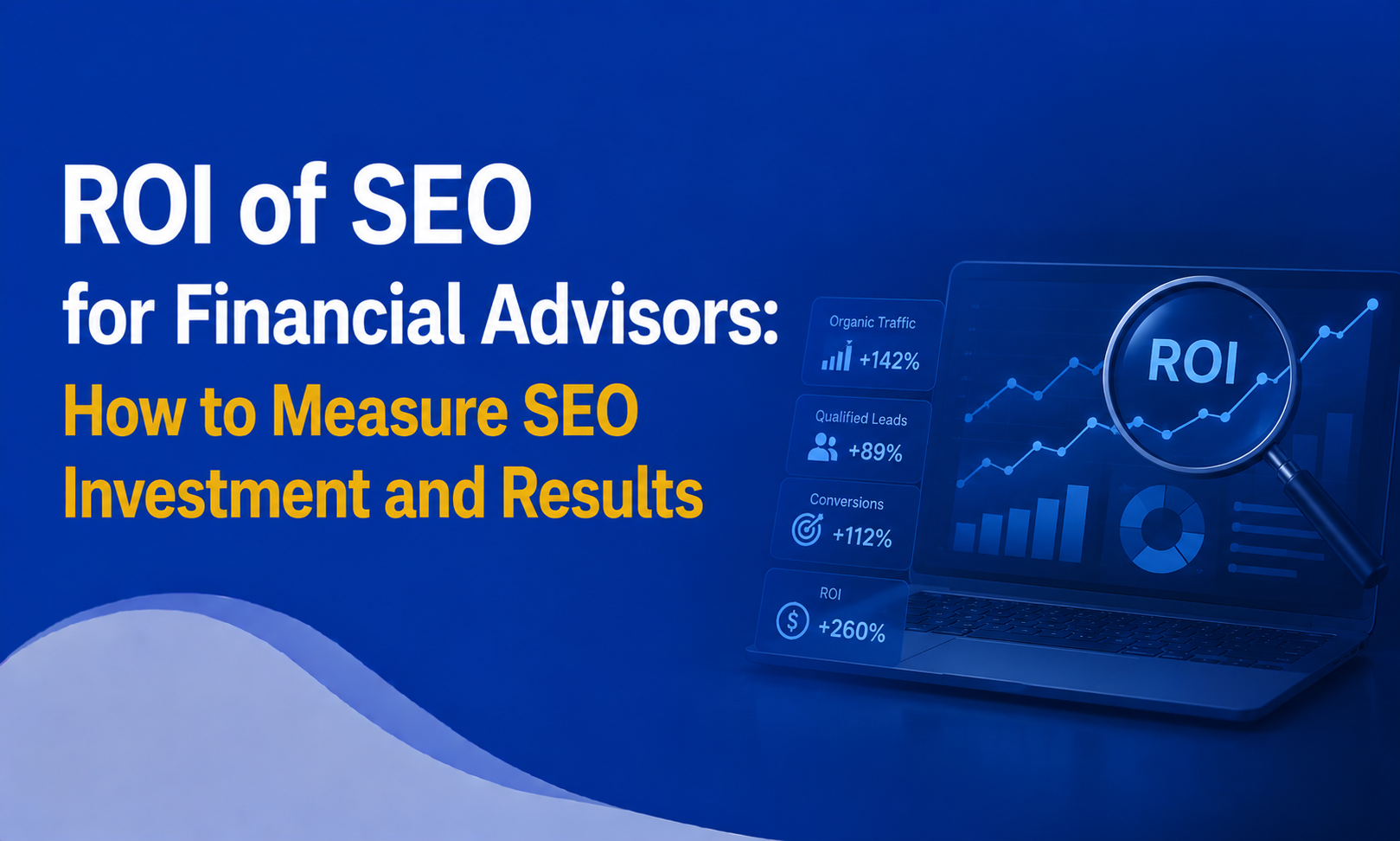
The ROI of SEO for financial advisors can be evaluated by connecting organic search activity to meaningful business outcomes. Rankings and website traffic are useful indicators, but they are only part of the picture. A well-planned SEO strategy is designed to help relevant prospects discover your firm, understand your expertise, and take an appropriate next step.
This guide explains how financial advisors can evaluate SEO ROI, which metrics matter, how long results can take, and how SEO fits into a broader financial advisor marketing strategy.
What Is the ROI of SEO for Financial Advisors?
SEO ROI shows the return a financial advisor receives from investing in search engine optimization. Costs may include content, technical SEO, local SEO, website optimization, and analytics.
SEO ROI = (Revenue Reasonably Attributed to SEO − SEO Investment) ÷ SEO Investment × 100
For example, if a firm invests $10,000 in SEO and reasonably attributes $30,000 in revenue to SEO-generated opportunities, the hypothetical ROI is 200%.
Because prospects may interact with SEO, email, webinars, referrals, and other channels before becoming clients, SEO ROI should be measured using leads, qualified prospects, appointments, clients, and revenue, not rankings or traffic alone.
Why SEO Can Be Valuable for Financial Advisors
Financial decisions often begin with online research. Potential clients may search for retirement planning, investment management, taxes, estate planning, or how to choose a financial advisor before contacting a firm.
SEO helps financial advisors become visible when those prospects are actively looking for answers.
A well-optimized website can support:
- More relevant organic traffic
- Greater online visibility
- More qualified inquiries
- Additional appointment opportunities
- Stronger educational content
- Less reliance on a single marketing channel
Results vary based on competition, search demand, content quality, website experience, and conversion strategy. The goal isn’t simply to attract more visitors—it’s to attract the right visitors who are more likely to need your services.
Best short version:
SEO helps financial advisors get discovered by the right prospects at the right stage of their search journey.
How to Calculate the ROI of SEO for Financial Advisors
Organic Search → Website Visit → Lead → Qualified Lead → Appointment → Client → Revenue
Step 1: Calculate Your SEO Investment
Include all SEO-related costs, such as agency fees, content, technical SEO, software, website work, and internal resources.
Illustrative Monthly Investment: $5,500
This is a hypothetical example, not industry-standard pricing. Actual costs vary by scope, market, competition, and provider.
Step 2: Track Organic Leads
Measure conversions that come from organic search, including:
- Contact forms
- Consultation requests
- Phone calls
- Appointment bookings
- Webinar registrations
- Resource downloads
Step 3: Measure Qualified Leads
Not every lead is a potential client. Track the progression:
Organic Leads → Qualified Leads → Appointments
This gives a clearer picture of SEO’s contribution to lead generation.
Step 4: Track New Clients
Go beyond lead volume and identify how many clients can reasonably be associated with SEO-generated opportunities. Because prospects may interact with multiple marketing channels, use a consistent attribution approach.
Step 5: Measure Revenue
Finally, estimate the revenue reasonably associated with SEO-generated clients. For recurring advisory relationships, client lifetime value may provide a more useful view than initial revenue alone.
In short: Don’t measure SEO only by rankings or traffic. Measure whether it contributes to qualified leads, appointments, clients, and revenue.
Which SEO Metrics Should Financial Advisors Track?
Rankings and traffic are useful, but financial advisors should focus on metrics that connect SEO to leads, appointments, clients, and revenue.
Organic Traffic
Shows how many visitors reach your website through unpaid search. Focus on relevant traffic, not just volume.
Non-Branded Traffic
Shows how many people discover your firm through searches that don’t include your brand name. This can indicate whether SEO is reaching new prospects.
Keyword Visibility
Track rankings for relevant financial services topics rather than relying on one keyword.
Organic Conversion Rate
Measures how often organic visitors take a desired action.
Conversion Rate = Organic Conversions ÷ Organic Visitors × 100
Qualified Lead Rate
Shows how many organic leads are actually suitable prospects.
Qualified Lead Rate = Qualified Leads ÷ Organic Leads × 100
Appointment Rate
Measures how effectively qualified leads turn into booked appointments.
Appointment Rate = Booked Appointments ÷ Qualified Leads × 100
Client Conversion Rate
SEO-Associated Revenue
The most important business metric is the revenue reasonably associated with SEO-generated opportunities.
SEO Funnel: Traffic → Leads → Qualified Leads → Appointments → Clients → Revenue
How SEO Turns Search Traffic Into Qualified Leads
Traffic alone does not create ROI. Your website must give visitors a clear next step based on their needs and search intent.
Financial advisors can use consultation forms, appointment scheduling, educational guides, webinars, newsletters, calculators, and relevant service pages to turn organic visitors into potential leads.
The CTA should match the visitor’s intent. Someone researching retirement basics may prefer a helpful guide, while someone searching for a specific financial advisor may be closer to booking a consultation.
This is how SEO for financial advisors can support lead generation—not just rankings and traffic.
How to Calculate the Value of an SEO Lead
Not every lead has the same value.
Hypothetical Client Value Example
Suppose a financial advisor generates 20 SEO-associated leads and four eventually become clients.
If the estimated average value of each new client is $8,000:
4 × $8,000 = $32,000 estimated client value
If the firm spent $8,000 on SEO during the relevant period:
($32,000 − $8,000) ÷ $8,000 × 100 = 300% ROI
This is a hypothetical example, not a typical or guaranteed result.
Actual attribution should account for factors such as sales cycles, recurring revenue, client retention, multiple marketing touchpoints, and whether SEO was the first, assisting, or final interaction.
Still, this framework can help advisors think beyond traffic and rankings.
What Factors Affect SEO ROI for Financial Advisors?
SEO results can vary significantly between firms.
1. Competition
A financial advisor operating in a highly competitive market may need more time and resources to establish search visibility.
2. Website Quality
A technically weak or poorly structured website can limit the potential impact of content and keyword targeting.
3. Content Quality
Publishing large quantities of generic content does not guarantee results.
Content should answer real questions, demonstrate relevant expertise, and provide a useful experience.
4. Search Intent
A page attracting visitors with little commercial relevance may produce traffic without generating meaningful business opportunities.
Strong strategies align content with different stages of the buyer journey.
5. Local Market
For advisors serving a specific geographic area, local search visibility can be particularly important.
6. Conversion Experience
Even strong organic traffic may produce limited results if the website has unclear CTAs, confusing navigation, weak service pages, or difficult contact processes.
7. Consistency
SEO generally requires ongoing monitoring and optimization rather than a one-time campaign.
Local SEO vs. National SEO: Which Offers Better ROI?
The answer depends on the firm’s business model.
A local financial advisor may benefit from searches containing geographic intent, such as:
- Financial advisor in [city]
- Retirement advisor near me
- Wealth management [city]
- Financial planner [city]
Local SEO can help firms become more visible to people searching for services in their market.
National or broader SEO may make more sense for firms serving a specialized audience across multiple locations.
For example, a firm specializing in a specific profession, retirement system, or financial need may create content around that niche regardless of where prospects live.
The best approach is usually based on where your ideal clients search and what services you actually provide, rather than choosing local or national SEO simply because one sounds more attractive.
How Content Marketing Improves SEO ROI
Content is one of the major components of an SEO strategy.
Financial services content marketing can help firms address prospects at different stages of the research process.
For example:
Early research
- What is retirement planning?
- How much should I save for retirement?
- What is a fiduciary?
Consideration
- Do I need a financial advisor?
- How much does financial planning cost?
- Financial advisor vs. robo-advisor
High intent
- Financial advisor near me
- Retirement planning advisor in [location]
- Schedule a financial planning consultation
This creates an opportunity to build a content ecosystem rather than relying on one page to rank for every search.
High-quality educational content can also support service pages through internal linking.
SEO vs. PPC for Financial Advisors
SEO and PPC serve different purposes.
Factor | SEO | PPC |
Speed | Usually slower | Usually faster |
Organic visibility | Yes | No |
Direct ad spend per click | No | Yes |
Long-term potential | Can build ongoing organic visibility | Depends on continued ad spend |
Content requirement | High | Moderate |
Targeting | Search intent and content | Audience and keyword targeting |
Common business metrics | Leads, appointments, clients, revenue | Clicks, leads, CPA, clients, revenue |
PPC can generate traffic quickly, while SEO can build organic visibility that may continue to generate visits after individual pieces of content are published.
Neither channel is automatically better for every financial firm.
For example, PPC may be useful for testing high-intent searches or generating traffic quickly, while SEO can build visibility for educational and commercial topics over a longer period.
The right mix depends on the firm’s goals, budget, market, compliance requirements, and acquisition economics.
How Long Does It Take to See ROI From SEO?
There is no fixed SEO timeline. Results depend on competition, website authority, content quality, technical health, search demand, and consistency.
A practical framework is:
- Early Stage: Improve technical SEO, indexing, rankings, and visibility.
- Growth Stage: Increase relevant traffic, leads, and conversions.
- Maturity Stage: Generate consistent leads, appointments, clients, and revenue.
Instead of focusing only on rankings, measure steady business growth from organic search.
Common Mistakes That Reduce SEO ROI
- Focusing Only on Rankings: High rankings mean little if they don’t attract potential clients.
- Ignoring Search Intent: Target relevant keywords based on what your audience actually wants.
- Publishing Generic Content: Create useful, original content that answers real client questions.
- Ignoring Conversions: Make it easy for visitors to book, contact, or take the next step.
- Measuring Only Leads: Focus on qualified leads and actual clients, not just lead volume.
- Treating SEO as One-Time Work: SEO requires ongoing content, technical updates, and optimization.
- Working in Isolation: Connect SEO with email, webinars, referrals, social media, and paid campaigns.
How a Financial Services Marketing Agency Can Improve SEO ROI
A specialized financial services marketing agency can improve SEO ROI by connecting SEO with other marketing channels, including:
- SEO and content marketing
- Website and conversion optimization
- Local SEO
- Email marketing
- Paid search and social media
- Webinars and analytics
An integrated strategy can turn organic traffic into leads, nurture prospects, and create more opportunities for appointments and clients. The results depend on the firm’s audience, offers, follow-up, and execution.
How to Build an SEO Strategy Around Qualified Appointments
Start with your ideal client, not just a list of keywords.
- Define Your Ideal Client: Identify their needs, location, profession, and search behavior.
- Map Search Intent: Target informational, commercial, transactional, and local keywords.
- Create Useful Content: Answer real questions and address relevant financial concerns.
- Strengthen Service Pages: Connect helpful content to relevant services.
- Use Clear CTAs: Guide visitors toward contacting you or booking an appointment.
- Track the Full Funnel: Measure Traffic → Lead → Appointment → Client → Revenue.
- Optimize for Results: Prioritize pages that generate qualified appointments and clients, not just traffic.
What Should Financial Advisors Look for in an SEO or Digital Marketing Partner?
When evaluating a financial services digital marketing agency, look beyond promises of rankings.
Ask potential partners:
- How do you measure SEO success?
- How do you define a qualified lead?
- How will you track appointments?
- What reporting will I receive?
- How do you approach financial services content?
- How do you handle compliance considerations?
- How do you determine which keywords to target?
- How do you measure conversions?
- How do SEO and content work together?
- How will you connect SEO performance with business results?
A strong agency should be able to explain its strategy in straightforward language.
Be cautious of guarantees around specific rankings, lead volumes, or client numbers. Search visibility and client acquisition depend on many variables outside an agency’s direct control.
How Does SEO Fit Into Financial Advisor Lead Generation?
SEO is one part of a complete financial advisor lead generation system:
- SEO: Attracts prospects through search.
- Content: Builds trust and answers questions.
- Landing Pages: Turn visitors into leads.
- Email: Nurtures prospects who aren’t ready yet.
- Webinars: Educate and engage potential clients.
- Sales Follow-Up: Converts qualified leads into conversations.
Together, these channels create a connected system that turns search traffic into qualified opportunities and clients.

Final Thoughts: Measure SEO by Business Results
The ROI of SEO for financial advisors is about more than rankings and traffic. The real measure is whether SEO generates qualified leads, appointments, clients, and revenue.
Search Visibility → Relevant Traffic → Qualified Leads → Appointments → Clients → Revenue
When SEO focuses on search intent, valuable content, strong user experience, and clear conversion paths, it becomes a measurable part of client acquisition.
FAQs About ROI of SEO for Financial Advisors
1. What is a good ROI for SEO for financial advisors?
There is no universal benchmark for a “good” SEO ROI. It depends on factors such as SEO costs, client acquisition costs, average client value, retention, conversion rates, and the firm’s market. The most useful comparison is between business value reasonably associated with SEO and the total cost of the SEO program.
2. How long does SEO take to generate leads for financial advisors?
SEO timelines vary. Less competitive opportunities may show progress sooner, while competitive markets can require longer-term investment. Advisors should evaluate progress through visibility, relevant traffic, conversions, qualified leads, appointments, and clients rather than relying on a predetermined timeline.
3. Can SEO really generate clients for financial advisors?
SEO can contribute to client acquisition when it attracts relevant prospects and the website provides an effective path from search to inquiry. However, rankings and traffic alone do not guarantee clients.
4. Is SEO better than PPC for financial advisors?
Neither channel is automatically better. PPC can provide faster visibility, while SEO can build longer-term organic visibility. Many firms can use both depending on their goals, budget, competition, and acquisition strategy.
5. What SEO metrics matter most for financial advisors?
Important metrics include relevant organic traffic, non-branded visibility, organic conversions, qualified leads, booked appointments, client conversion rates, client acquisition cost, and revenue reasonably associated with SEO.
Disclaimer:
This article is for general informational and educational purposes only and does not constitute financial, legal, tax, or investment advice.
SEO results, ROI, leads, and revenue can vary based on individual circumstances and market conditions.
Examples and figures are hypothetical and do not guarantee specific results.