
- Written & Reviewed by Jeremy
- Published
- Last Updated Jun 08, 2026
In financial advisory services, the difference between a busy calendar and a profitable practice is not the number of appointments it is the quality of those appointments.
A financial advisor can speak to dozens of prospects each week, but if most of those conversations are early-stage, unready, or mismatched to the advisor’s services, the pipeline becomes inefficient. That is why understanding what makes an appointment “qualified” is essential for sustainable growth.
This article breaks down qualification in a practical, real-world way—without hype, without assumptions, and aligned with how modern advisory firms actually evaluate prospects.
What Is a Financial Advisor Appointment?
A financial advisor appointment is a scheduled meeting between a prospect and an advisor, typically focused on financial planning, investment strategy, retirement planning, or insurance-related solutions.
However, not all appointments represent the same level of opportunity. In practice, appointments fall into three broad categories:
- Exploratory appointments – Early-stage curiosity, general information gathering
- Comparative appointments – Prospect is evaluating multiple advisors
- Decision-ready appointments – Prospect is preparing to take financial action
Only the third category consistently aligns with what firms consider a truly qualified appointment.
A Clear Definition of a Qualified Appointment
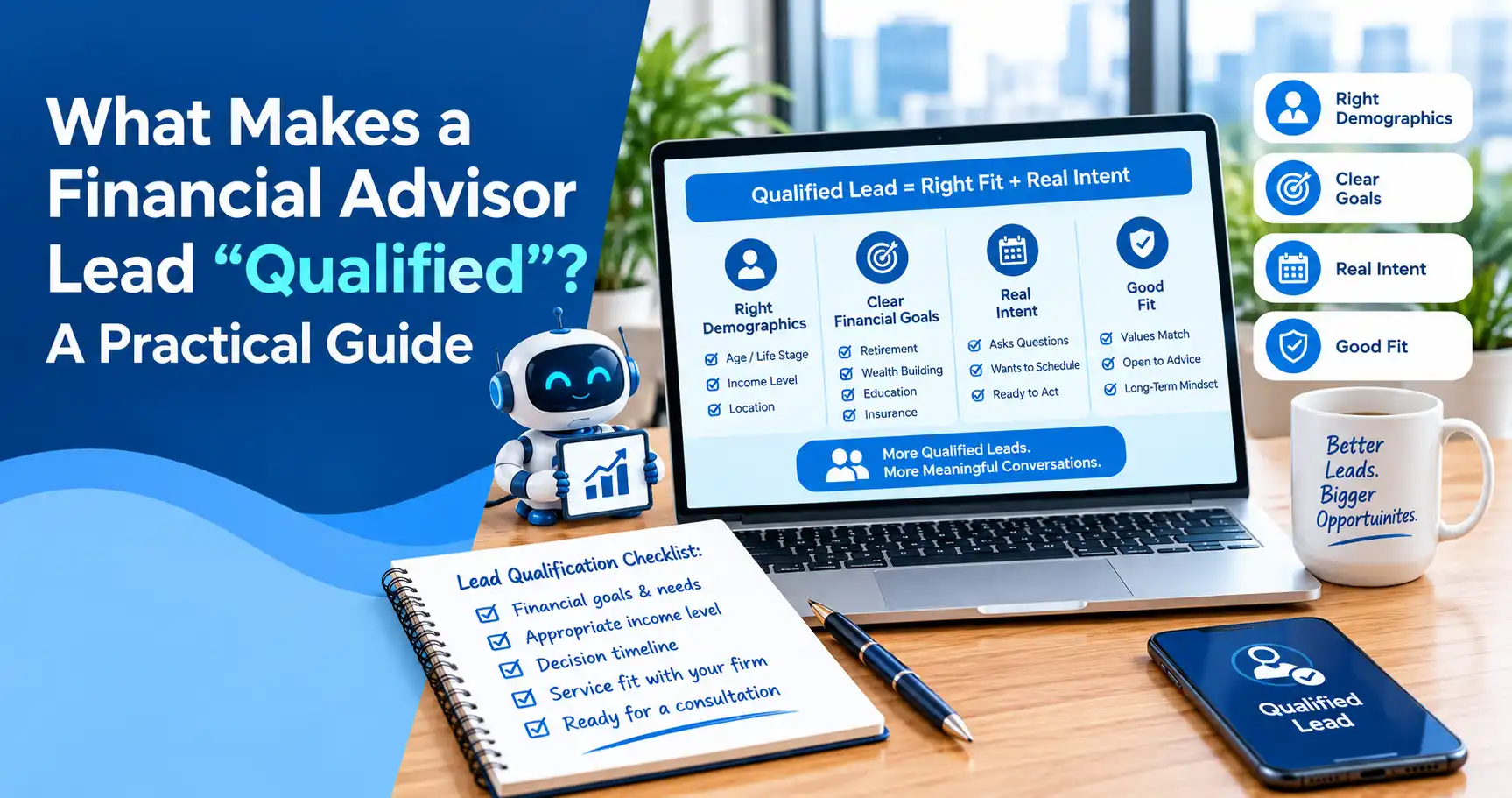
A qualified financial advisor appointment is a scheduled meeting with a prospect who demonstrates:
- A real financial need or trigger event
- A reasonable fit for the advisor’s service model
- A realistic timeline to take action
- Engagement beyond general curiosity
In simple terms:
A qualified appointment is a conversation with someone who is both able and likely to become a client in the near term.
The 3-Part Qualification Framework (Intent–Fit–Readiness)
To avoid vague or subjective definitions, modern advisory teams often evaluate qualification using a simple structure:
1. Intent (Why are they here?)
The prospect should have a clear financial reason for seeking advice.
Common triggers include:
- Retirement planning or pension decisions
- Portfolio restructuring due to market changes
- Business sale, inheritance, or liquidity events
- Tax planning or estate-related needs
- Job transition or major life change
If there is no specific trigger, the appointment is usually informational, not qualified.
2. Fit (Should this person be served?)
Even if interest exists, not every prospect matches the advisor’s business model.
Fit typically includes:
- Investable assets or income level aligned with the firm’s focus
- Complexity of financial situation that requires advisory support
- Compatibility with pricing model (AUM, flat fee, insurance-based, etc.)
- Long-term advisory potential
Fit is not about excluding people it is about maintaining service consistency.
3. Readiness (Are they prepared to act?)
Readiness determines whether the conversation can move forward meaningfully.
A ready prospect usually has:
- Decision-making authority
- A defined timeline (0–12 months is common)
- Willingness to discuss financial details
- Prior consideration of financial solutions or advisors
Without readiness, the appointment remains early-stage regardless of interest.
Cold vs Warm vs Qualified Appointments
Understanding intent stages helps clarify pipeline quality.
Type of Appointment | Description | Financial Readiness | Outcome Likelihood |
Cold | Early curiosity, no urgency | Low | Low |
Warm | Researching options | Medium | Moderate |
Qualified | Clear need, fit, and timeline | High | High |
However, modern advisory systems do not rely only on this model—they also use behavioral and data-based qualification before booking happens.
Where Appointment Quality Actually Comes From
A common misconception is that appointment quality is determined at the booking stage. In reality, it is shaped much earlier in the funnel.
1. Traffic Source Intent
Different acquisition channels produce different lead quality:
- SEO traffic → Higher intent due to active search behavior
- Referrals → Higher trust and faster qualification
- Paid advertising → Highly dependent on targeting and messaging
- Webinars → Strong when topic-specific and problem-focused
- Email nurturing → Effective for filtering and warming leads
2. Pre-Qualification Before Booking
Modern advisory funnels increasingly use filtering mechanisms such as:
- Intake forms with asset/income ranges
- Financial goal selection
- Timeline-based questions
- Service-fit screening questions
This ensures unqualified leads are filtered before they reach the calendar.
3. Behavioral Signals (Modern Standard)
Beyond forms, firms also evaluate behavior such as:
- Repeat website visits
- Content depth engagement
- Webinar attendance
- Email interaction history
These signals help indicate intent strength before any conversation occurs.
Common Signs of an Unqualified Appointment
Unqualified appointments usually show predictable patterns:
- No clear financial reason for seeking advice
- Vague goals like “just exploring options”
- No timeline or urgency
- Limited or no financial context shared
- Focus on free information rather than planning outcomes
- Misalignment with advisor’s service model
These meetings are not useless but they are typically not ready for advisory conversion.
How Financial Advisors Improve Appointment Quality
Improving qualification is not about changing sales skills it is about improving the system that brings prospects into the calendar.
1. Add Pre-Booking Filters
Before scheduling, collect structured information:
- Financial range (income or assets)
- Goals and objectives
- Timeline for action
- Current financial situation
2. Improve Messaging Clarity
Clear positioning reduces irrelevant bookings:
- Who the service is for
- Who it is not for
- What outcomes are realistic
- What the advisory process looks like
Clarity naturally filters out low-intent prospects.
3. Use CRM-Based Qualification
Modern advisory firms rely on CRM systems that assign lead scores based on:
- Engagement behavior
- Content interaction
- Form responses
- Event participation
Only high-scoring leads are prioritized for appointments.
4. Align Content With Intent
Educational content plays a filtering role when designed correctly.
A structured financial services content marketing strategy does not just attract traffic—it attracts relevant traffic by focusing on specific financial problems instead of generic topics.
Role of Marketing Systems in Qualification
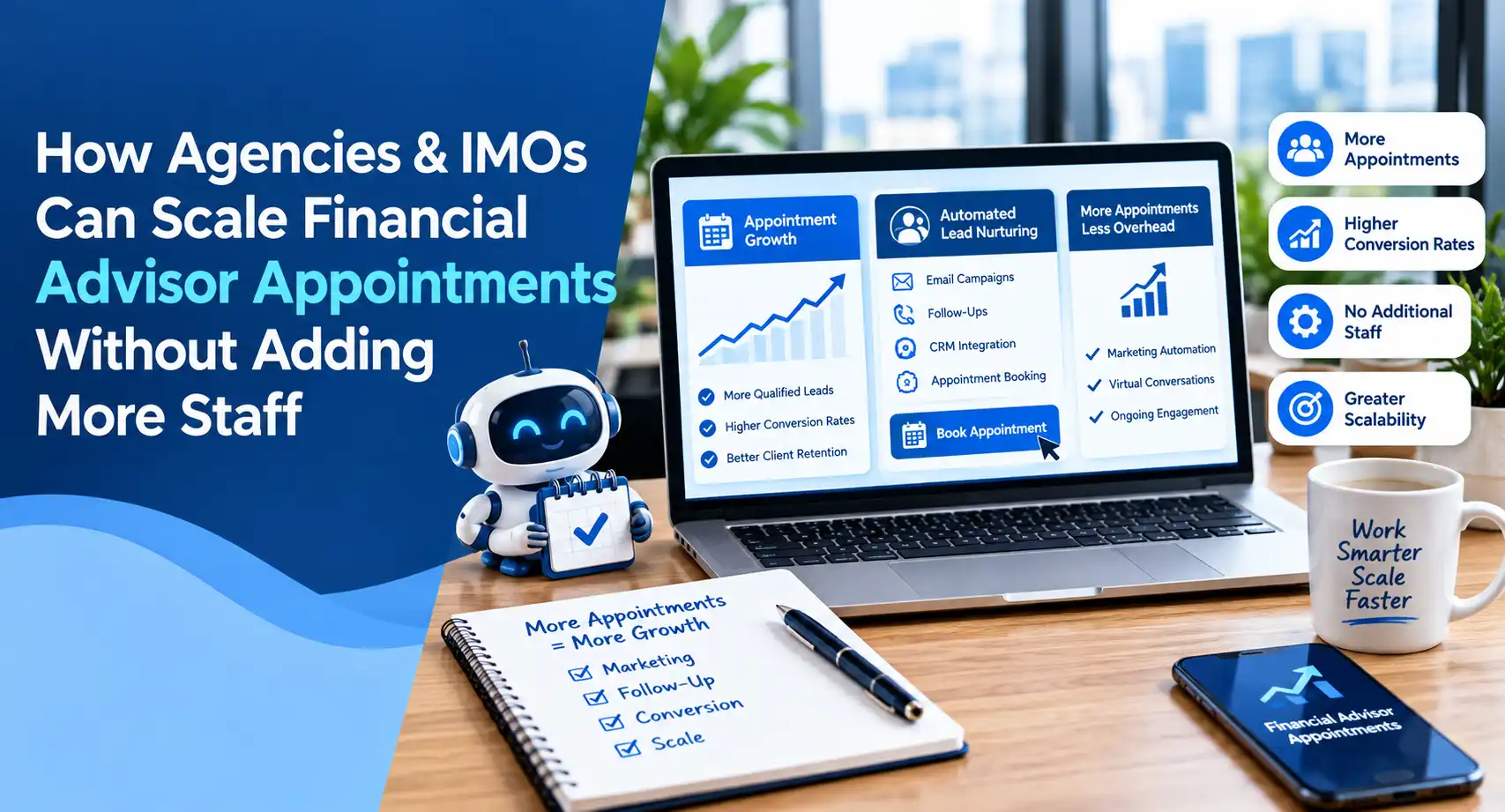
A modern financial services marketing agency does more than generate leads—it builds the structure that determines whether those leads are usable.
This typically includes:
- Funnel architecture (awareness → nurture → booking → conversion)
- CRM automation and scoring logic
- Email nurturing workflows
- Conversion-focused landing pages
- Compliance-aware messaging
Without this structure, firms often experience high lead volume but inconsistent appointment quality.
How to Measure a Qualified Appointment
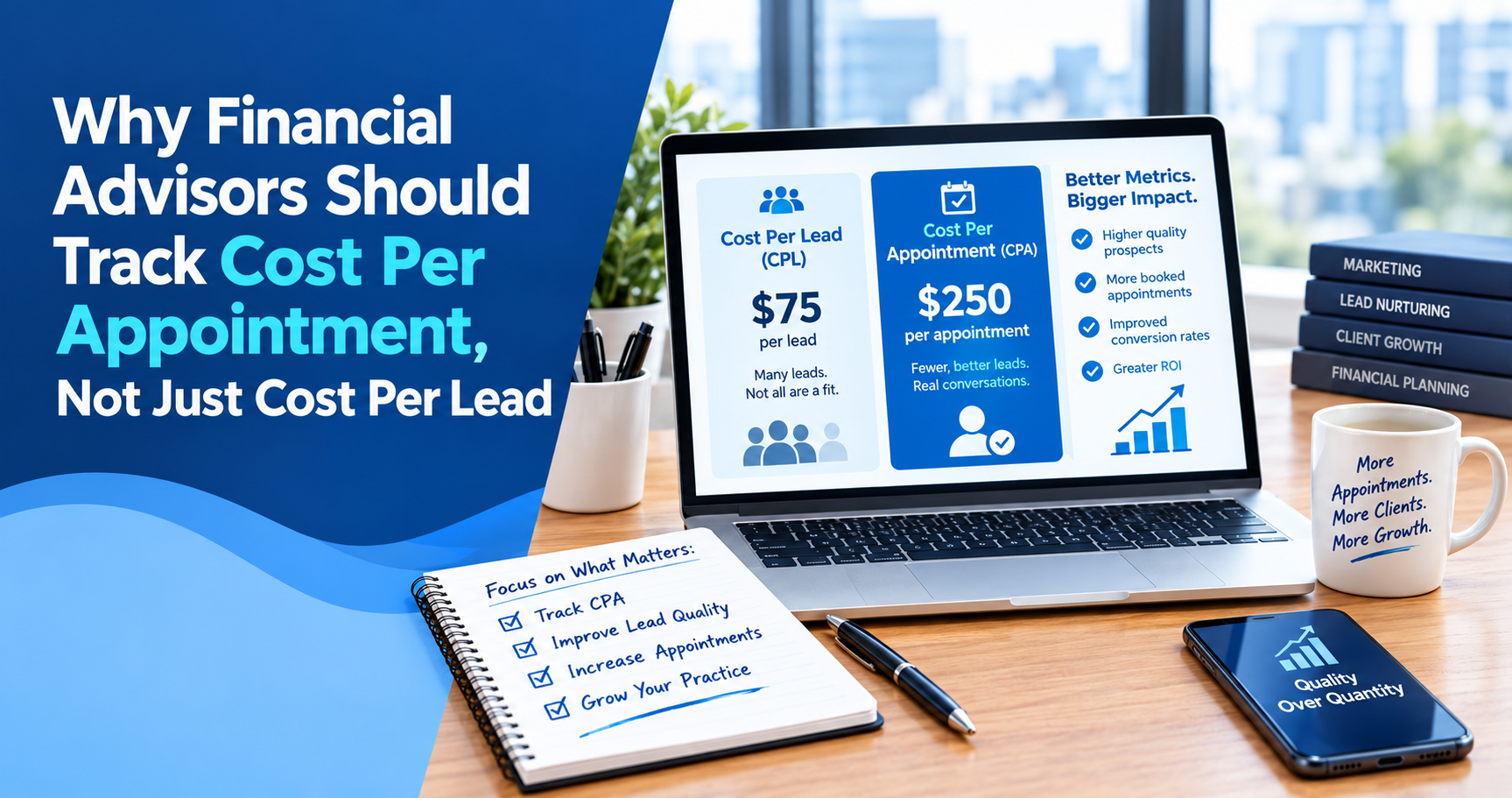
Rather than relying on assumptions, firms evaluate appointment quality using downstream performance:
- Show-up rate consistency
- Conversion rate per appointment segment
- Average client value (AUM or revenue)
- Sales cycle length
- Retention and long-term client quality
If these metrics are weak, the issue is usually qualification not sales performance.
When Should a Firm Focus on Qualification?
Qualification becomes a priority when:
- Calendars are full but revenue is flat
- Advisors spend time on low-value conversations
- Lead volume increases but conversion declines
- Sales cycles become unpredictable
At this stage, improving qualification has a greater impact than increasing lead generation.

Final Thoughts
A qualified financial advisor appointment is not defined by interest alone. It is defined by the alignment of intent, fit, and readiness within a structured advisory system.
The most successful financial advisory firms do not focus solely on getting more appointments they focus on ensuring that the right appointments reach the calendar in the first place.
In modern financial marketing, qualification is not a sales step. It is a system outcome built through targeting, content strategy, behavioral filtering, and structured pre-screening.
FAQs
1.What is a qualified financial advisor appointment?
A meeting with a prospect who has financial intent, service fit, and readiness to take action.
2. Why is qualification important?
It improves efficiency, conversion rates, and overall client quality.
3. How do advisors improve appointment quality?
Through pre-qualification systems, CRM scoring, better targeting, and structured content.
4. What makes an appointment unqualified?
Lack of financial intent, no urgency, or mismatch with advisor services.
5. Should every lead become an appointment?
No. Only leads that meet qualification criteria should be booked.
Disclaimer
This article is for informational and educational purposes only and does not constitute financial, investment, tax, or legal advice. Financial advisory suitability varies based on individual circumstances, regulatory requirements, and firm-specific policies. Readers should consult a qualified financial advisor or licensed professional before making any financial decisions.