- Written & Reviewed by Jeremy
- Published
- Last Updated Sep 29, 2026
Generating leads is only one part of growing a financial advisory practice. The bigger challenge is often turning those leads into actual conversations.
A prospect may fill out a form, download a guide, attend a webinar, or respond to an email. What happens next can determine whether that person eventually speaks with an advisor or simply moves on.
This is where appointment setting becomes important.
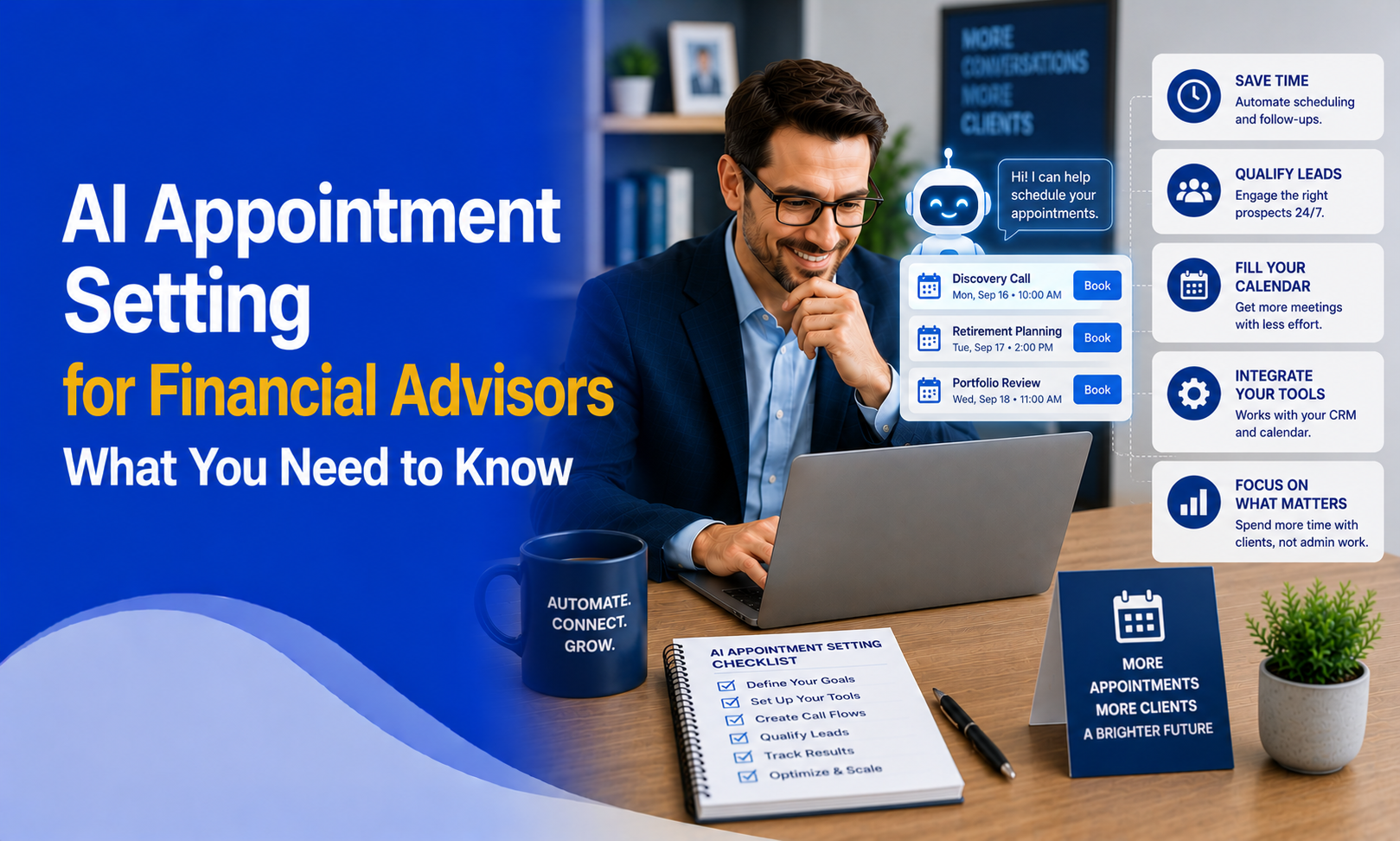
Today, financial advisors can use artificial intelligence (AI) to respond to leads, qualify prospects, follow up, and schedule meetings. AI marketing for financial advisors can help streamline these activities while making lead nurturing more personalized and data-driven. At the same time, human appointment setters continue to play an important role when conversations require context, flexibility, and personal interaction.
So, which approach works better?
There is no single answer for every financial firm. AI and human appointment setting each have different strengths, and many firms may find value in combining the two.
What Is Appointment Setting for Financial Advisors?
Appointment setting is the process of moving a potential client from an initial inquiry to a scheduled conversation with a financial advisor.
It can include:
- Responding to a new inquiry
- Asking basic qualification questions
- Following up with prospects
- Answering general questions
- Helping prospects understand the next step
- Scheduling appointments
- Sending appointment confirmations and reminders
- Re-engaging prospects who did not book initially
Appointment setting is different from lead generation.
Lead generation brings potential prospects into the marketing funnel, helping financial advisors connect with people who may be interested in their services. AI-powered financial advisor lead generation can help streamline prospect identification and outreach, while appointment setting helps move appropriate prospects toward a conversation with an advisor.
For example, an advisor might generate leads through SEO, paid advertising, social media, webinars, or downloadable content. If nobody follows up consistently, however, many of those leads may never become appointments.
Why Generating Leads Does Not Always Mean Getting Appointments
A lead can have genuine interest and still fail to book a meeting.
They may be busy when they submit the inquiry. They may forget to respond. They may have questions before agreeing to a call. Or they may simply need another reminder.
Slow response times and inconsistent follow-up can create unnecessary gaps between lead generation and appointments.
That is why financial advisor lead generation should be viewed as part of a larger process rather than the final objective.
What Is AI Appointment Setting?
AI appointment setting uses artificial intelligence and automation to handle some of the repetitive tasks involved in responding to and scheduling prospects.
Depending on the system, AI may be able to:
- Respond to inquiries
- Ask predefined qualification questions
- Send follow-up messages
- Answer common questions
- Provide scheduling options
- Send appointment reminders
- Re-engage older leads
- Route certain conversations to a human
A typical process might look like this:
Lead submits an inquiry → AI responds → Basic qualification → Follow-up → Appointment scheduling → Advisor receives the appointment
The exact workflow depends on the technology and how the financial firm configures it.
How AI Appointment Setting Can Save Time
Human appointment setting involves a person communicating directly with a prospect to help move the conversation toward an appointment. For financial advisors exploring a scalable alternative, AI appointment setting for financial advisors can help automate parts of the prospect engagement and scheduling process.
A human appointment setter can listen to what the prospect is asking, ask follow-up questions, recognize hesitation, and adjust the conversation based on the person’s responses.
This can be particularly useful when a prospect’s questions do not fit neatly into a predefined workflow.
Why Human Conversation Can Matter in Financial Services
Financial conversations can involve subjects such as retirement planning, investments, insurance, income, and long-term financial goals.
A prospect may have questions that require context rather than a simple automated response.
For example, someone might say:
“I’m interested in speaking with an advisor, but I’m not sure whether I should schedule a retirement planning consultation or an investment consultation.”
A human can ask additional questions and help direct the person to the appropriate next step.Audience: Appointment-page visitors who did not submit
Follow-up message: Information about what to expect from an introductory meeting
That type of interaction can be harder to replicate through a rigid automated workflow.
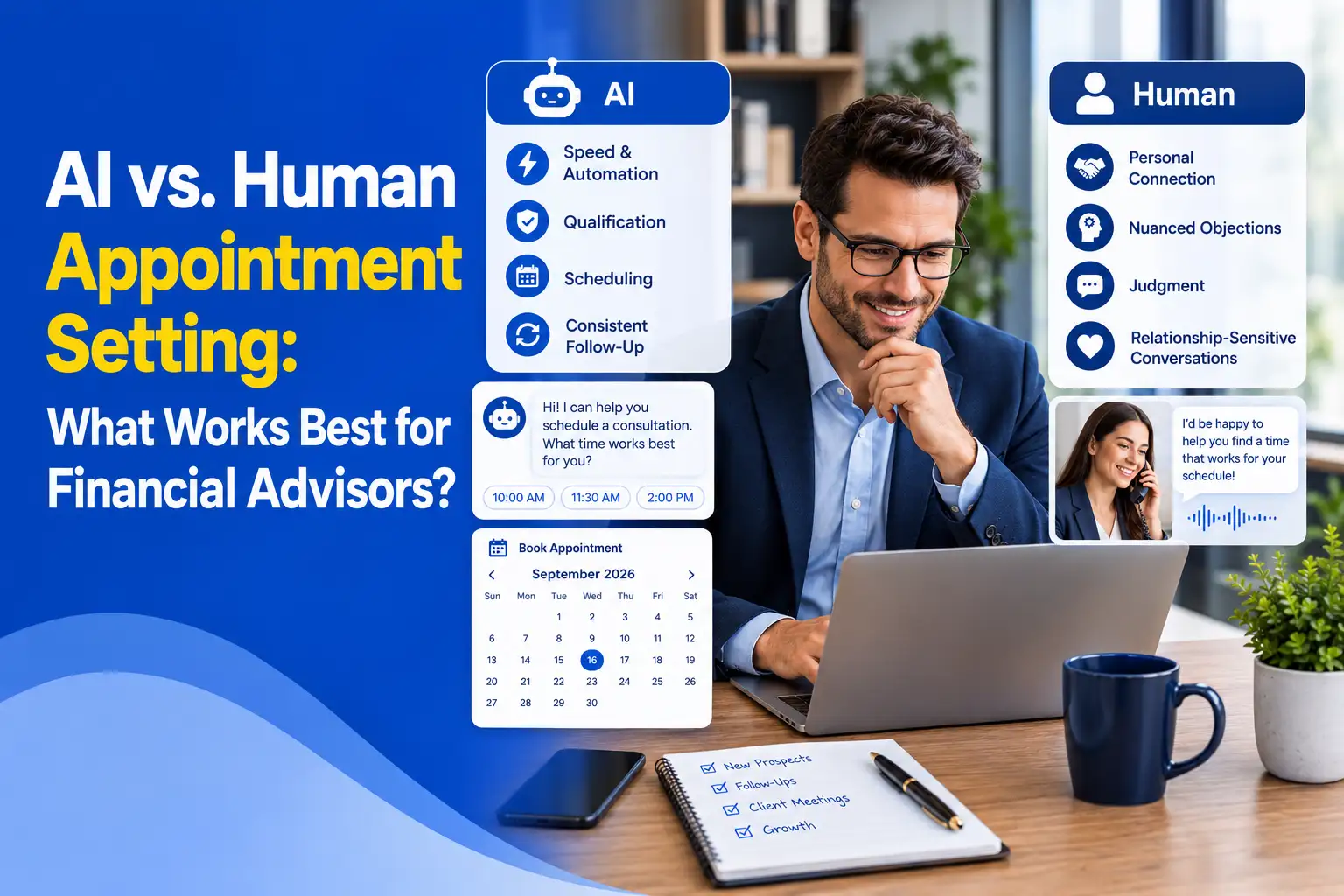
AI vs. Human Appointment Setting: Key Differences
AI and human appointment setting are not identical approaches. Each has different characteristics that may matter depending on the firm’s goals and lead process.
Factor | AI Appointment Setting | Human Appointment Setting |
Response speed | Can respond almost immediately | Depends on staff availability |
Availability | Can operate outside normal business hours | Usually limited by working hours |
Repetitive follow-up | Highly scalable | Requires staff time |
Personalization | Based on configured data and workflows | Can adapt naturally during conversations |
Complex questions | May require escalation | Can handle more nuanced conversations |
Rapport building | More limited | Greater opportunity for personal interaction |
Lead qualification | Effective for predefined criteria | Can account for conversation context |
Scalability | Can handle large volumes | Requires additional staffing as volume grows |
Consistency | Consistent when properly configured | Can vary between team members |
Human interaction | Limited unless escalated | Built into the process |
Cost structure | Technology and implementation costs | Labor and staffing costs |
Monitoring | Requires workflow and output review | Requires staff supervision and training |
The important point is that these differences do not automatically make one option right for every financial advisor.
The appropriate model depends on how the firm generates leads, how many inquiries it receives, what prospects expect, and how complicated the qualification process is.
Where AI Appointment Setting Works Well
AI can help financial advisors with repetitive, time-sensitive tasks:
- Immediate Lead Response: Responds to inquiries quickly, including after hours.
- Follow-Up: Handles basic questions and scheduling when staff are unavailable.
- High Lead Volumes: Manages initial interactions so staff can focus on qualified prospects.
- Appointment Reminders: Sends reminders to help reduce missed meetings.
- Lead Re-Engagement: Follows up with older prospects who previously showed interest.
Where Human Appointment Setting Works Better
Human interaction is useful when conversations require judgment or personalization:
- Complex Questions: Handles detailed, situation-specific questions.
- High-Value Prospects: Provides more personalized communication.
- Building Trust: Creates a more personal conversation.
- Handling Hesitation: Addresses concerns before asking prospects to book.
- Situations Requiring Judgment: Manages conversations that go beyond basic scheduling.
Can AI and Human Appointment Setting Work Together?
Yes. AI and human appointment setting can work together, with each handling the parts of the process they are best suited for.
A Typical Hybrid Workflow
- Lead submits an inquiry — Through a website form, ad, webinar, or direct contact.
- AI responds — Provides an immediate response and next steps.
- Basic qualification — Asks predefined questions to understand the prospect’s needs.
- Scheduling — Offers available appointment times.
- Human escalation — A team member handles questions that need personal attention.
- Advisor consultation — The qualified prospect meets with the advisor.
This approach can combine AI’s speed and consistency with the personal interaction provided by human team members.
What Should Financial Advisors Consider Before Choosing an Appointment-Setting Model?
Before choosing AI, human, or a hybrid approach, consider:
- Lead Volume: High inquiry volumes may benefit from automation.
- Lead Quality: AI can help qualify and prioritize prospects.
- Communication Preferences: Consider whether prospects prefer calls, email, text, chat, or online scheduling.
- Service Complexity: Complex services may require more human involvement.
- Team Capacity: Automation can help when staff struggle with timely or consistent follow-up.
- Budget and Scalability: Compare technology and staffing costs based on current needs and future growth
What About Compliance When Using AI for Financial Advisor Appointment Setting?
Compliance matters whenever financial firms use automated communication. AI is not automatically compliant simply because it handles appointment scheduling.
Firms should consider how AI handles prospect data, messaging, follow-ups, and escalation. Clear boundaries should define what the system can communicate and when human oversight is required.
For guidance on improving the website journey from visitors to scheduled conversations, see turning website visitors into booked appointments.
Retargeting can continue their education through related articles, downloadable resources, calculators, or other relevant content.
How AI Appointment Setting Can Affect the Prospect Experience
AI can improve the prospect experience in some situations.
Potential benefits include:
- Faster responses
- Convenient scheduling
- Consistent follow-up
- Fewer administrative delays
- Availability outside traditional office hours
However, there can also be limitations.
Poorly configured automation may:
- Provide irrelevant responses
- Repeat the same questions
- Make conversations feel impersonal
- Fail to understand unusual questions
- Frustrate prospects who want a real person
The quality of the workflow matters as much as the technology itself.
How Human Appointment Setting Can Affect the Prospect Experience
Human appointment setting offers a different set of advantages.
A trained person can adapt to the conversation, recognize uncertainty, and ask questions that are not part of a standard script.
This can create a more personal experience.
However, human processes also have limitations.
A team may struggle with:
- Slow response times
- Limited office hours
- Inconsistent follow-up
- Staffing costs
- High lead volumes
For this reason, some firms may use automation for the initial stages and bring humans into the conversation when appropriate.
Common Mistakes Financial Advisors Make With AI Appointment Setting
Automating Everything
Not every conversation should be handled by AI. Complex situations may require human support.
Using Generic Scripts
Generic messages can make interactions feel robotic and less relevant to prospects.
Ignoring Lead Quality
More appointments do not always mean better results. Focus on whether the appointments are with qualified prospects.
Each stage serves a different purpose.
No Human Escalation
Prospects should have an easy way to connect with a person when AI cannot provide the right response.
Not Monitoring AI
Review AI interactions regularly to identify issues and improve the workflow.
Focusing Only on Appointment Volume
Track appointment quality and conversion, not just the total number of bookings.
Common Mistakes Financial Advisors Make With Human Appointment Setting
Manual appointment setting can also create problems.
Slow Lead Response
If the team waits too long to respond, a potentially interested prospect may move on.
Inconsistent Follow-Up
The important point is that the appointment happened after several touchpoints.
A lead may receive one call or email and never receive another follow-up.
No Qualification Process
Without clear qualification criteria, staff may spend considerable time scheduling prospects who are not a good fit.
Relying Too Heavily on Scripts
Human appointment setters still need flexibility.
A script can provide consistency, but conversations should not necessarily sound like someone is reading from a script.
Measuring Activity Instead of Outcomes
The specific mix depends on traffic volume, audience availability, campaign objectives, budget, and advertising platform requirements.
Making 50 calls does not tell the firm whether those calls produced meaningful opportunities.
The focus should be on the results of the appointment-setting process.
What Metrics Should Financial Advisors Track?
Regardless of whether AI, humans, or a hybrid system is used, financial advisors should measure the performance of the appointment-setting process.
Important metrics can include:
- Lead response time
- Contact rate
- Qualified lead rate
- Appointment booking rate
- Appointment confirmation rate
- Appointment show-up rate
- Appointment-to-client conversion
- Cost per booked appointment
- Cost per qualified appointment
- Lead-to-client conversion rate
Why Booked Appointments Alone Are Not Enough
It is easy to focus on appointment numbers because they are simple to measure.
But the complete process looks more like:
Lead → Qualified lead → Booked appointment → Attended appointment → Advisor conversation → Potential client
Improving one stage while ignoring the others may not improve the overall result.
For example, an automated system could increase the number of appointments while simultaneously increasing the number of poorly qualified appointments
That is why appointment quality should be considered alongside appointment volume.
How AI and Human Appointment Setting Fit Into a Broader Marketing Strategy
Appointment setting works best when it connects with the firm’s overall marketing strategy.
SEO
SEO for financial advisors can attract people searching for financial services. Once they become leads, effective follow-up can help turn that interest into appointments.
Email Marketing
Email marketing for financial advisors can nurture prospects who are not ready to book immediately and encourage them to take the next step.
Content Marketing
Helpful content can educate prospects and build familiarity with a firm before they schedule a consultation.
Webinars
Webinars can generate engaged prospects who can then be followed up with and invited to schedule a consultation.
Webinar → Follow-up → Qualification → Appointment → Advisor consultation
How Webinars Can Connect With Appointment Setting
A webinar allows financial firms to educate prospects before asking them to schedule a conversation.
After the webinar, prospects can receive follow-up communications based on their interaction.
For example:
- Attended the webinar → receives follow-up resources
- Asked a question → receives additional information
- Expressed interest → receives an appointment option
- Did not attend → receives a recording or alternative resource
The appointment-setting process can then help move interested prospects toward a consultation.
Should Financial Advisors Choose AI, Humans, or a Hybrid Model?
The right approach depends on the firm’s needs, lead volume, and communication process.
AI May Be Useful When:
- Lead volume is high
- Fast responses are important
- Follow-up is repetitive
- Scheduling takes significant time
- Qualification criteria are clear
Human Appointment Setting May Be Useful When:
- Conversations are complex
- Prospects need personalized responses
- Questions require context
- Qualification requires human judgment
A Hybrid Model May Be Useful When:
- AI can handle initial responses and scheduling
- Humans can manage complex conversations
- The firm wants both efficiency and personal interaction
What Should Financial Advisors Look for in a Marketing Partner?
The goal is not necessarily to choose one over the other. Advisors can decide which parts of the process should be automated and where human involvement adds value.
How to Evaluate an Appointment-Setting Provider
Before choosing an appointment-setting provider, financial advisors should ask how leads are qualified, contacted, followed up with, and re-engaged. Financial advisor retargeting can also help maintain engagement with prospects who have not yet booked an appointment.
Consider
- How are leads qualified?
- How quickly are leads contacted?
- Is there human support?
- Can messaging be customized?
- How are reminders handled?
- What reporting is provided?
- How is lead quality measured?
- How are compliance requirements addressed?
A reliable provider should explain the full process—not just the number of appointments generated.

Final Thoughts: AI vs. Human Appointment Setting for Financial Advisors
AI and human appointment setting solve different parts of the same problem.
AI can provide speed, consistency, scheduling support, and scalable follow-up. Human appointment setters can provide context, flexibility, personal interaction, and support for conversations that require more judgment. Combining these strengths can help financial advisors move beyond simply generating leads and focus on turning prospects into booked appointments with meaningful opportunities for follow-up.
For some financial firms, AI may handle much of the initial process. Others may prefer a primarily human approach. A hybrid model can combine automated lead response and scheduling with human involvement when a conversation requires it.
The important question is not simply how many appointments a system can book.
Financial advisors should also consider who those booked appointments are with, whether the prospects attend, how qualified they are, and what happens after the meeting.
A well-designed appointment-setting process should fit into the firm’s broader marketing strategy, from lead generation and content marketing to email follow-up and advisor consultations.
The technology is only one part of the equation. The process, messaging, qualification criteria, human oversight, and overall prospect experience matter too. This is especially important when agencies and IMOs are looking to build a more consistent and effective appointment-setting process.
FAQs About AI vs. Human Appointment Setting
What is AI appointment setting for financial advisors?
AI appointment setting uses artificial intelligence to respond to leads, ask basic qualification questions, follow up with prospects, schedule meetings, and send reminders.
Is AI appointment setting better than human appointment setting?
Neither approach is universally better. AI can help with speed, repetitive follow-up, and scalability, while humans can handle complex questions and provide more personalized communication. The right approach depends on the firm’s needs.
Can AI and human appointment setting work together?
Yes. A hybrid approach can use AI for initial responses, qualification, scheduling, and reminders while human team members handle complex conversations and situations that require personal attention.
Is AI appointment setting compliant for financial advisors?
Using AI does not automatically make an appointment-setting process compliant. Financial firms should review messaging, data handling, recordkeeping, escalation procedures, and the technology provider’s processes to ensure they meet applicable requirements.
What should financial advisors measure when evaluating appointment setting?
Advisors can track metrics such as response time, qualified lead rate, appointment booking rate, show-up rate, cost per qualified appointment, and appointment-to-client conversion.
Disclaimer:
This article is for general informational and educational purposes only. It does not constitute legal, regulatory, financial, investment, or compliance advice. The use of AI, automation, or human appointment-setting services may be subject to applicable laws, regulations, and firm-specific policies. Financial advisors and firms should evaluate their own requirements and consult qualified legal or compliance professionals when appropriate.